*Post written by Mona Meyer, Archives and Special Collections Metadata Librarian.
In the first half of the 20th century, Evansville was a bit of a sleepy southern town, suffering, as did the rest of the country, from the lingering Depression. December 7, 1941 changed that dynamic completely as Evansvillians geared up for war. “Vanderburgh County firms would, by March 1944, receive more than $600 million in defense contracts, more than any southern Indiana county. One study in 1981 indicated that forty-eight Evansville businesses did some sort of war work.”[i] A number of these contracts dealt with aviation. Perhaps the biggest player in aviation defense contracts was Republic Aviation, a company that wasn’t even in Evansville until November 1942. The parent company was in Farmingdale, NY. “
In order to chart the history of Republic Aviation, we have to go back to the Seversky Aircraft Company which was founded in 1931 by Alexander de Seversky, a Russian expatriate and veteran WWI pilot who had lost a leg in the war. After several failed attempts at winning military aircraft contracts, Seversky Aircraft finally won a design competition for a new Army Air Corps fighter, and was awarded its first military contract in 1936 for the production of its P-35. In 1939, Seversky Aircraft again entered a military fighter competition with its AP-4. Unfortunately, the contract was awarded to Curtiss with its P-40 Warhawk. The Army Air Corps was very pleased with the AP-4’s medium and high altitude performance and ordered 13 for testing. They were given the designation YP-43. By April 1939, Seversky Aircraft Corporation had lost $550,000, and Seversky was forced out of his own company by the board of directors while he was on a business trip. In September 1939, the company was reorganized as the Republic Aviation Corporation.”[i]
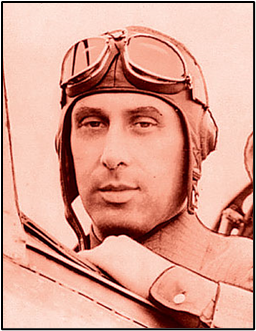
The NY plant built a number of different aircraft, but soon the Army was calling for a long-range aircraft that could escort bombers into Germany. In response, Republic engineers designed what would become the P-47 Thunderbolt. Although it was not perfect, the Army was pleased.

Concurrent with this, (the mayor of Evansville) William Dress set about to improve the then inadequate Evansville airport to make it more attractive to the aircraft manufacturing industry.
Although almost all materials were being diverted to the war effort, the mayor, through connections in the cement industry, was able to get a quantity of material. With no official sanction whatsoever, he ordered a runway expansion program. It was a fortunate move because at the time the Republic Aviation Corporation in Farmingdale, New York, secured a government contract to produce an unlimited number of P-47 fighter planes known as Thunderbolts. The president of Republic felt that the East Coast was too vulnerable to attack from the sea, so he set out to find a site for a new plant in the Midwest. He called an old St. Louis friend and neighbor, G. Nelson Smith, for suggestions. Smith was by this time the vice-president of Hoosier Lamp and Stamping Company in Evansville, so it was through this connection that Evansville was selected for the new $16 million airplane factory. Mayor Dress was informed that his expansion program was much too conservative and that the U.S. Air Corps would take over. In April 1942 ground was broken for the new plant on the south end of the airport along U.S. Highway 41.[i]
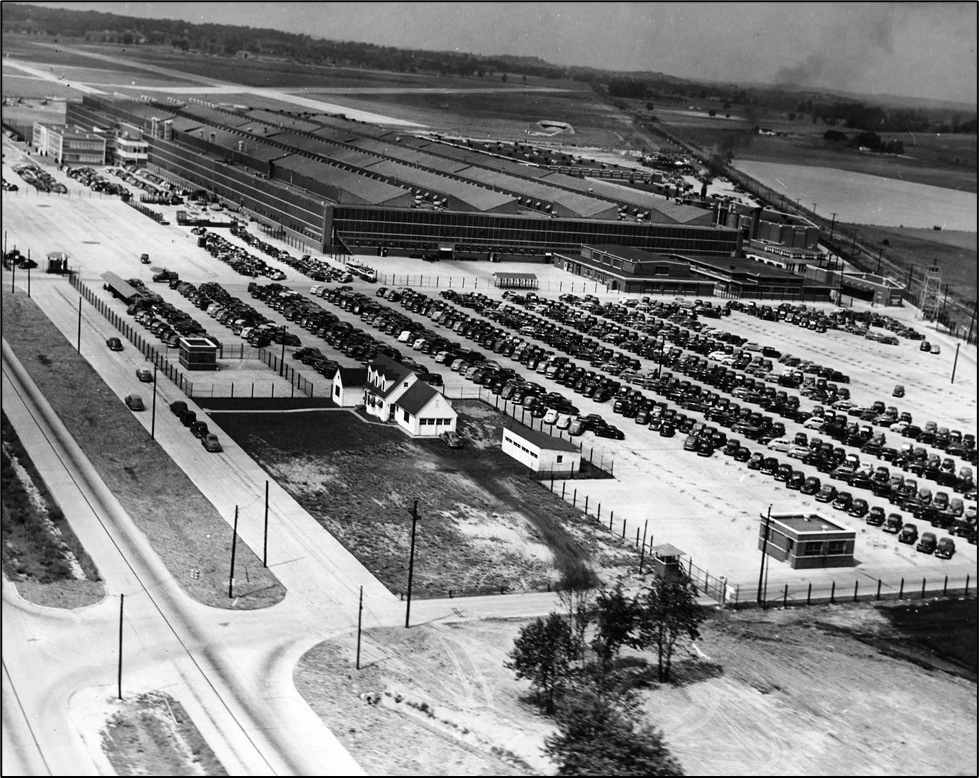
You may recognize this location as the site of the former Whirlpool Corporation.
Ground was broken in April 1942 and construction of the new plant continued around the clock. Construction of the planes began very soon thereafter, before the plant was even complete. Diane Igleheart, wife of International Steel president (which provided the raw materials) James Igleheart, noted, “they just kept building the plant around the way the plane had to go so when the last section that they built [was complete], the plane was there and it was sent right across.”[i] Within 20 months, 1,000 planes had rolled off the assembly lines. President Franklin D. Roosevelt, on an unannounced tour of defense plants, visited the Evansville plant on April 27, 1943. News of this visit didn’t appear in local newspapers until April 30, and this photograph wasn’t released until much later.

A newsletter was published by the Evansville Shipyard and called The Invader. This image comes from the May 1945 issue, v.3:no.7, p. 18. It is from the Evansville in WWII collection of the Evansville Vanderburgh Public Library digital archive.
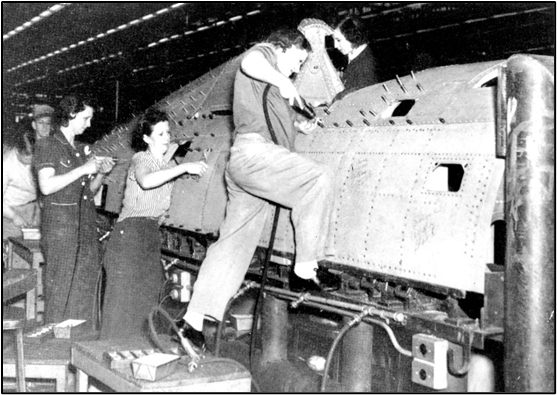
MSS 157-0782, the Schlamp-Meyer Collection
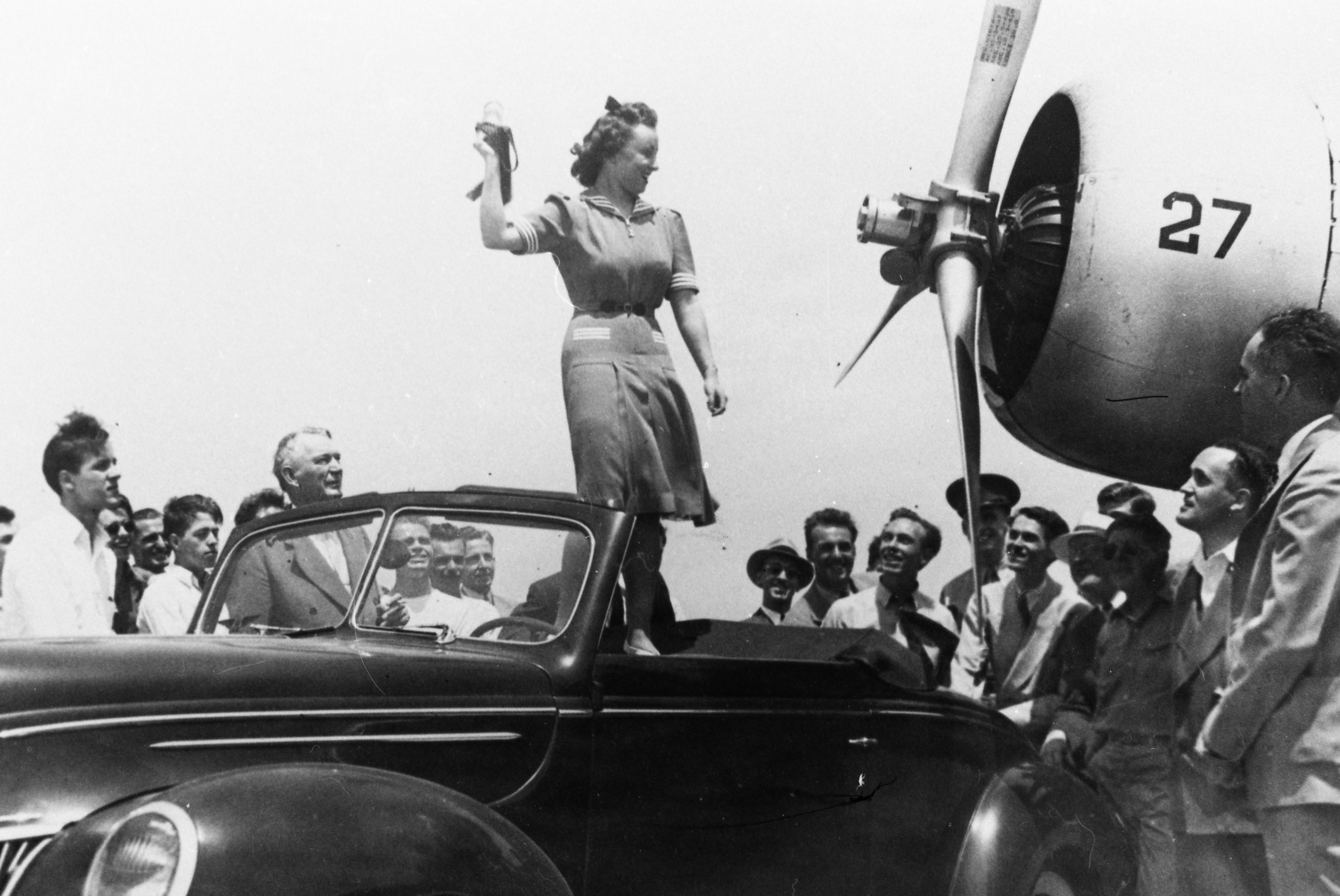
MSS 181-1017, the Darrel Bigham Collection

Production ceased in mid-August 1945. By that time, some 5,000 employees (about half women) had contributed 6,242 P-47 Thunderbolts to the war effort. Combat pilots loved the P-47. It did the job, and it brought them home safely.
Nicknamed the “Jug” (short for “Juggernaut”) by adoring pilots, the P-47 was a heavyweight warbird — and one that packed a devastating punch. … The P-47 was a big plane. It was three feet wider than the P-51 and four feet longer. And at more than 10,000 pounds empty, it was about 50 percent heavier than the Mustang and nearly twice the weight of the British Spitfire. In fact, along with the three-seat Grumman Avenger, the P-47 was among the heaviest single-engine aircraft of World War Two. Despite its considerable mass, the P-47’s 18-cylinder, 2,600-horsepower Pratt & Whitney R-2800 Double Wasp engine (the same power plant used by the Vought Corsair and Grumman Hellcat) enabled the unwieldy Jug to keep pace with the Mustang. Both had a top speed of around 440 mph (700 km/h). And while the P-47 could reach altitudes in excess of 40,000 feet (12,000 meters), its range of just over 800 miles (1,300 km) gave it half the legs of the P-51. With four .50 caliber machine guns mounted in each wing, the Thunderbolt could shred both enemy warplanes and ground targets alike with equal ferocity. Its internal stores were capable of holding 3,400 rounds (the Mustang’s six guns could pack only 1,800 bullets), which enabled the P-47 to unleash a torrent of lead for 30 seconds straight. While the Jug did poorly in fast turning dogfights against smaller planes, it was at its best when diving on (or “bouncing”) enemy fighters with all guns blazing. It was even more effective as a ground attack aircraft; it was capable of carrying as much as 3,000 pounds of external ordnance. In fact, when fully armed, a P-47 Thunderbolt could deliver about half the payload of a B-17 Flying Fortress. When equipped with 4.5-inch M8 rockets, the Jug had the firepower equal to a battery of 105 mm howitzers. … Not only was it capable of absorbing staggering amounts of punishment, the cockpit was roomy and comfortable. Some fliers likened the aircraft’s seat to a lounge chair. Plus, the bubble canopy, which was added to D-model variants, afforded aviators enhanced visibility. The plane’s safety record was nothing short of astounding – only about 0.7 percent of Thunderbolts were lost in action. … The P-47 made its combat debut in April 1943, when a Thunderbolt with the U.S. Army’s 4th Fighter Group brought down a Focke Wulfe FW-190 over France. Over the next two years, the planes would fly more than half a million sorties in Europe and the Pacific and would claim nearly 4,000 enemy aircraft, 9,000 trains, 86,000 trucks and 6,000 armored vehicles.[i]
Republic Aviation wasn’t the only company in Evansville that produced planes or plane parts for WWII.
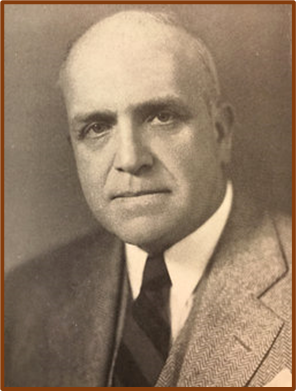
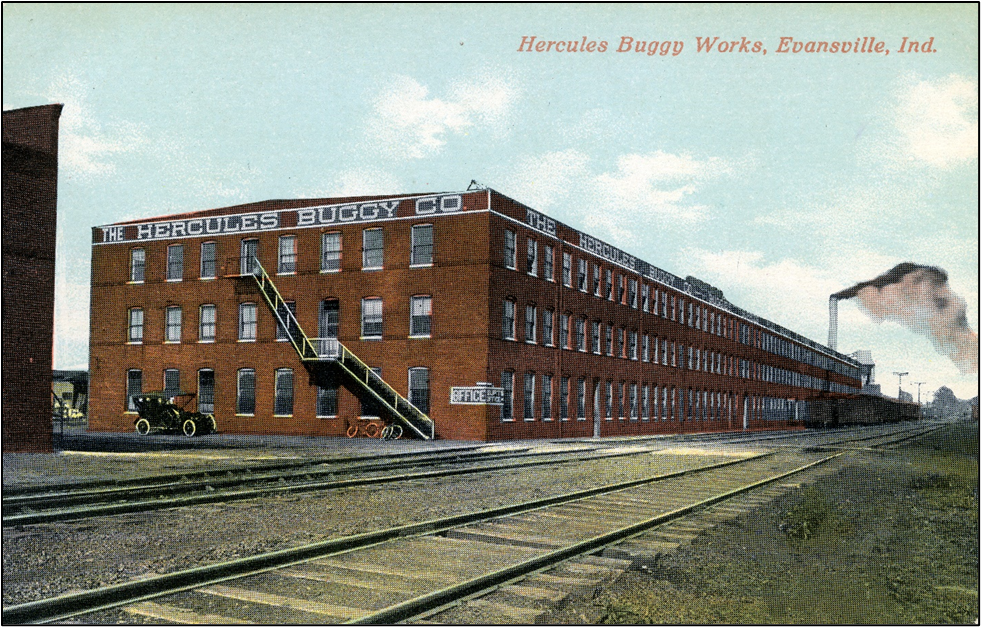
Another big player was the refrigeration giant, Servel, located at 119 N. Morton Ave. In 1902 the Brighton Buggy Works of Cincinnati moved to Evansville and became known as the Hercules Buggy Company. Circa 1926, looking to broaden its product line, it began manufacturing home refrigerators. With the slogan of “Serving Electrically,” the company name evolved, after reorganization, into SERV-EL (Servel). Servel president Louis Ruthenburg “was one of the most influential community leaders in the city and was a conspicuous and successful presence in the efforts of local leaders to get war contracts.”[i] On March 28, 1942, Ruthenburg announced that, while Servel was currently working on several defense contracts, it soon would begin a new contract that was worth millions and would greatly increase both employment and production. This new contract was to make wing panels for Republic Aviation’s P-47s. “It, like Chrysler and Sunbeam, was also in the ordnance-production business and
manufactured 20 million 40-millimeter shell casings and 9 million 37-millimeter shell casings, as well as casings for other grades of shell, landing gear assemblies, field ranges and airplane head castings.”[i] Below are two pictures of the Servel plant. The first is a postcard, circa 1910, of the original Hercules Buggy Company plant. Second is an undated aerial view of Servel, providing a better view of the size of the plant.

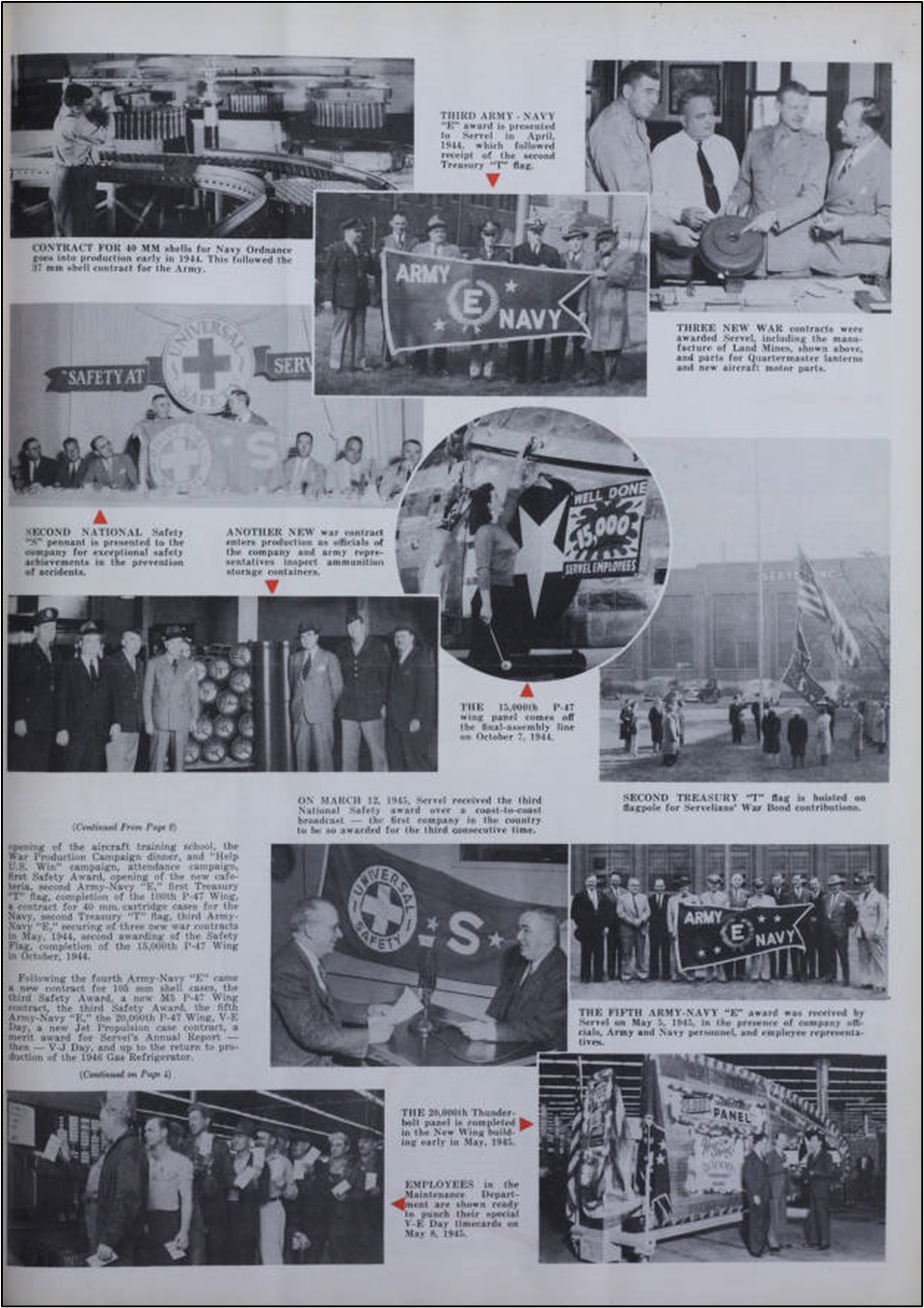
The Servel Inklings newsletter of November 30, 1945 (v. 12:no.24) contained a 4 page spread called “From Peace to War and Back: A History of Servel’s War Years Told in Pictures.” This is the third page of this special report, touting the 15,000th P-47 wing panel being completed on October 7, 1944 (center of page), and the 20,000 in May 1945. That would average out to almost 42 wing panels being completed daily.
EVPL Digital Archive: Evansville in WWII

The Briggs Indiana Corporation, located at 800 E. Columbia St. (formerly the Graham-Paige Automobile Company) built wings for the Navy fighter plane the Vought F4U Corsair during WWII, among other products. (This image is from 1940, before the factory tooled up for the war effort.)
The contribution of International Steel cannot be discounted, both in providing steel to build/retool the factories, but also for the construction of the planes themselves. More will be said about this in the next blog of this series…keep reading!
Resources Consulted
Bigham, Darrel. Evansville : The World War II Years. Charleston, S.C. : Arcadia, c2005. General Collection F534.E9 B54 2005
MacLeod, James Lachlan. Evansville in World War II. Charleston, SC : History Press, 2015. General Collection F534.E9 M335 2015
McCutchan, Kenneth P. et al. Evansville at the Bend in the River: An Illustrated History. Sun Valley, CA. : American Historical Press, c2004. General Collection F534.E9 M38 2004

 amUSIngArtifacts
Leave a comment