*Post written by Mona Meyer, Archives and Special Collections Metadata Librarian.
If you order a drink “on the rocks,” you want it over ice. Here we are going to look at a different kind of ice—ice so thick on the river that it freezes over. In today’s climate of global warming, this might not happen again, but it certainly did in the past.
An ice gorge is when the river not only freezes, but the ice piles up higher and higher. “The formation of river ice is rare. It happened in only 14 winters out of more than 140 years of record keeping in Cincinnati. … The deeper and wider the river, and the faster the water flow, the less likely it is to freeze. Moving water generates friction, which heats the water (even if only a bit).”i Today’s rivers are different—between dredging and the system of dams, the water level is kept far most constant, making for consistently deeper and swifter water. Thus the likelihood of freezing over or ice gorges is greatly diminished, but when it did happen, it was quite a sight to see.
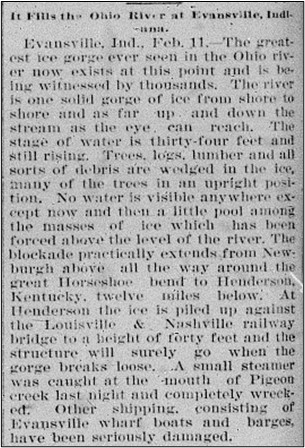
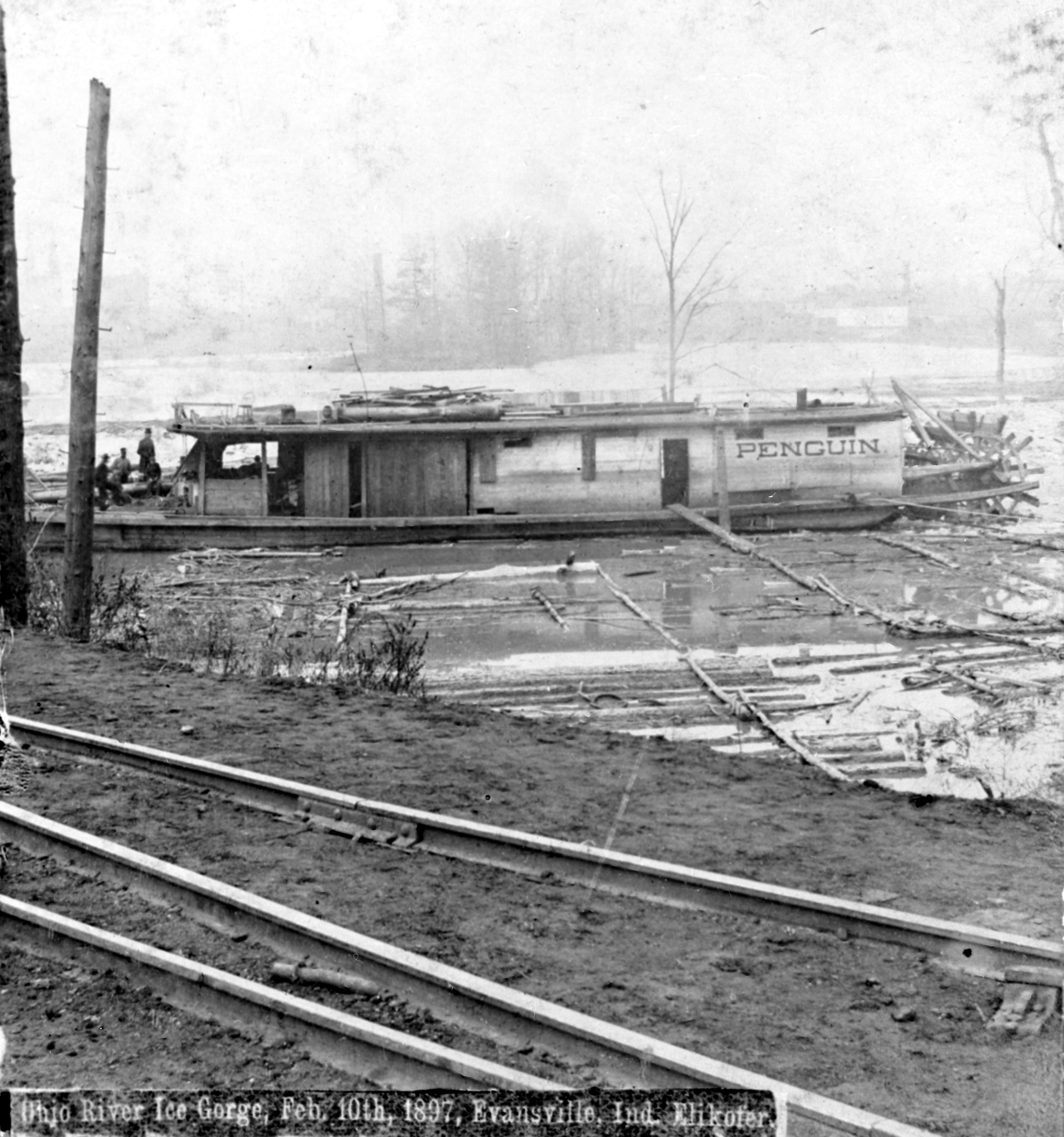
This article from the Fort Morgan, Colorado Times February 19, 1897 describes the situation in Evansville the week prior.
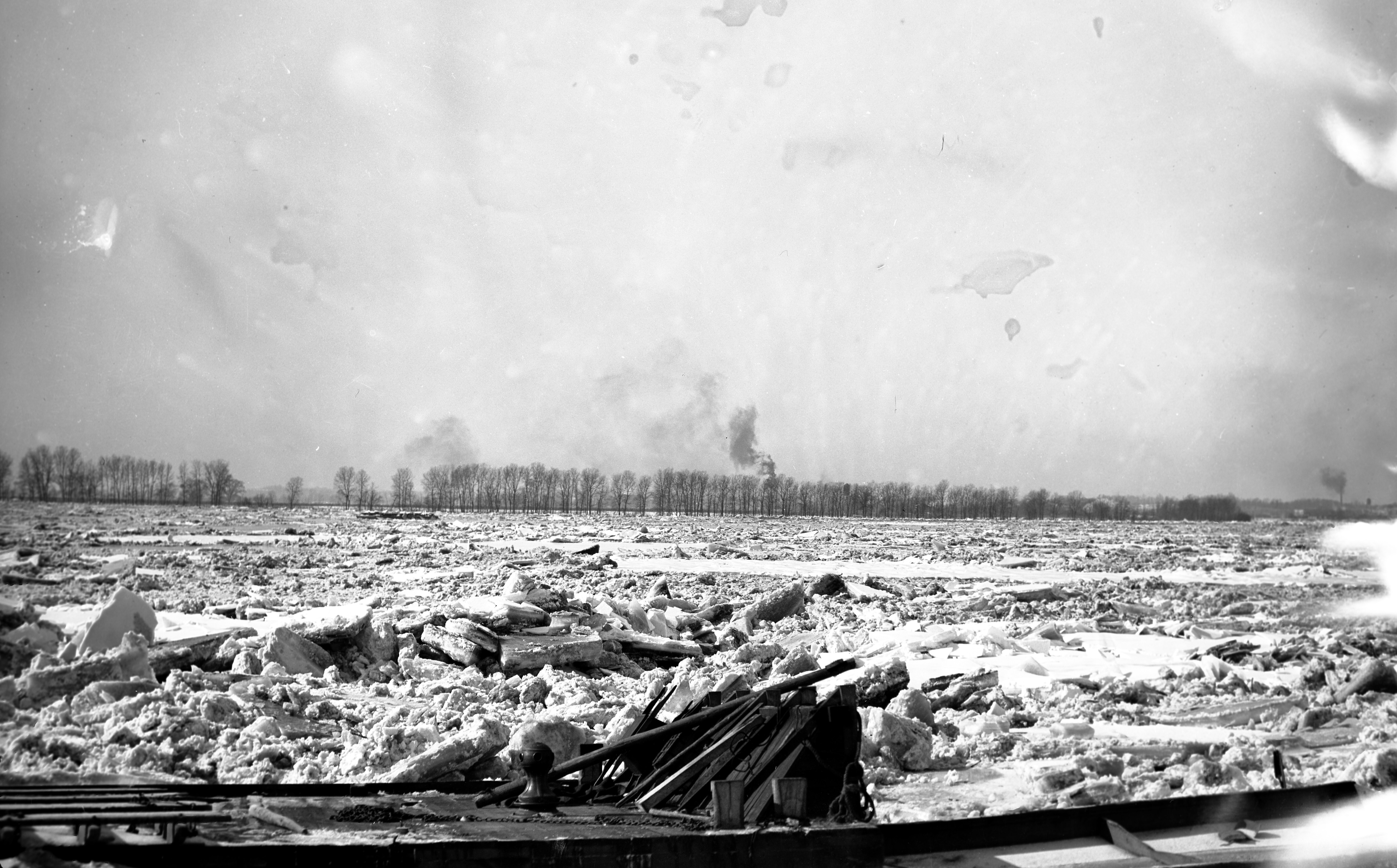
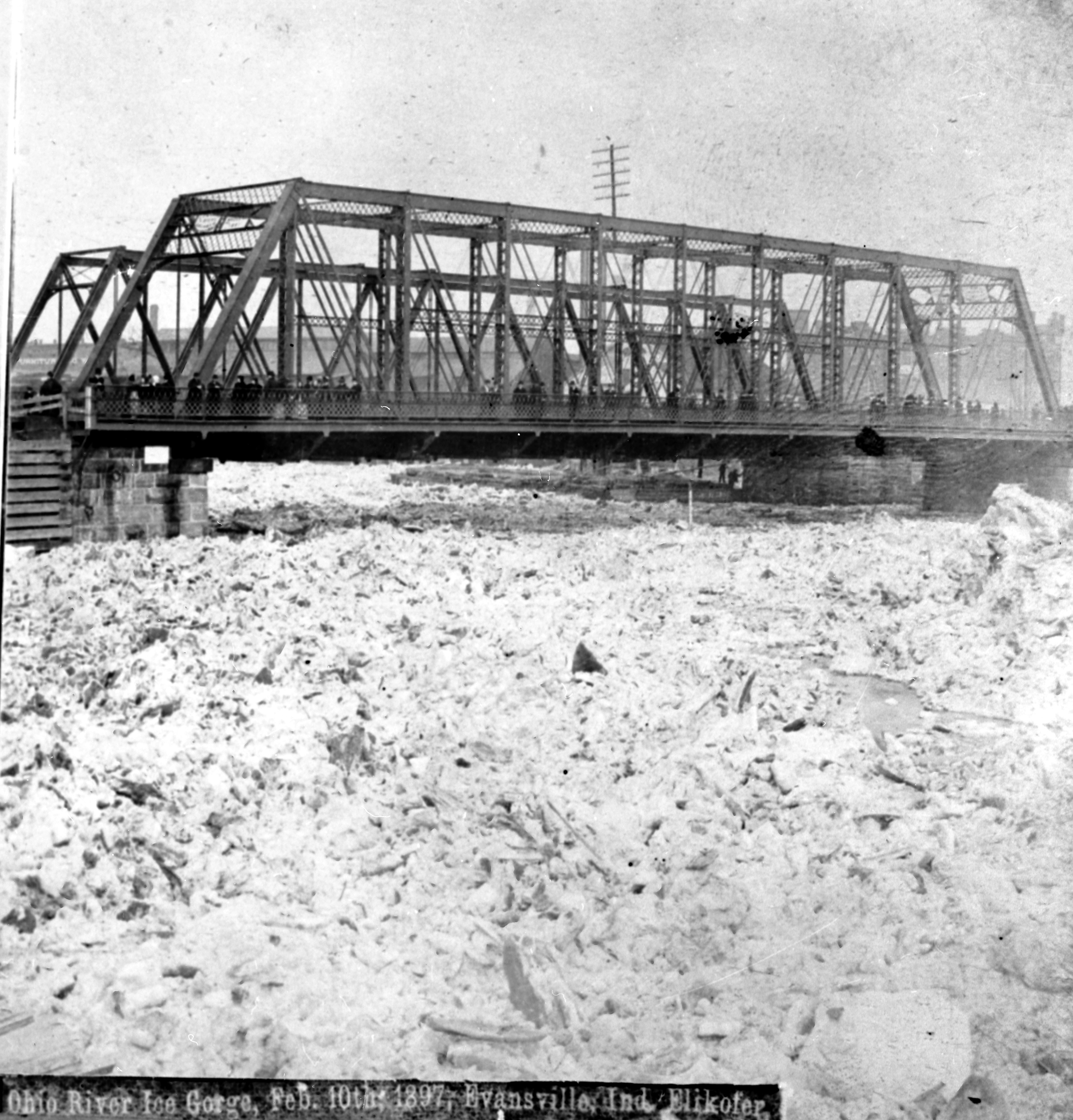
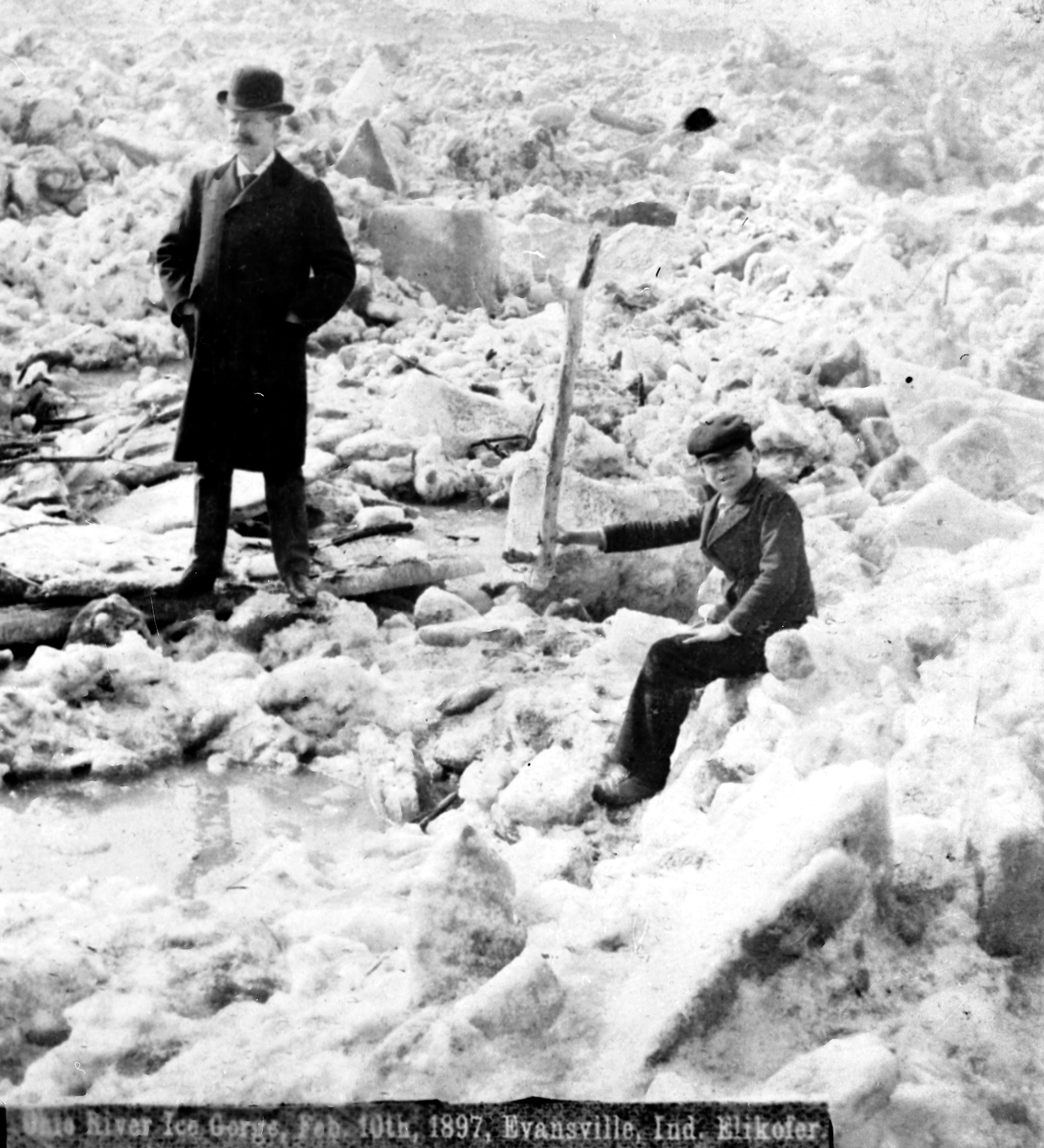
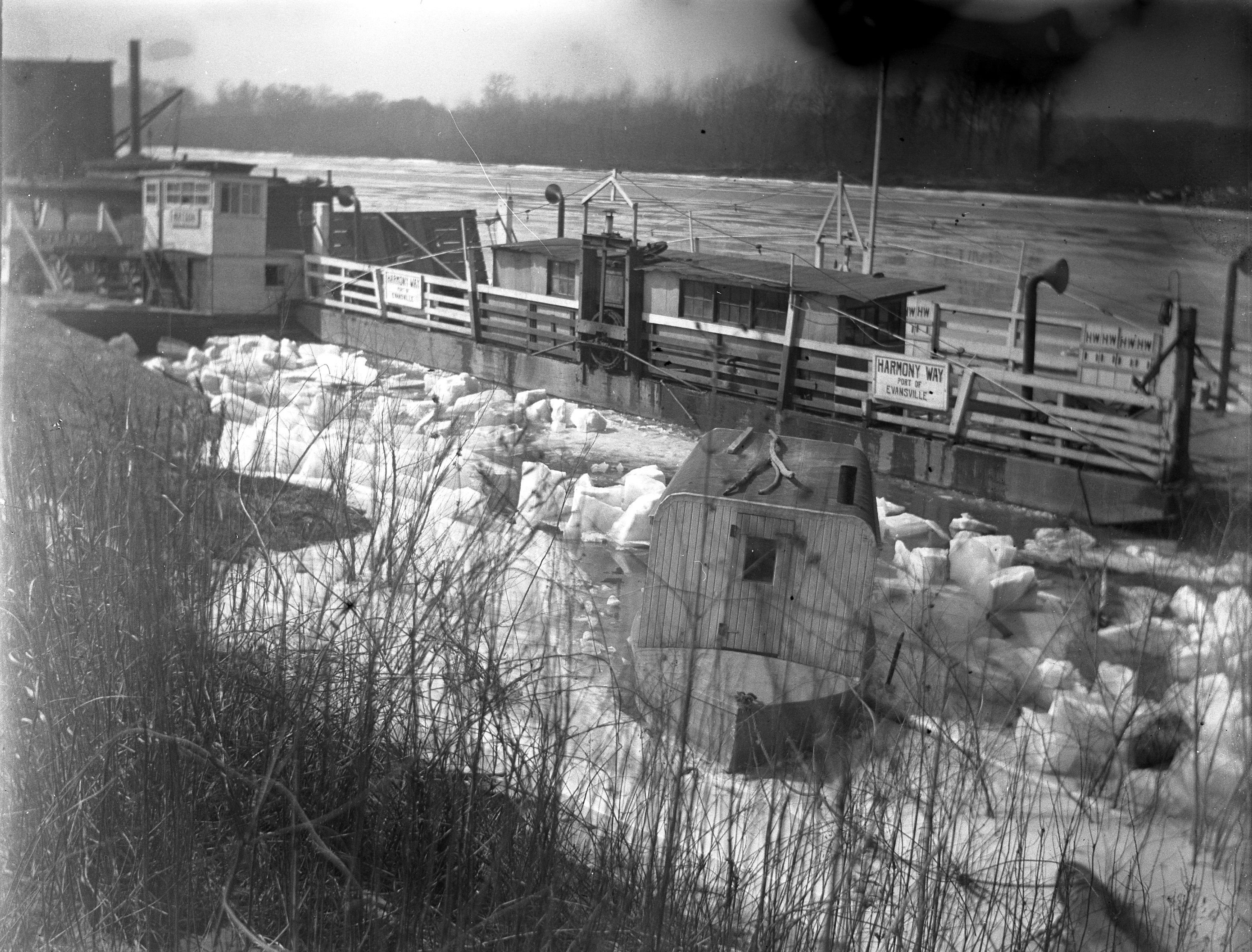
The following six pictures are all from UASC MSS 264, the Thomas Mueller Collection and show the February 10, 1897 ice gorge in Evansville.




Freezing of the Ohio River happened in January 1856, leading to both a heroic act and a work of literature. Margaret Garner was a slave in Boone County, Kentucky, who, with her family, escaped across the frozen river to freedom in Ohio. This did not have a happy ending as she and her family were recaptured, but not before Margaret killed her 2 year old daughter to prevent her from being enslaved again, and was ready to kill her other children and herself when she was caught. Despite intense publicity and a trial, she and other family members were sent back into slavery and soon disappeared from history. The novelist Toni Morrison based her novel Beloved on this real life tragedy. If this peaks your interest, there are 4 different editions of the book available in Rice Library, in the General Collection, with the call number PS3563.O8749 B4 (there is a date after this that varies with the edition, but the basic call number is the same). There is also a DVD of the movie: DVD PN1997 .B456 1999.
The Evansville Journal on January 10, 1856, carried a list of ships stuck in the ice here: the Monarch, Ohio, J.M. Stockwell, Sultanna, T.C. Twitchell, Tecumseh, W.A. Eaves, and the South America.

Probably related to this 1856 freeze in Cincinnati is this tale from St. Louis in December 1855. “When the river froze over during the bitterly cold month of December 1855, newspapers nicknamed it the ice gorge. An expansive ice sheet fused St. Louis to the Illinois shore, and just like every other time the river froze, city officials begged St. Louisans to stay off it. Unsurprisingly, their pleas were ignored: thrilled St. Louisans came out by the hundreds for ice parades, midriver bonfires, and carriage rides. They set up makeshift businesses on the new frozen real estate, including bowling alleys, skating rinks, pop-up saloons, and gambling houses. Farther from the levee, brewery workers chopped away large chunks of river ice to pack into their beer cellars. … The ice revelers disappeared as the weather warmed up — which is precisely when catastrophe struck. On Feb. 27, 1856, some St. Louisans noticed that a few of the docked steamboats had been nudged up onto the levee’s dry cobblestones. This was the first sign of a slow-motion disaster. As the sheet of river ice broke up and moved, it dragged more than 100 steamboats along with it. Astonished, St. Louisans gathered on the riverfront, listening to the eerie snaps and booms as the ice’s powerful force crushed one boat after another. The St. Louis Republican reported on the chaos: . . . the destruction commenced . . . [the steamers] were torn away from shore as easily as if they had been mere skiffs, and floated down with the immense fields of ice. The shock and crashing of these boats can be better imagined than described. All their ample fastenings were as nothing. . . . The whole business portion of the levee was clear of boats. . . . There was not a single boat at the levee which entirely escaped injury. The ice piled up into a jagged, 20-foot-high wall along the riverfront, twisted pieces of steamboats mixed throughout. As the blackened piles of slushy ice melted away that spring, they left behind a graveyard of pulverized boilers, mangled brass chandeliers, crunched china, and splintered bed frames.”ii
It happened again in St. Louis in 1888 and as seen in the image below, undoubtedly both of these vehicles suffered damage and/or were demolished.

Here are some images of the frozen Wabash River early in the 20th century. The Evansville Press, on December 11, 1937 carried this memory of 20 years ago, probably related to the 1918 pictures seen below: because of the ice gorge local schools were only part time due to a lack of fuel. Five loaded barges tore loose of their moorings and were grounded in the Howell area. Because there was no ferry, there was no traction car service to Henderson (meaning that it was cut off from Evansville—no bridge until 1932).

In addition to the massive flood on the Ohio River in 1937, 1936 and 1937 had very cold winters and the rivers (Wabash and Ohio) froze over both years.
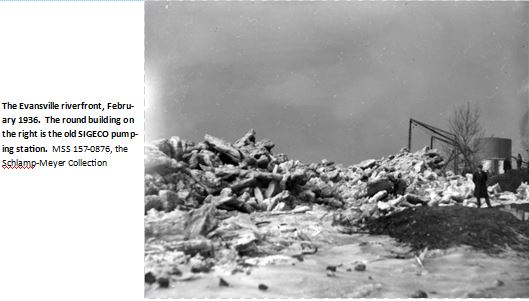
In the Evansville newspapers, the 1936 ice gorge seemed like a party, particularly as the gorge was breaking up later in February. From the front page of the Evansville Journal, February 24, 1936: “Thousands of cars passed the riverfront during the day viewing the scene from the foot of Main St. and various points on Ohio St. … Pedestrians and tourists filled the plateau atop the [Reitz] hill so that from a distance it resembled a piece of jam covered bread discarded at a picnic and taken over by ants.” On the same day the Evansville Press (p. 10) reported that 50, 000 saw the gorge break at Evansville. “Thousands of sightseers, many of whom motored to Evansville from other cities, jammed the river from Sunset Park to Ingle St. all day Sunday, watching the ice gorge break. … Several whistles were blown Sunday, signalling the break. Crowds filled the streets quickly, all running toward the river.”
Some were quick to capitalize on the situation. The Evansville Journal, February 28, 1936, had this advertisement: “Spectacular Ohio River ice gorge pictures for mailing to friends…5 prints [of] Evansville and Newburgh 25 cents, 5 set $1.” If this wasn’t enough, you could attend a Pathe newsreel viewing at the Grand Theater showing the the choked river, crushed wharfboat, and Ocoee riverboat, and the gorge breaking up and moving downriver. (Evansville Press, February 28, 1936)
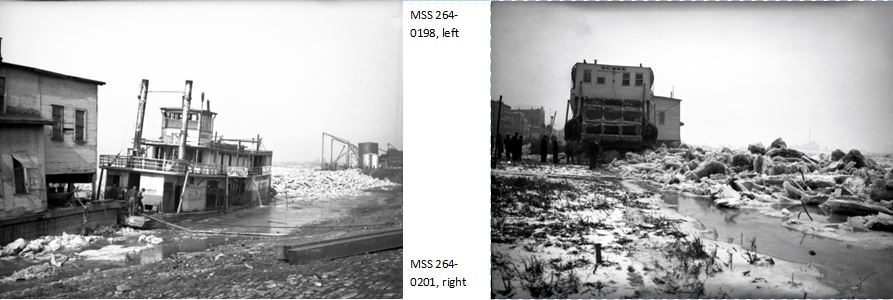
These two pictures of the Ocoee paddlewheeler were dated as 1936. You can easily see the damage caused by the ice. In the first image the Ocoee is chained to the wharfboat, which itself was not in good shape. Both photos are from UASC MSS 264, the Thomas Mueller Collection.


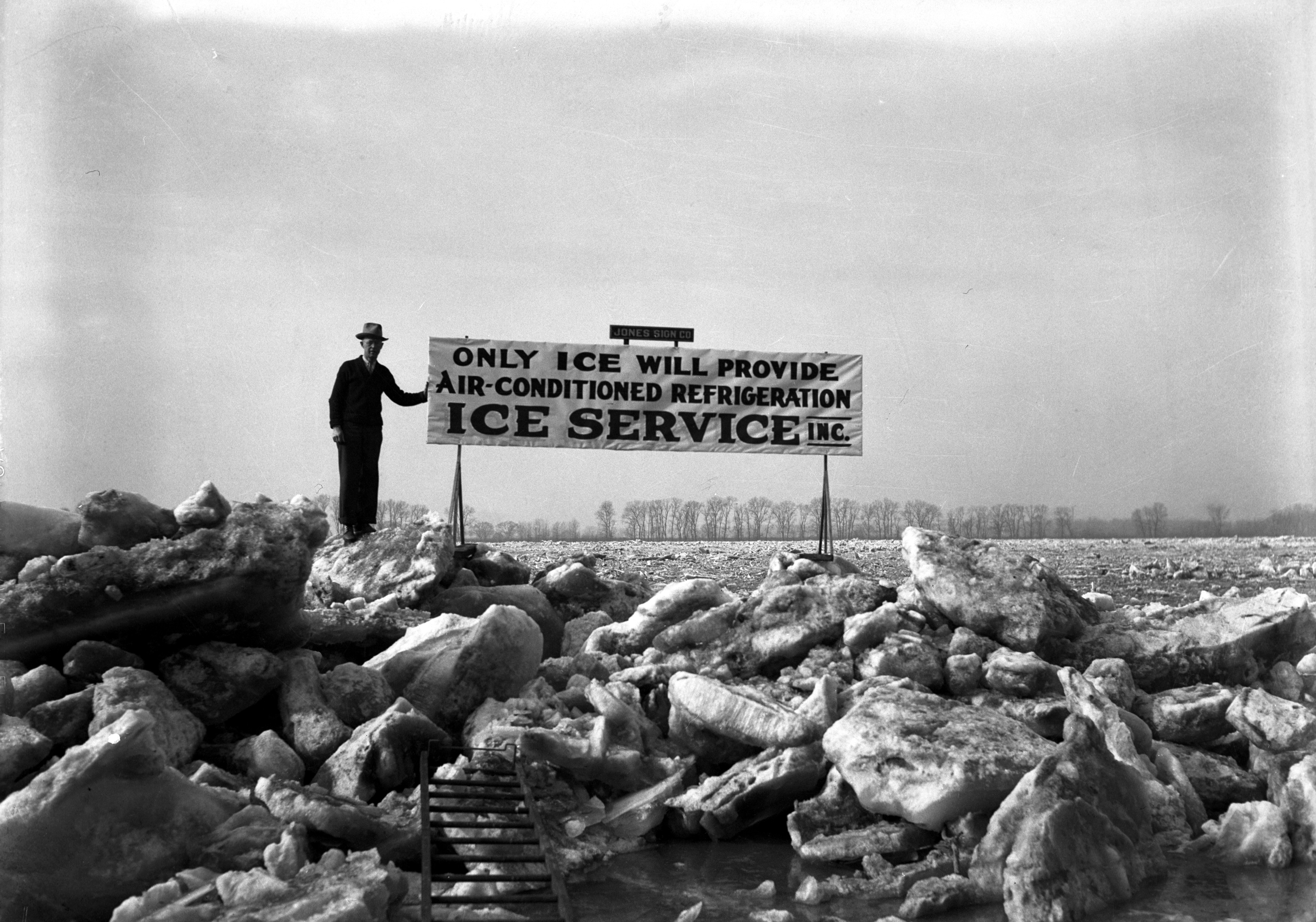
This gentleman was seizing a great publicity opportunity in 1937!
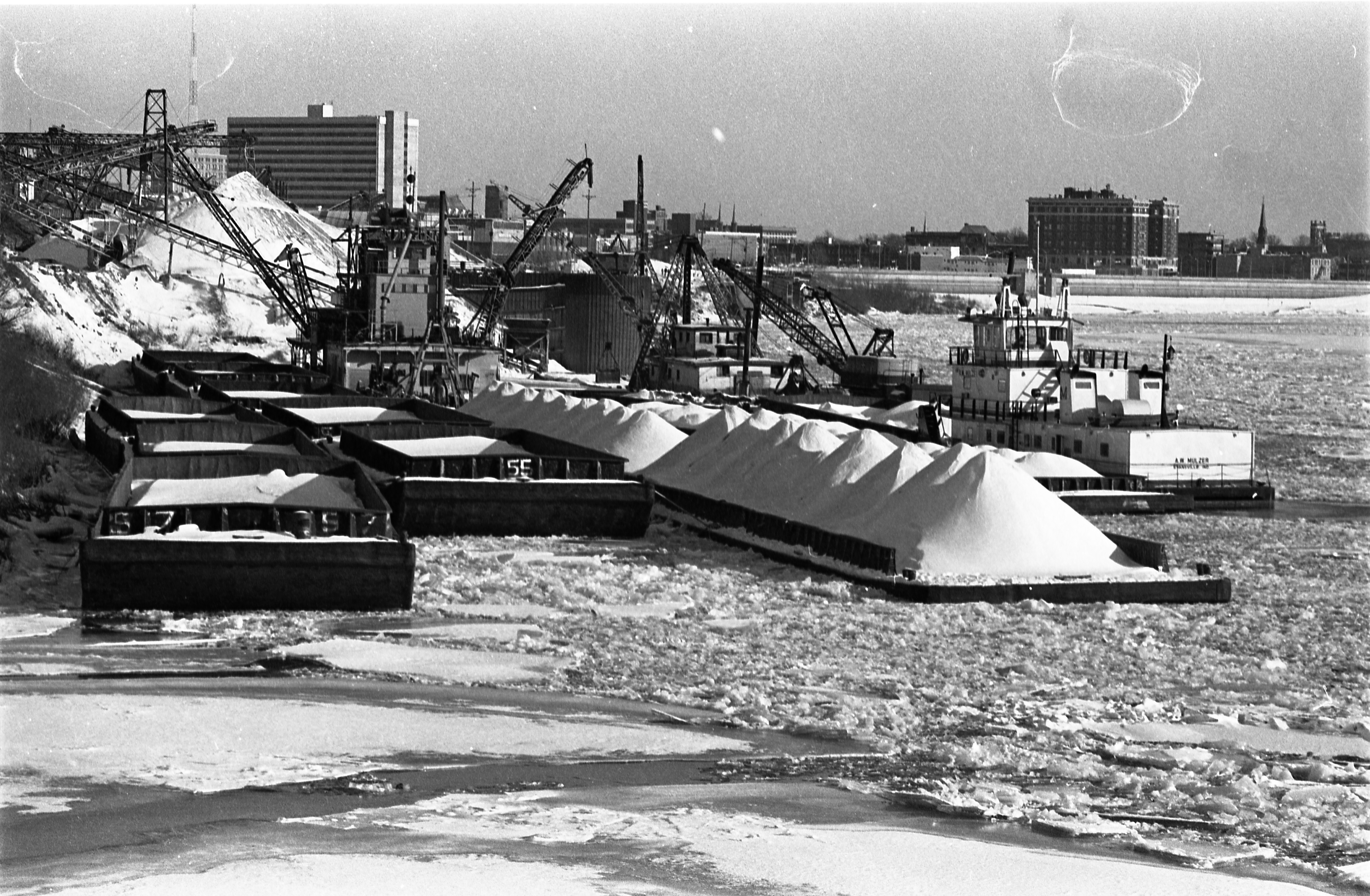
It happened again the winter of 1977. Although the ice does not look as impressive in this picture, it caused the barges and towboat shown here to be stuck on the riverfront. This location is probably near the end of NW Riverside Dr., where it turns into Fulton Ave. One of the tugboats says A.W. Mulzer, and Mulzer Crushed Stone (today’s name) is very near this location or may, indeed, be this specific location. The big building on the right is the McCurdy Residential Center Inc. at 101 SE 1st St. (formerly the Hotel McCurdy).
The year 1977 was the last date the Ohio River has frozen. As noted earlier, global warming might mean it won’t happen again, but you’ve seen plenty of evidence here of what it looked like when it did.
Resources Consulted
“Archives: In January of 1977, the Ohio River froze over.” Cincinnati: WLWT, January 2, 2020.
“The Ice Gorge: Tales from the Mighty Mississippi.” Missouri History Museum: Sproutlight.
U.S. Dept. of Commerce: Weather Bureau. Ice in the Ohio River at Cincinnati 1874 through 1964. Orsanco.org
i Will
ii Ice Gorge

 amUSIngArtifacts
Leave a comment