*Post written by Mona Meyer, Archives and Special Collections Metadata Librarian.
Lush hardwood forests abounded along the Ohio River valley in the early 19th century. In 1800 Indiana had 19,500,000 acres of forest land.i After Indiana became a state in 1816, the population continued to grow, and there was a need to exploit this natural resource. One of the biggest users of this resource was the lumber industry. One pamphlet called Evansville “’the greatest hardwood lumber market in the world.’ This may not have been far from the truth. It is said that at one time, except for the area reserved for the wharf, the banks of both the Ohio River and Pigeon Creek were a solid mass of great piles of logs. Many of these logs came considerable distances, floated down the Patoka, the Wabash, and Green rivers, and then were pulled in great rafts by little towboats to Evansville.”
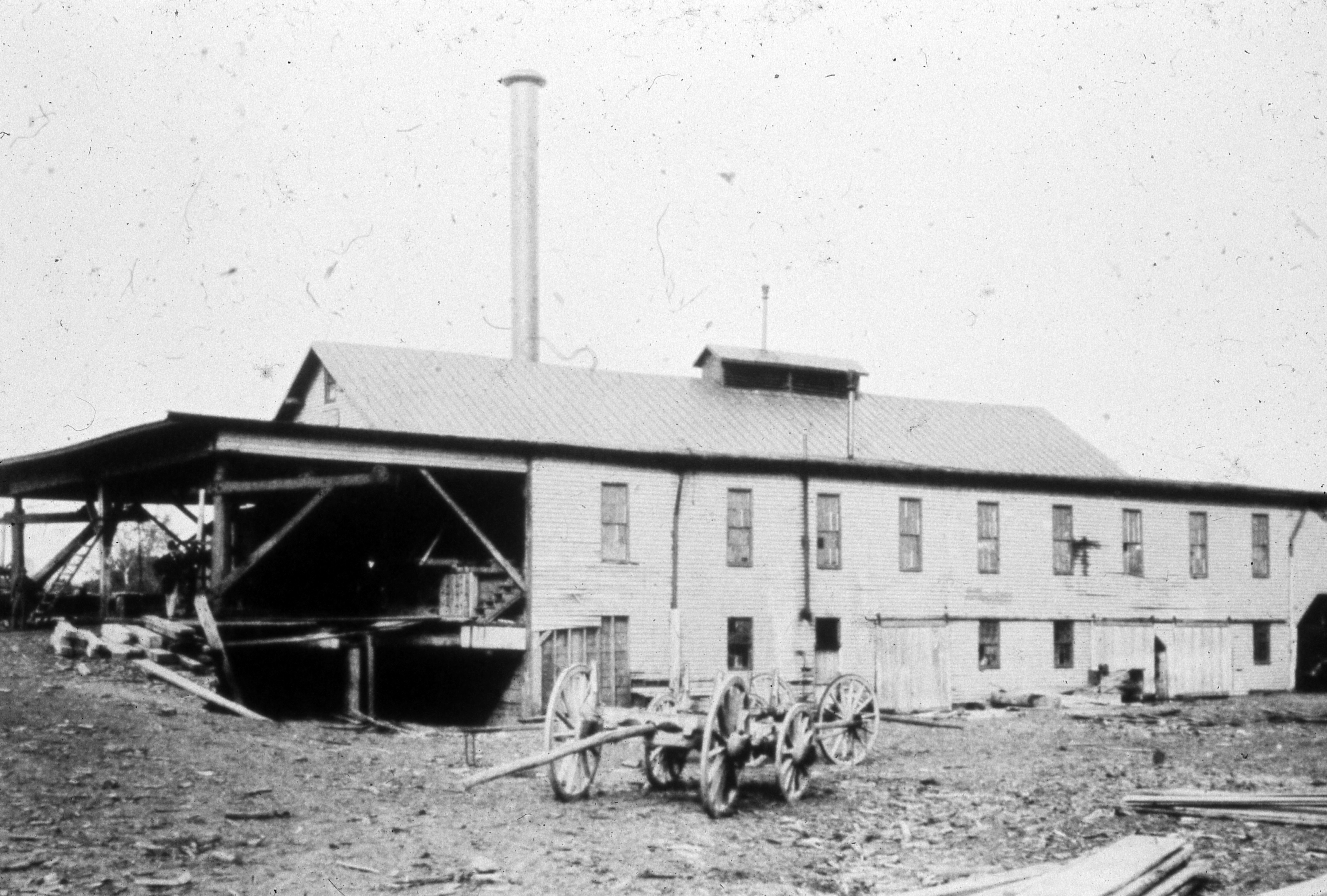
The largest lumber company in Evansville was owned by German immigrant John Augustus Reitz. Born in 1815, Reitz was a member of a well-to-do family. His family saw that he was well educated, and at the age of 21, he came to the United States. Moving to Evansville in 1838, he originally intended to go into the pottery business, but this proved unsuccessful. He then worked at a sawmill and learned the trade. He opened his own sawmill near the mouth of Pigeon Creek (near where Mulzer Crushed Stone is in 2023) in 1845 and never looked back. In 1873 it was incorporated into John A. Reitz & Sons. From 1883-1893 it manufactured more hardwood lumber than any other sawmill in the United States. “It was operated when the elements permitted twenty-two hours out of twenty-four and six days of the week.”ii It did not cease operation until 1918, and the building was razed circa 1962.
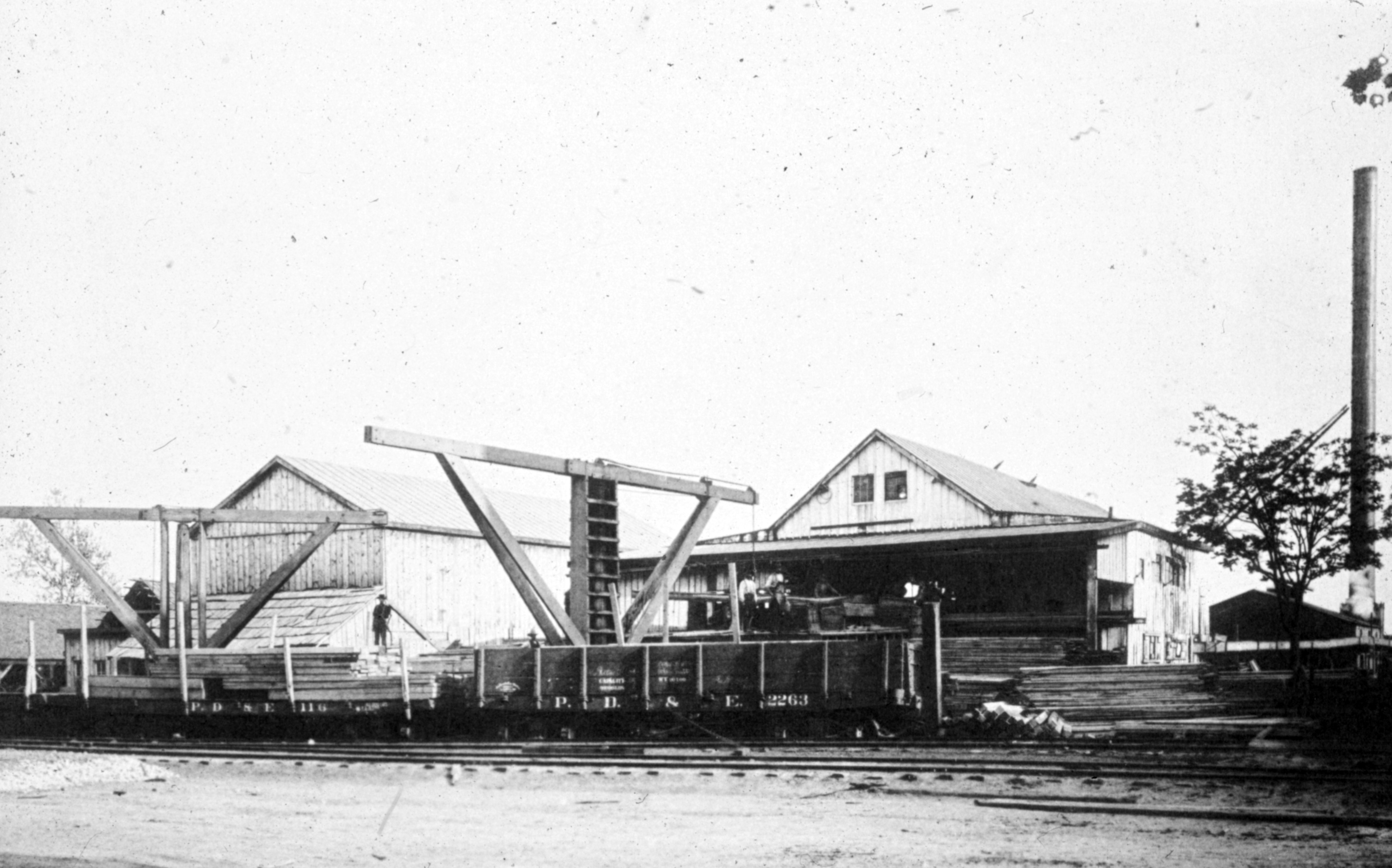
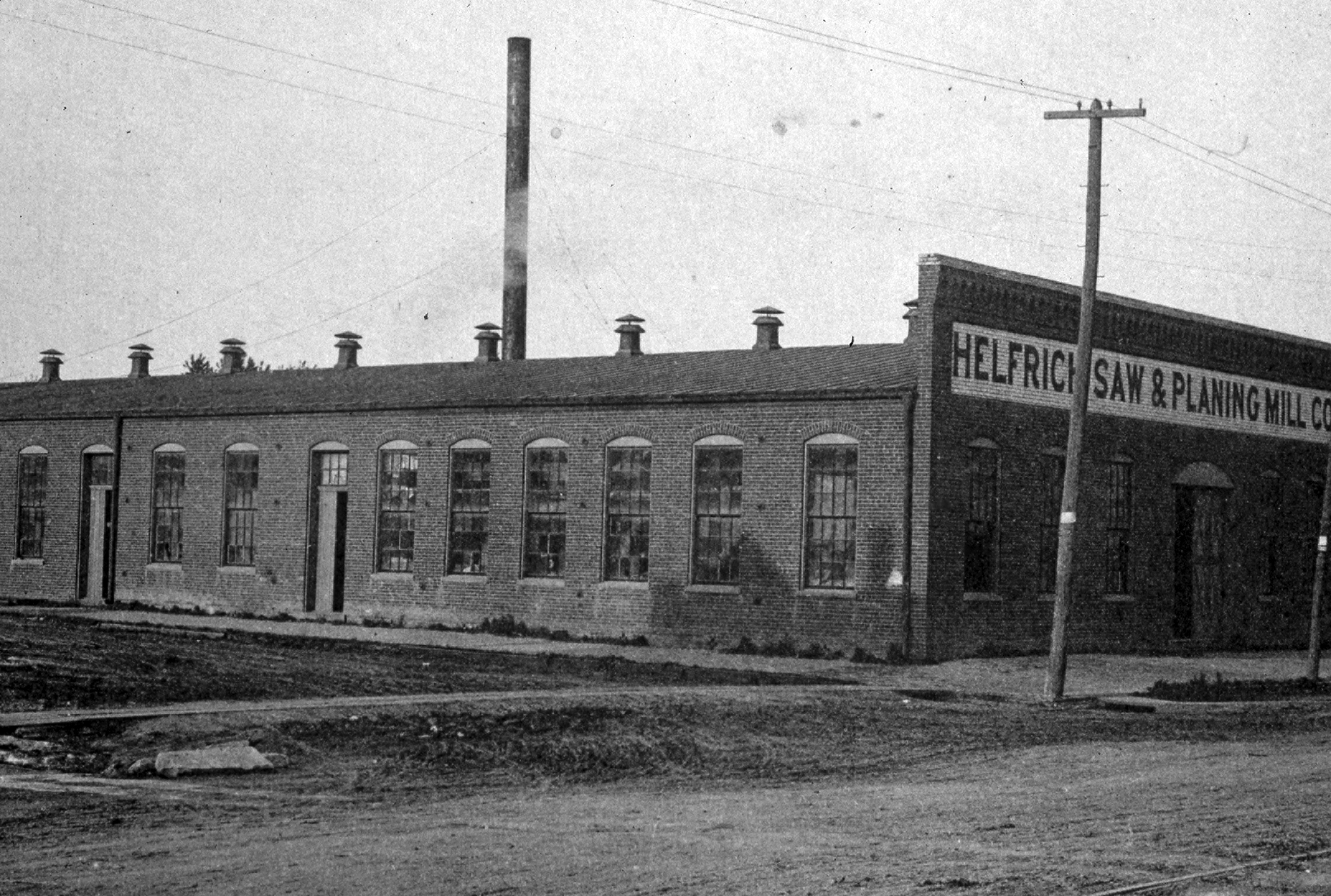
Reitz may have been the “Lumber Baron,” but his was not the only sawmill in business. Seen left is the Schultze Waltman & Co. (sawmill), located at 712 W. Ohio St., at the corner with Wabash Ave. It was founded in 1878 and located next to Peoria, Decatur and Evansville Railroad (PD&E); razed circa 1930. The back of this operation would have faced on the Ohio River. The Schultze was George T. Schultze who died in 1933; some time after 1910 the company became known as the George T. Schultze Lumber Company. The Waltman was Joseph Waltman, Sr., who died in 1915. NOTE: this location would have been close to the Reitz business. The Helfrich Saw & Planing Mill Company (seen to the right) was at 613-615 W. Franklin St. (The 1904 city directory calls this the Helfrich Lumber & Manufacturing Co.) Adam Helfrich was the president. On August 24, 1884 the sawmill and lumber were destroyed by fire, for a loss of $17,000. Sometime around 1895 this property became a flour warehouse, was vacant circa 1910 and razed circa 1922. The Historic Evansville website says that some of oak beams used in the Old Mill restaurant were salvaged from this facility.
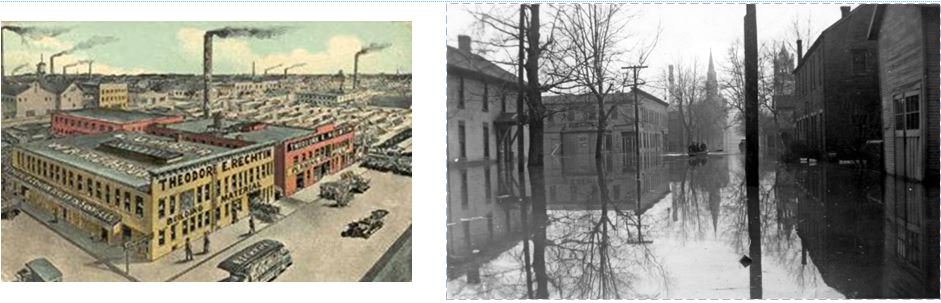
Rechtin Lumber Company, seen here in a picture postcard and in the 1937 flood (it’s the building on the right) began in 1872 and was destroyed by fire in 1949. It was located at 714-720 Ingle St., near the corner with 7th St. At this time there was also a Stremming Lumber Company at 1031 W. Missouri St., Yosemite Mills at 100-104 Sixth Ave., S.W. Little Saw Mill at 830 W. Ohio St., H. Herrmann Saw Mill on Vermont St., and Rietman & Schulte Saw Mill at 519 W. Ohio St.
Sawmills were not the only industry to benefit from the abundant supply of hardwood. “Many small companies sprang up to manufacture barrels and kegs, wagons, carriages, boats and barges, coffins, farm implements, and—most importantly—furniture. The commercial manufacture of furniture began in Evansville at a very early date—as early as 1837 when Thomas Smith moved his cabinetmaking shop from Princeton. … Many skilled cabinetmakers and wood-carvers were among the German immigrants who arrived in the 1840s and 1850s, so by mid-century several small furniture shops had sprung up, each employing three to seven men.

The Evansville Coffin Company was located at 401 N. Main St., formerly 1601-1617 Main St. “Organized in 1881, the business manufactured “fine funeral furnishings” for markets that eventually reached as far south as Alabama. The four-story factory, located on the northeast corner of Main and Michigan, covered half a city block and produced 500 coffins a week by 1890. By then, Evansville’s abundant supply of lumber, easy access to river transportation, and numerous railroad lines combined to make the city a leading manufacturer of wagons, coffins, furniture, and other products.” In the 1930s the name was changed to Evansville Casket Co. It reorganized in the middle 1940s, went out of business within 10 years, and this building was razed in the early 1950s.
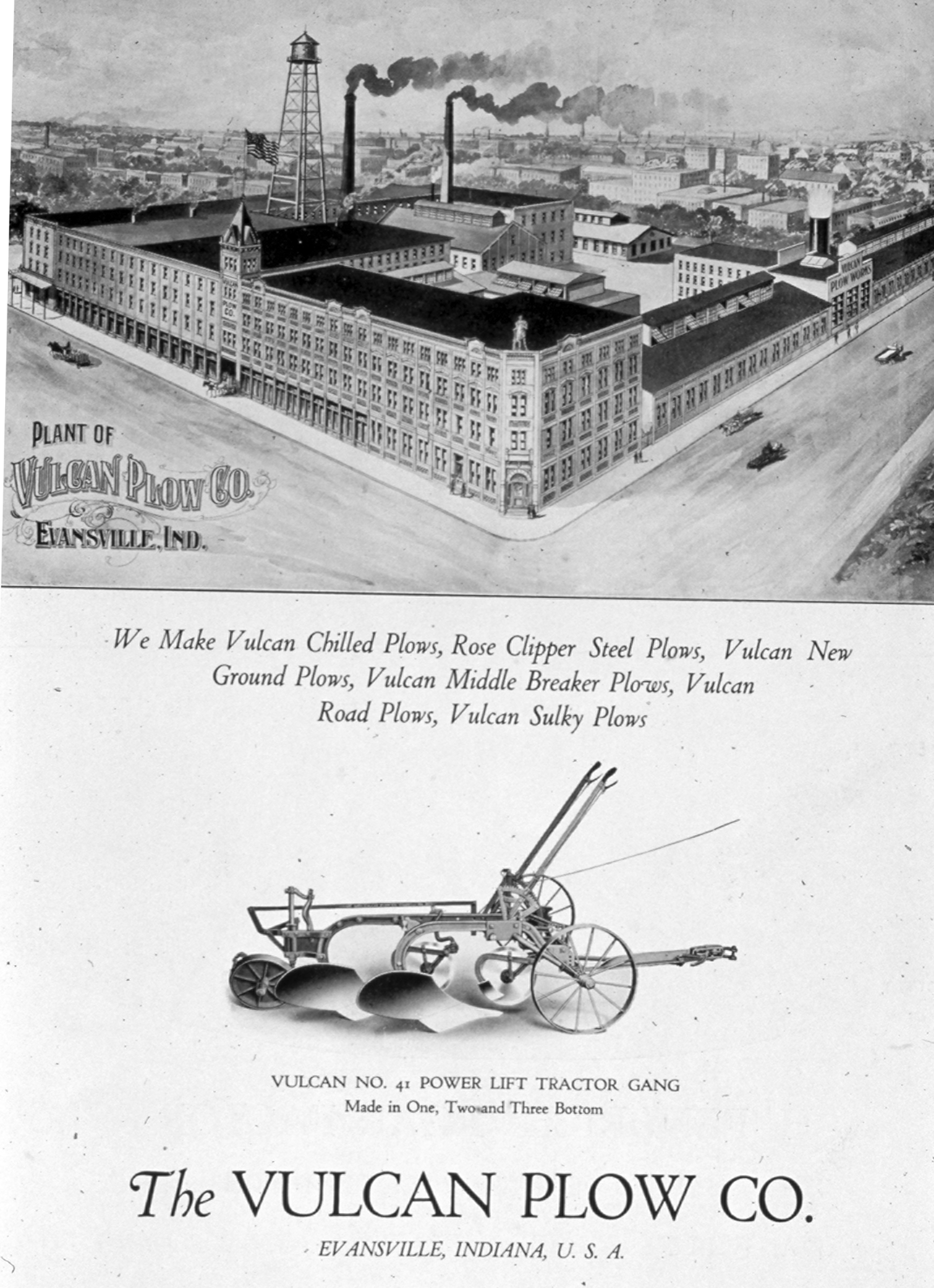
This advertisement for Vulcan Plow, located at 101-27 Lower 1st St., is another example of a company that benefited from the availability of local timber. William Heilman, a German immigrant and U.S. Congressman, founded Heilman Plow Works in 1847. Renamed Vulcan Plow Works in 1890, the company was a leading manufacturer of various farming equipment in the Ohio Valley before merging with three other companies in Illinois and Ohio, to form Farm Tool, Inc. The last known vestige of that company in Evansville left in 1949 and went out of business all together in the 1950s. The building was razed in the late 1950s.
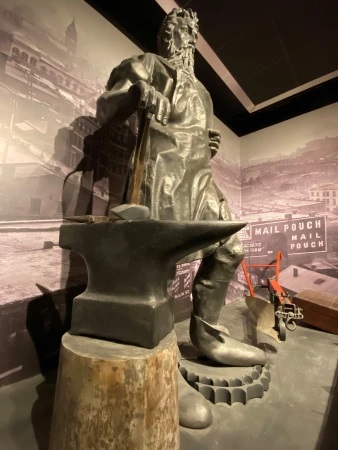
Just barely visible atop the front corner of the factory is a statue of Vulcan, the Roman god of fire, foundry and metalworking. The statue resided in a number of different locations after the building was razed, finally moving to the Evansville Museum where it can be seen today.
“In the 1870s and 1880s the largest furniture factory in the city was operated by the Armstrong Brothers in a six-story building at Seventh Avenue and Franklin Street, where they turned out large quantities of high quality hand-carved, Victorian-style bedroom suites, marble-top tables, etageres, and various upholstered pieces, as well as less expensive machine-made lines. Their furniture was displayed and offered for sale in 15 rooms located between 209 and 215 Main Street. It is said that Queen Victoria’s emissaries once came to Evansville to order furniture for one of her residences.”iv
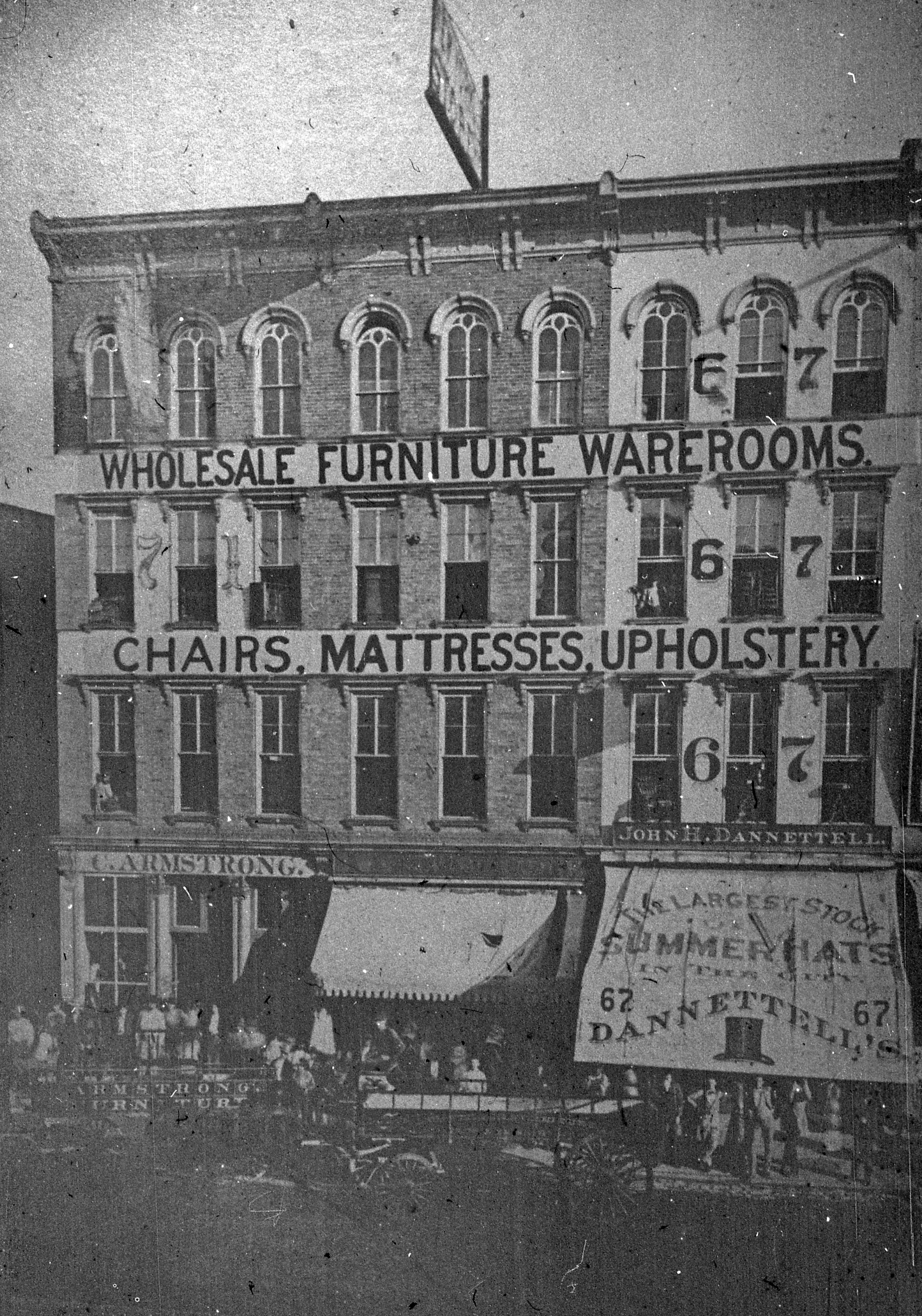
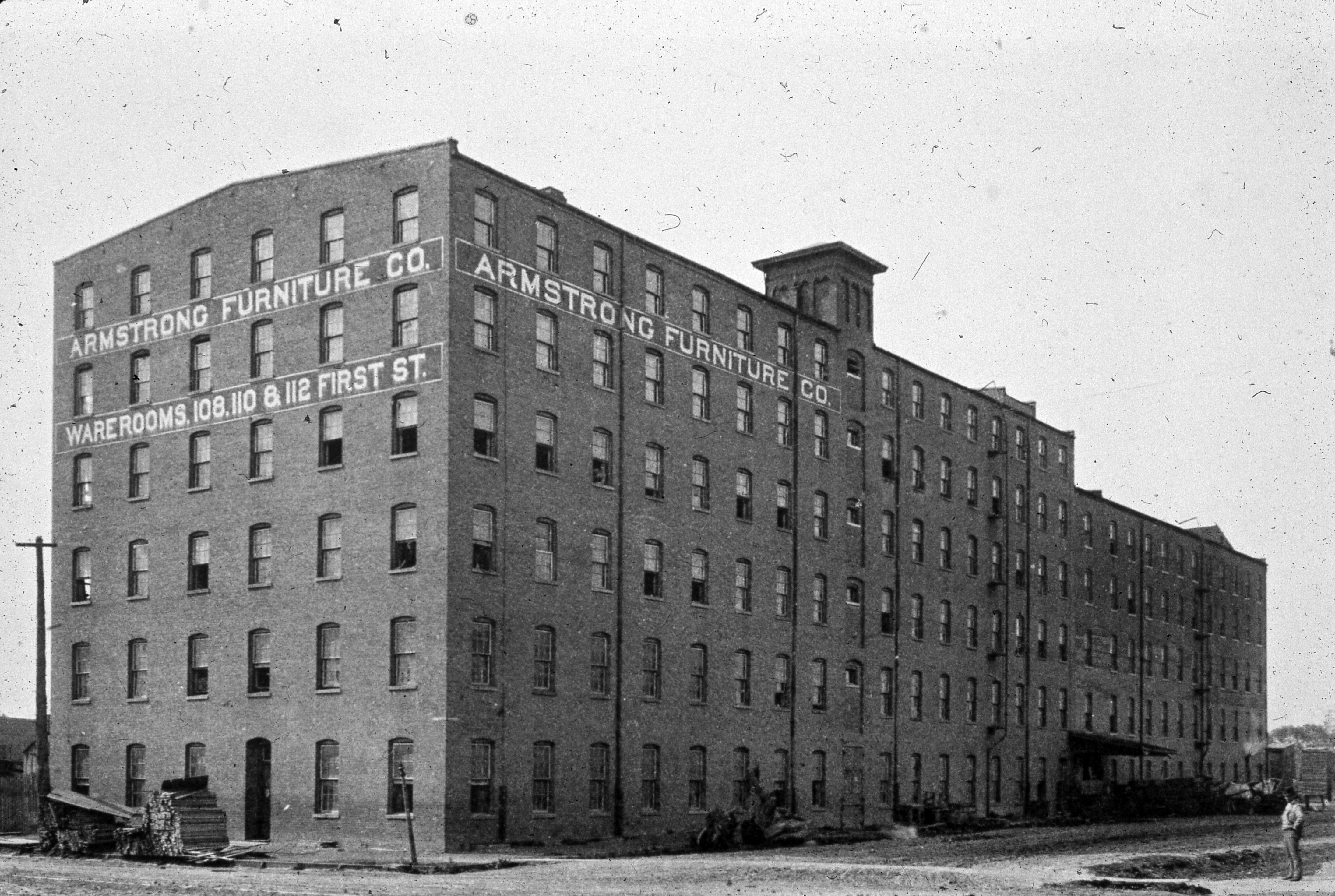

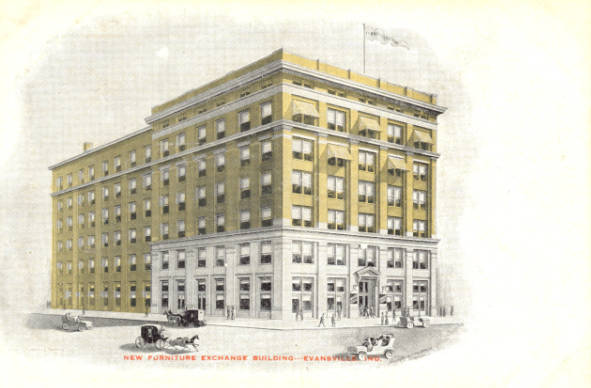
By the last decade of the 19th century, there were 9 large and probably many more smaller furniture factories in Evansville, providing employment for over 700. Amazingly, that growth continued until in 1909, the Furniture Building or Furniture Exchange Building was built at 123 NW 4th St. It offered 60,00 square feet of display space for 31 exhibitors. This building still stands today, now the Court Building.
Although this type of economic growth is beneficial to the local economy, not to mention the fortunes it made for the lumber-related business owners, it was not sustainable. “With the commencement of frontier settlement at the dawn of the
19th century, Indiana had over 20 million acres of forest covering about 87 percent of the land. The forest proved invaluable to providing for the pioneers’ need for home and barn building materials, fences, fuel for cooking and heating, barrels, tools, and machinery. Nonetheless, forests were also viewed as a threat, harboring Indians and dangerous wild beasts, and as a hindrance to progress. Forests needed to be cleared for crop fields and pastures, roads, businesses, and towns. Deforestation accelerated through the 19th century and into the early 20th century, clearing forests at an average rate of over 178,000 acres/year over a 100 year span. By 1900 only 8 percent, or 1.8 million acres, of Indiana remained covered by remnant forests. Those remnant forests were growing on land that was too steep or too wet to farm. Though not cleared, they were often grazed, burned, and almost certainly heavily logged.”v

Fortunately, with legislation and better forest management, Indiana’s forests, although not free from danger, are making a recovery. But that’s a topic for another venue! Meanwhile, I hope you enjoyed this glimpse of Evansville history.
Resources Consulted
Elliott, Joseph P. A history of Evansville and Vanderburgh County, Indiana; a complete and concise account from the earliest times to the present, embracing reminiscences of the pioneers and biographical sketches. Evansville, Ind., Keller Printing Co. [c1897; Evansville, Ind., Unigraphic, Inc., 1970] General Collection F532.V2 E4 1970
McCutchan, Kenneth P. et al. Evansville at the bend in the river: an illustrated history. Sun Valley, CA : American Historical Press, c2004. General Collection F534.E9 M38 2004
iCarman, p. 14
iiElliott, p. 370.
iiiMcCutchan, p. 41
ivMcCutchan, p. 41
vRathfon, p. 2-3

 amUSIngArtifacts

Leave a comment