Post written by Mona Meyer, Archives and Special Collections Metadata Librarian
Welcome to Archives Madness 2024, the friendly contest between area institutions vying for recognition for having the coolest artifact. We’ll start by introducing the institutions and their nominated artifacts, then proceed with several weeks of voting (which you will be able to do online) until all but the winner are eliminated. You may notice a similarity between this a certain athletic competition that takes place in March and culminates this year on April 8. That similarity is intentional!
And the winner is…
Congratulations to the
Championship Results
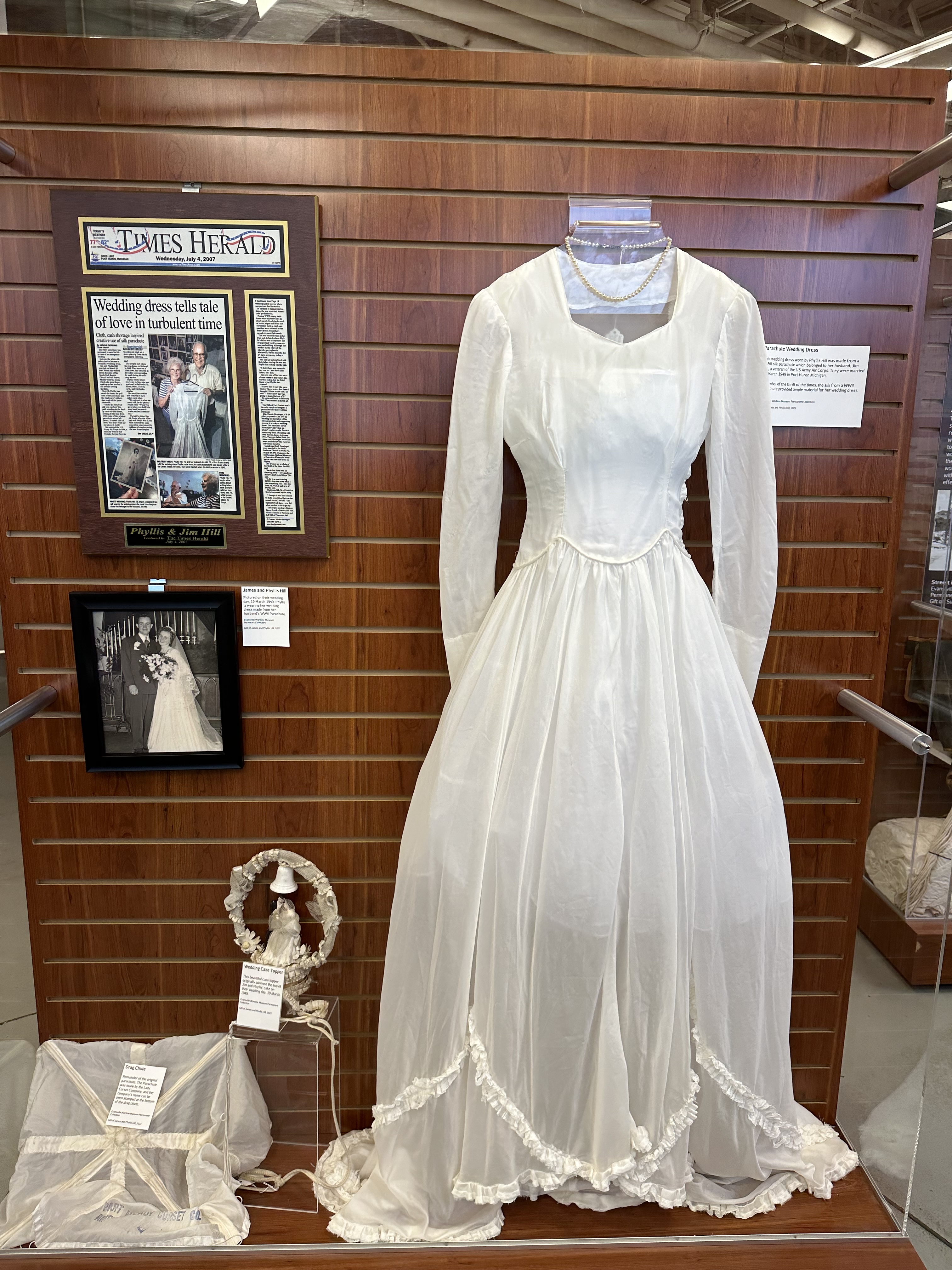
Parachute Dress (854) VS Archie Mascot (518)
Final 4 Results
Civil War Letter (94) VS Archie Mascot (384)
Tennessee Club Car (184 VS Parachute Dress (241)
Elite 8 Results
Civil War Letter (233) VS Passenger Pigeon (211)
Rising Sun Quilt (168) VS Archie Mascot (281)
Saint Dorothea (201) VS Tennessee Club Car (238)
Napoleon Letter (188) VS Parachute Dress (260)
Sweet 16 Results
Civil War Letter (378 votes) VS Willard Library Building (224 votes)
Passenger Pigeon (374 votes) VS Accordion (192 votes)
Rising Sun Quilt (355 votes) VS Crazy Quilt (218 votes)
Harmonist Cabinet (96 votes) VS Archie Mascot (476 votes)
Saint Dorothea (346 votes) VS 1919 Postcard (220 votes)
Napoleon Letter (340 votes) VS Army Biscuit (229 votes)
Chemise (195 votes) VS Parachute Dress (386 votes)
Evansville City Charter (155) VS Tennessee Club Car (448)
Now, let’s meet the competitors and their artifacts.
University Archives and Special Collections, Rice Library, 3rd floor/University of Southern Indiana
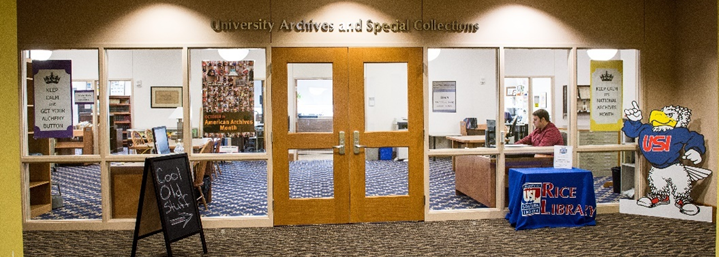
In the summer of 1972 the Lilly Endowment, Inc. of Indianapolis, Indiana awarded the then Indiana State University Evansville a three-year grant to establish an archival project for the acquisition, preservation and processing of regional material. At the end of the third year the University was to assume responsibility for continuing the growth of the Special Collections. It started with just a few regional history books on Indiana from the library’s own collection. Today, the University Archives and Special Collection has over 850 unique collections, 800 oral history interviews, 6,500 rare and unique books, and 30,000 digital resources.
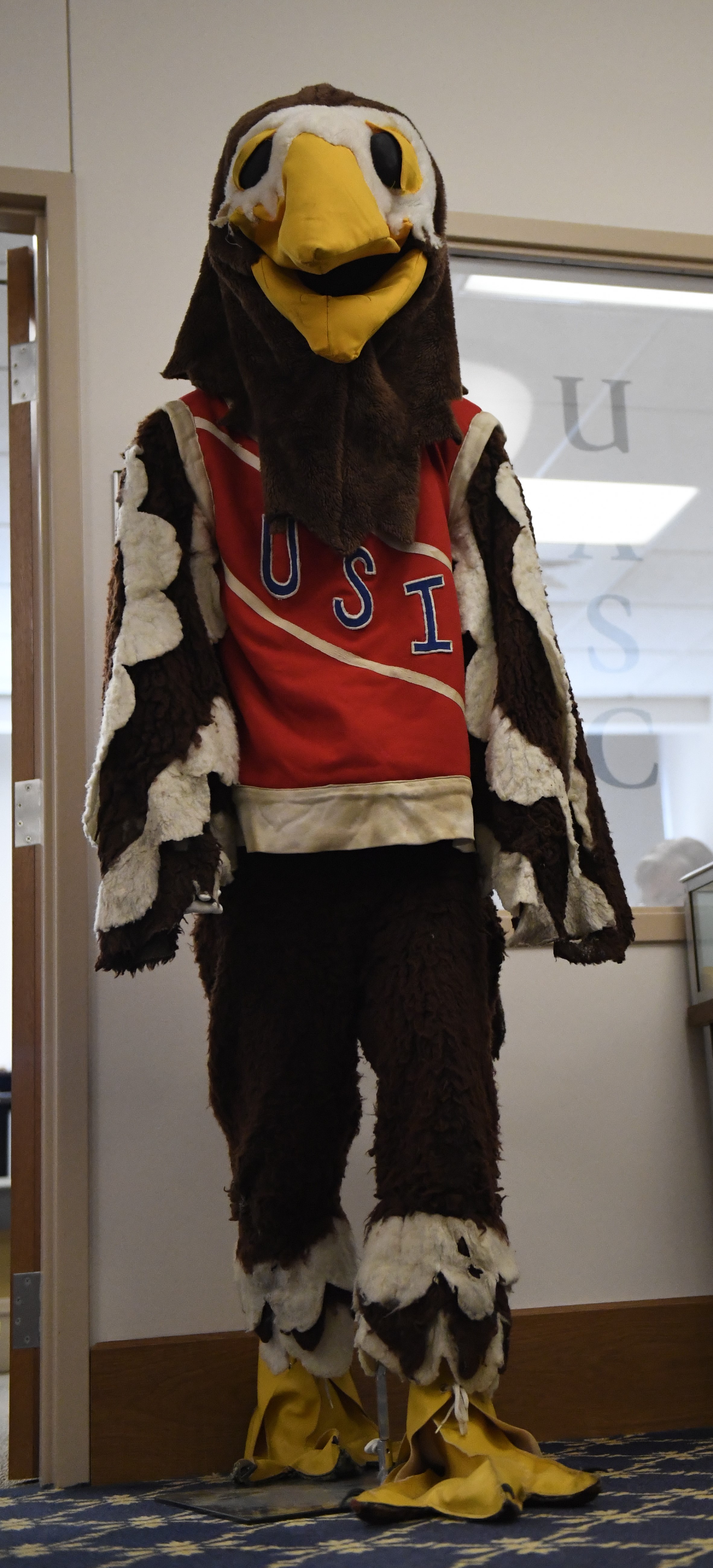
The first item is this circa 1970 original suit for USI’s mascot, Archibald the Screaming Eagle. The head is the second one used with this costume. The original head was made of papier mache. Fondly nicknamed “Creepy” Archie, this item greets everyone who comes into UASC.
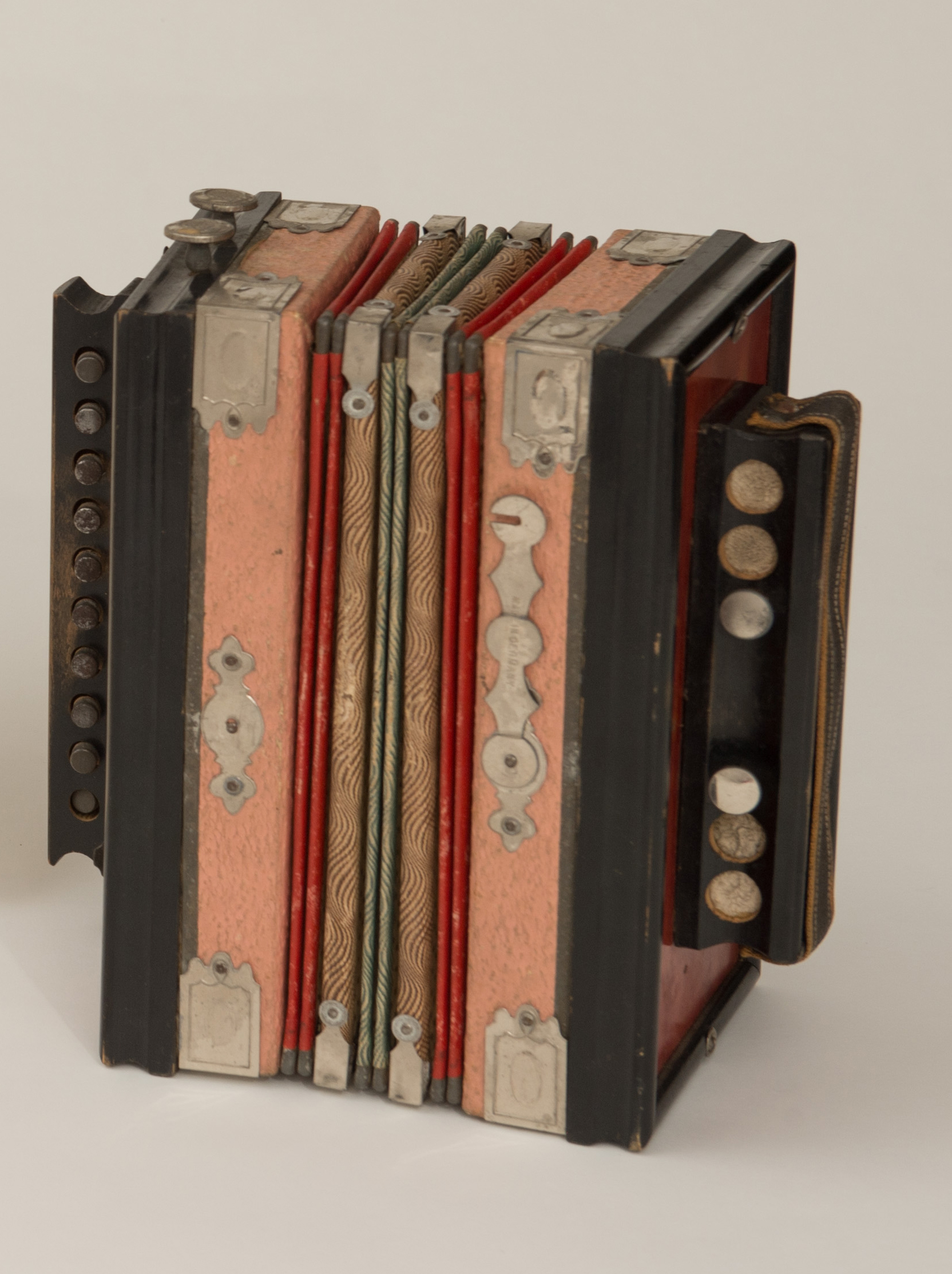
The second item is this accordion from the William J. Moutoux collection, MSS 280. Nothing is known about this particular accordion, but a quick search online found it to be similar to German instruments dated 1880-1890. It is the type of instrument that might have accompanied a family as they immigrated to this country. William Moutoux’s parents were both German immigrants, making this a possibility, made stronger by the fact that his collection contains quite a bit of sheet music, but nothing that can be proven conclusively.
Evansville Museum of Arts, History, and Science at 411 SE Riverside Dr.

Evansville has had a museum since 1906, with today’s location dating to the 1950s. This appearance dates to a major update/remodel circa 2014. “The Evansville Museum of Arts, History & Science houses a permanent collection of more than 30,000 objects, including fine and decorative art, as well as historic, anthropological, and natural history artifacts. Over twenty temporary, regional and international exhibitions are displayed each year in four galleries. The Koch Immersive Theater houses a 40-foot diameter domed screen with 360-degree digital projection featuring astronomy and science programming. Evansville Museum Transportation Center (EMTRAC) featuring transportation artifacts from the late 19th through the mid-20th centuries. On exhibit is a three-car train. The museum is home to a model train diorama of Evansville.”
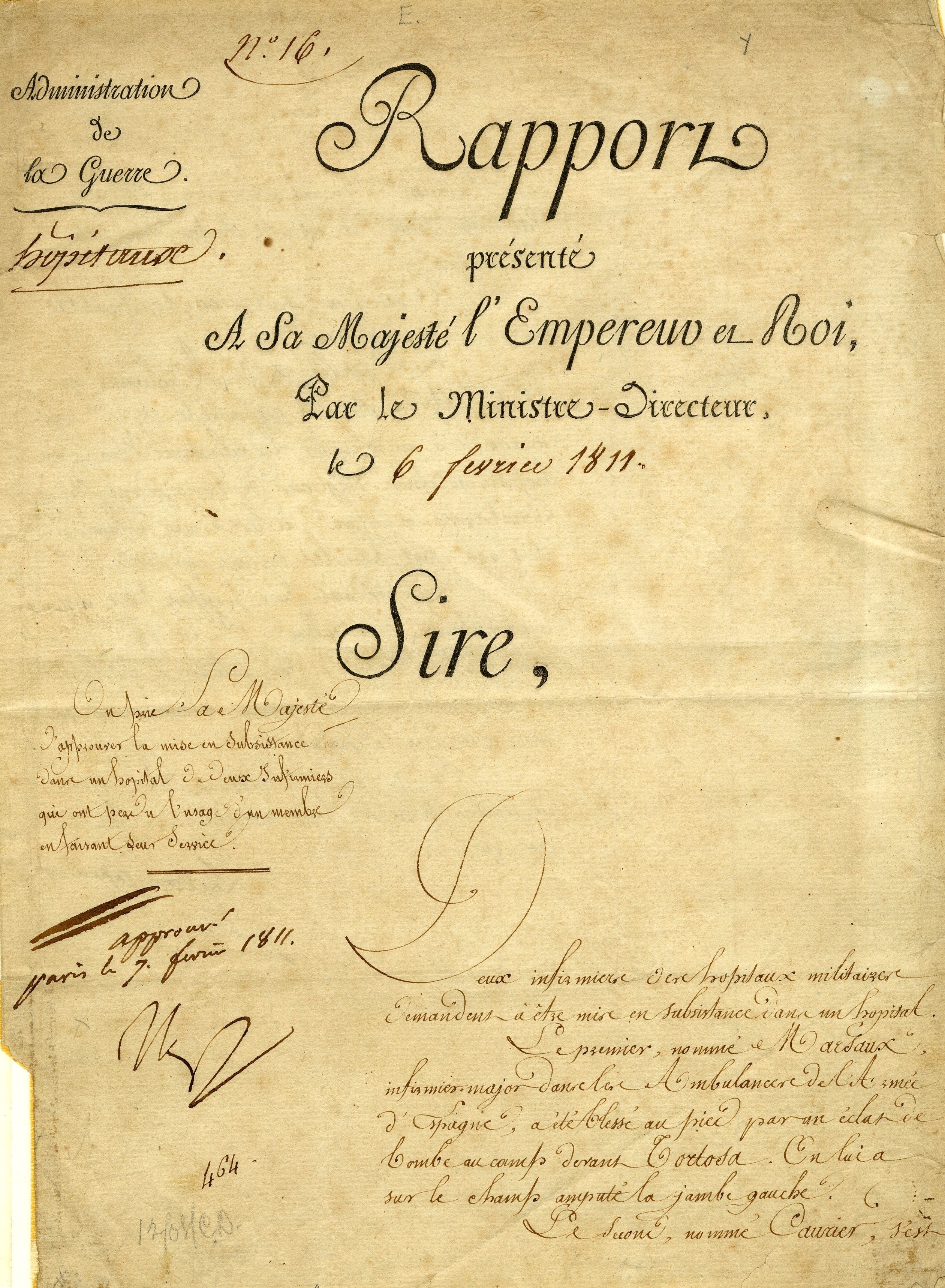
The first item from the Evansville Museum is a document signed by Napoleon Bonaparte. This is a request submitted to the Emperor Napoleon of France on February 6, 1811, requesting pensions for two military nurses. Napoleon approved these pensions by signing this document, at lower left, on February 7, 1811.
The second item is the Tennessee Club Car of the Louisville & Nashville Railroad, acquired by the Evansville Museum in 1966. Capable of seating 38 people, this car ran on the Cincinnati to New Orleans passenger train the Pan American. It also played a role in American politics. In 1952, it was part of a campaign train of General Dwight Eisenhower in his successful run for the presidency. In 1964, the press corps used this car when it was assigned to a train utilized by Lady Bird Johnson as she toured the South on behalf of her husband, President Lyndon Johnson

Newburgh Museum at 503 State St. in Newburgh, IN

The Newburgh Museum preserves exhibits and educates all visitors about the history and culture of Newburgh and the surrounding areas’ unique river town heritage.
The first item is a handwritten letter dating to the Civil War, written by a soldier in the field to his wife tending the family at home. The letter is very informative of the Battle of Memphis as well as very tender and touching in the author’s love and support of his wife’s domestic hardships.

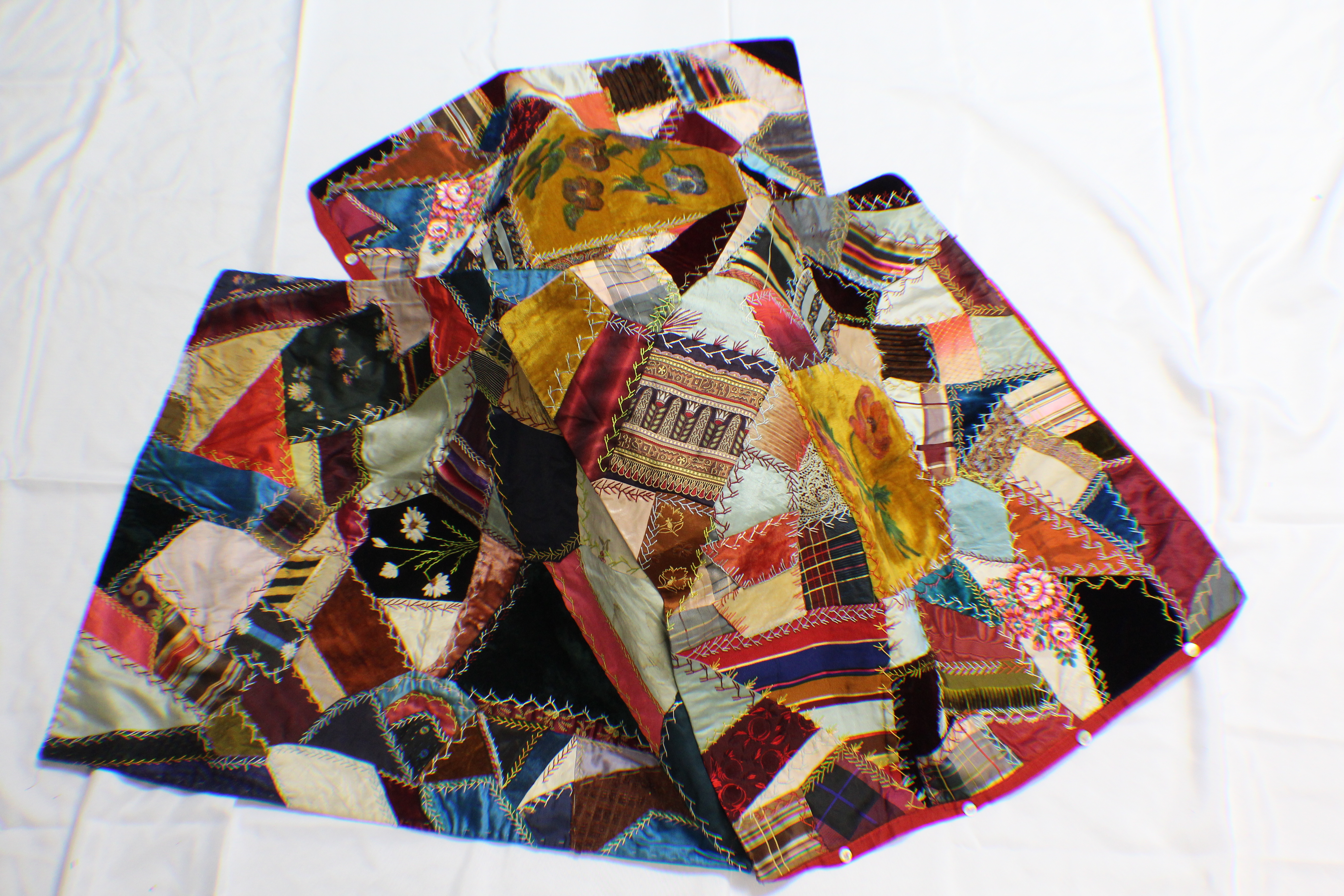
The second item is this colorful “Crazy Quilt,” made in 1893. It was made by Nannie Morrow and donated to the museum by her descendent, Mary Jean Barr. This pattern is indicative of the 19th century. Notice in particular the embroidered details, hand-painted fabrics, and overall richness of the textiles used.
Evansville Wartime Museum at 7503 Petersburg Road, Evansville, IN 47725

“Evansville Wartime Museum is the place to visit for the surprising, interesting and world-changing story of our community’s involvement in winning WWII. The stories we tell come from home front workers and battlefront warriors — these are the people who were there. You can also explore the history of Evansville during WWI, the Korean War, and the Vietnam War in our exhibits dedicated to those times.”
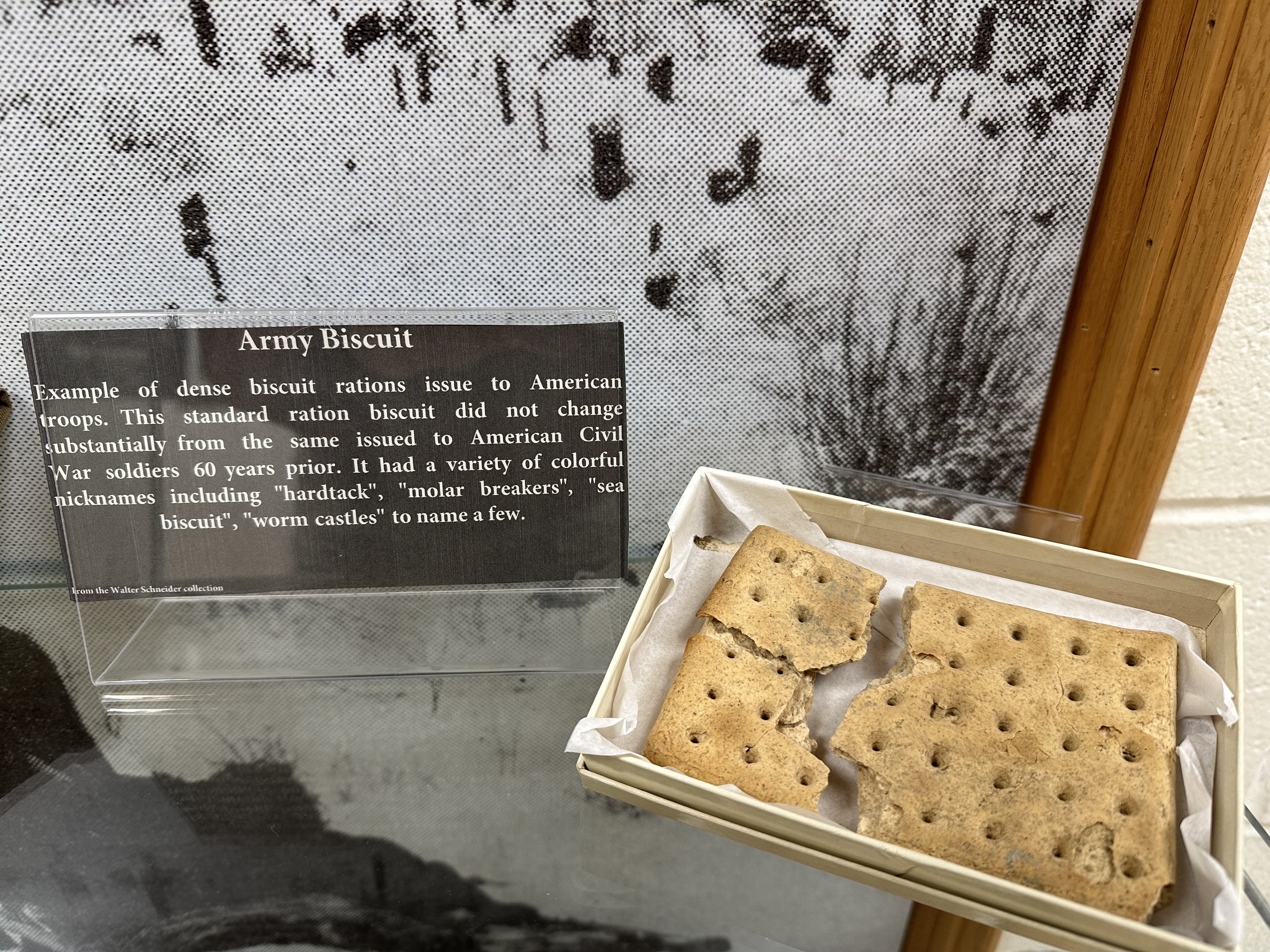
The first item is this piece of WWI hardtack (here called an Army biscuit), an integral part of soldiers’ diets because it was easy to make and non-perishable.
The second item is this silk wedding dress, made from the bride’s fiance’s WWII parachute. It was worn by Phyllis Hall when she married Jim Hall, a veteran of the US Army Air Corps on March 19, 1949 in Port Huron, Michigan. “Real” silk would have been expensive, but the thrifty bride had plenty of fabric from the parachute.
Owensboro Museum of Science and History at 122 East 2nd Street, Owensboro, KY 42303
The Owensboro Museum of Science & History, founded in 1966, is housed within a historic 19th/early 20th-century building in downtown Owensboro, Kentucky. The museum is a gathering spot, a learning center, and a family-friendly entertainment experience.
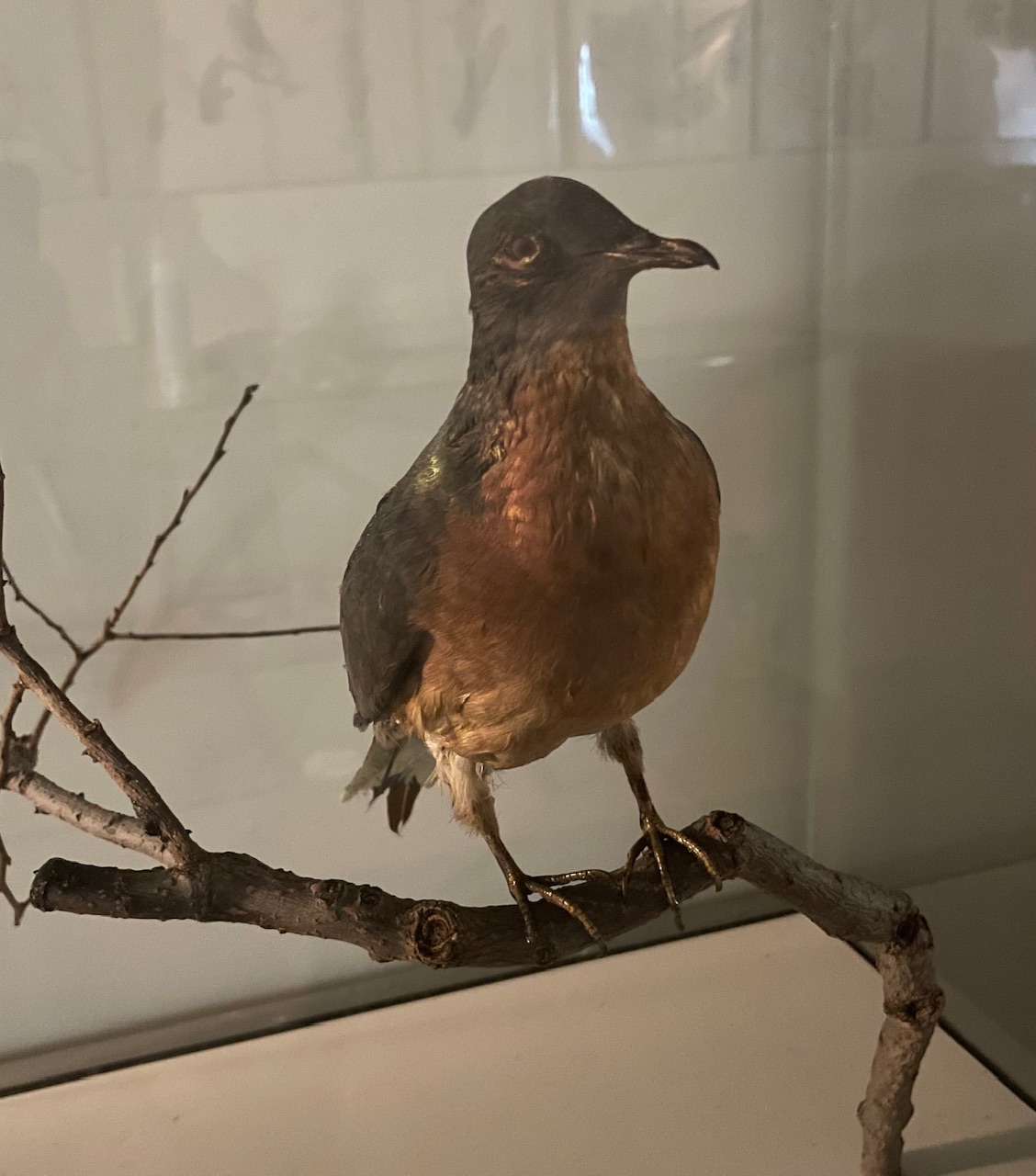
The first item is young male Passenger Pigeon, weighing approximately 10 ounces. A full-grown male could weigh up to 12 ounces. Although extinct, at one time the Passenger Pigeon represented 40% of all bird life in North America. In 1813, near Henderson KY, Audubon observed one flock, approximately 1 mile wide and 180 miles long, containing an estimated 1.2 billion birds. One nesting site in Michigan covered 850 square miles. For centuries, these birds were used for food by indigenous inhabitants, and later by early settlers of this area. By the 1830s their feathers were used for bedding, their fat for cooking and soap making, and their flesh for food for animals and people alike. In 1869, during one 40 day period, 120 carloads of salted pigeons (7.6 million birds) were shipped from a single nesting site in Michigan to New York. After 1870 their numbers began to decline rapidly, and by 1890, sightings were rare. Attempts were made to protect the birds as early as 1848, but the first law providing complete protection was not passed until 1897. The Passenger Pigeon needed large numbers for optimum breeding conditions and survival. The last one, named Martha, died September 1, 1914 at the Cincinnati Zoological Society.
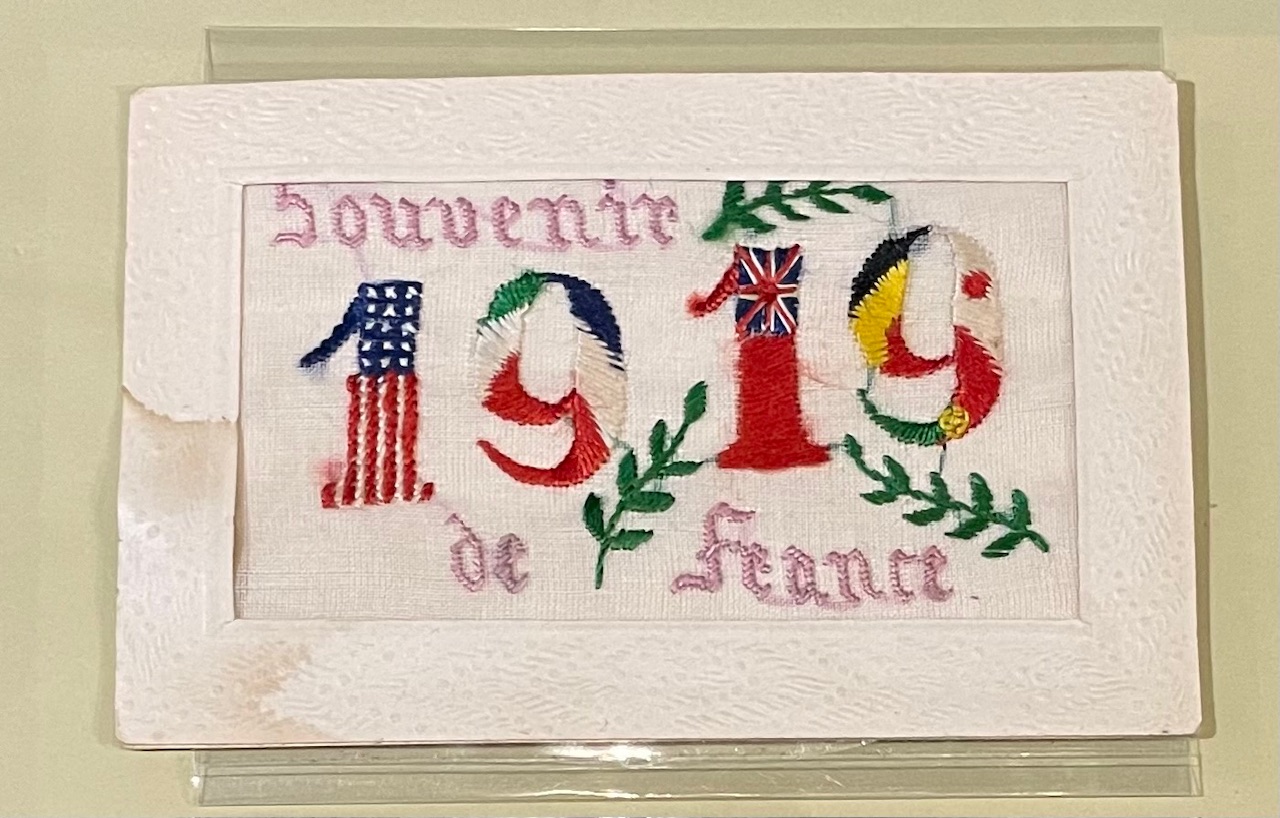
The second item is this embroidered silk postcard, dating to 1919. Postcards were a common souvenir from WWI. They were blank postcards glued on embossed paper that helped frame and hold the central piece of silk. On the silk, a design was hand-embroidered in colorful thread. Embroidered postcards were sold in thin paper envelopes and were usually mailed with letters. Designs, often patriotic or sentimental, featured flags, butterfly wings, bird plumage, rainbows
and a few words.
University Art Collection, University of Southern Indiana
The mission of the University of Southern Indiana Art Collection is to provide educational and aesthetic experiences for members of the University community and the surrounding region through the exhibition, research, and preservation of original works of art.
The first item is this painting entitled The Annunciation of Saint Dorothea, 14th century, by a member of the Sienna School, Egg tempera on panel, 18 1/2” h x 27 1/2” w x 3” d. St. Dorothea is the protector of young girls according to the inscription on the reverse of the painting. 1989.561.001

The second item is this quilt, entitled Rising Sun, 2003, pieced by Miriam Graber and Amos A. Graber, and hand quilted by Delores Kemp. This quilt was made in Montgomery, Indiana, in the Old Order Amish community. Medallion style quilt made from cotton and poly-cotton blend fabric and medium loft polyester batting. 92″ x 107″. 2013.025.001

Working Men’s Institute, 407 Tavern Street, New Harmony, IN 47631
Established by philanthropist William Maclure in 1838, the Working Men’s Institute (WMI) set as its mission the dissemination of useful knowledge to those who work with their hands. After 170 years of continuous service, this goal is still at the heart of our mission. Maclure, who was a business partner with Robert Owen in the communal experiment in New Harmony from 1825-1827, was devoted to the ideal of education for the common man as a means of positive change in society. At New Harmony, The Working Men’s Institute was one manifestation of this ideal. The Working Men’s Institute in New Harmony was the first of 144 WMIs in Indiana and 16 in Illinois. It is the only one remaining. Many WMIs were absorbed by township libraries or Carnegie libraries. Yet the one in New Harmony remained. Today, the WMI is a public library, a museum and an archive. In each of these areas, the WMI tries to stay true to the original mission of William Maclure.
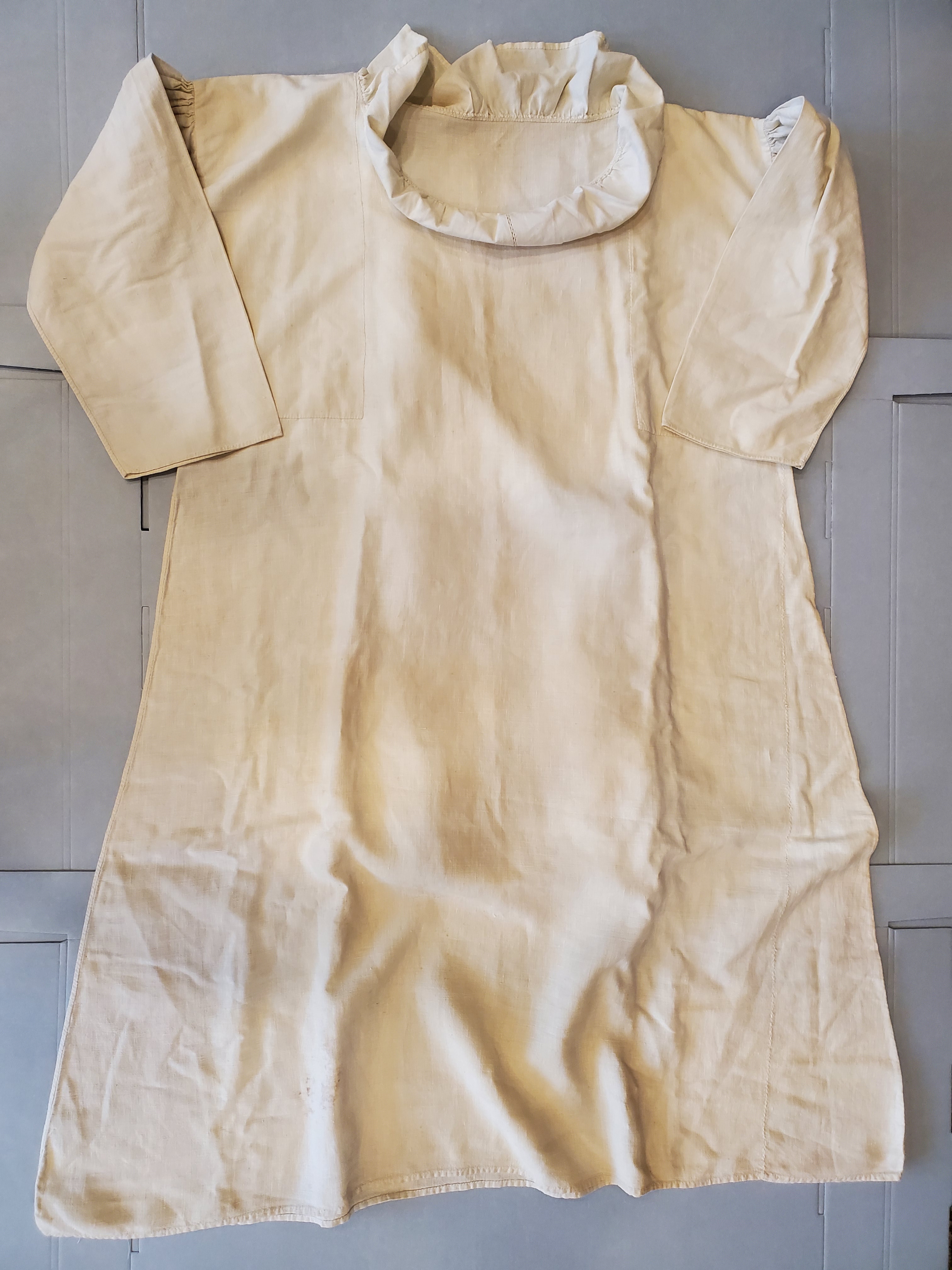
The first item is a Harmonist linen chemise dating from Harmonist days, 1814-1824.
The second is a miniature hutch cabinet made as part of a WPA (Works Progress Administration, a New Deal program) in 1938.

Willard Public Library at 21 N. First Ave.

Willard Carpenter was born in Vermont in 1803 and came to Evansville in 1837 to continue to pursue his fortune. Desirous of leaving a lasting legacy, in 1876 he expressed his intention “to establish and endow a public library, to be located in a public park, on land owned by me, situated in the city of Evansville. I am induced to do this in the well-grounded hope that such an institution may become useful toward the improvement of the moral and intellectual culture of the inhabitants of Evansville, and collaterally to those of the State of Indiana; and also toward the enlargement and diffusion of a taste for the fine arts.” The library opened in 1885, 2 years after Carpenter’s death.
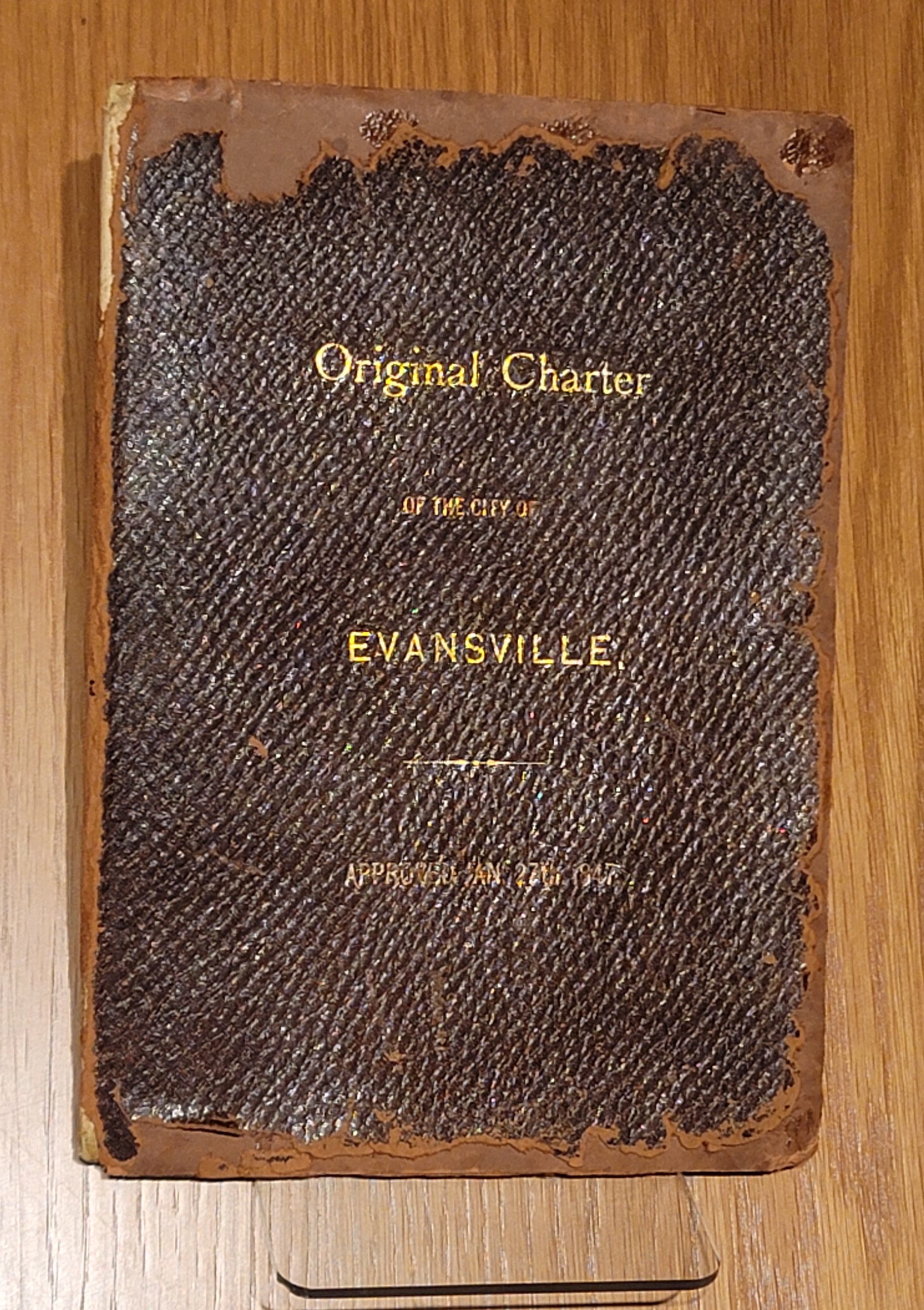
The first item, and last year’s winner, is this original charter of the city of Evansville. An act granting Evansville a city charter was approved by the state of Indiana on January 27, 1847. The Indiana Secretary of State issued this certified copy.
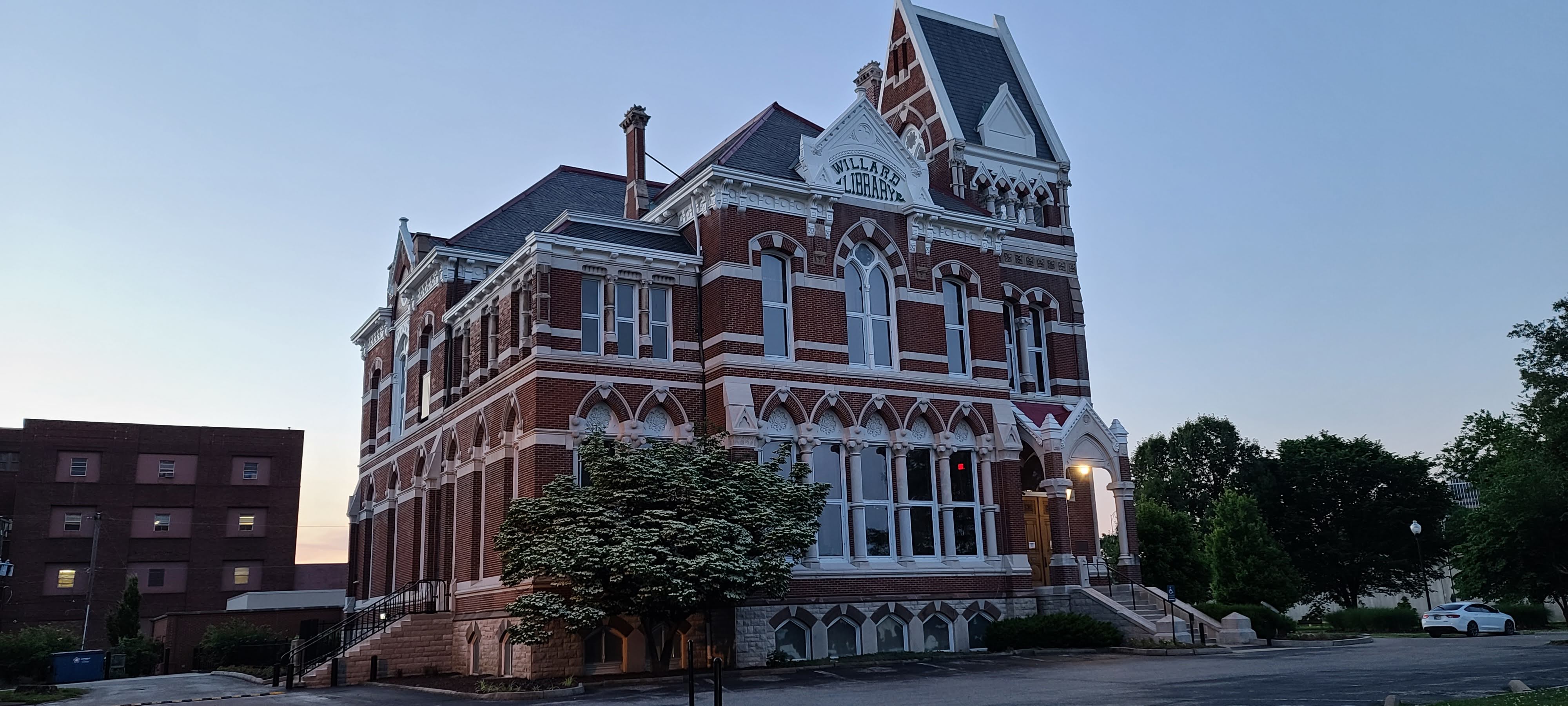
The second item is Willard Library itself. Willard Public Library opened in 1885 following nearly a decade of construction of its Victorian Gothic building, designed by the Reid Brothers. It was added to the National Register of Historic Places in 1972. It is the state of Indiana’s oldest public library building. More information can be found above, next to the library’s logo.
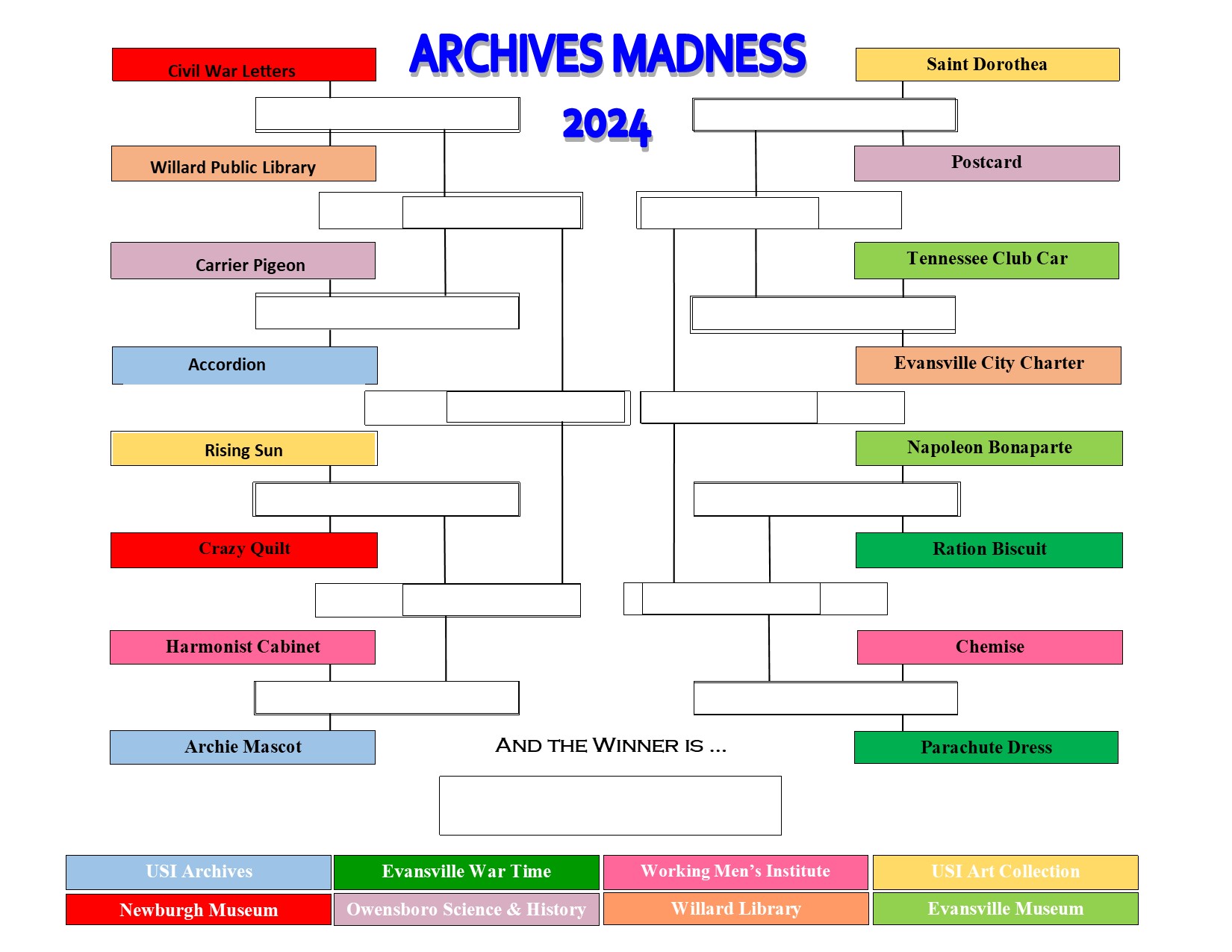
Now that you’ve met all the candidates, it’s time to consider your vote. Here’s the first round bracket.

 amUSIngArtifacts
Leave a comment