
Backyard Ballyhoo: Shining a Light on the Dark Side of the Circus
By Stella A. Ress, Associate Professor in the Department of History, Affiliated Faculty of Gender Studies

The canvas tent, the cotton candy, the clowns, the big cats! For many, the circus is a perennial and beloved spectacle that conjures images of daring feats, extraordinary talents, and a respite from the normal humdrum daily activities we all must do. For most then, “the circus” as a serious area of research and study, might sound as laughable as its clown performers. Yet, in actuality, the circus was a big part of U.S. history starting from the mid-19th century when it became the most popular form of entertainment in the nation (a title it enjoyed up until the mid-twentieth century when television took its crown).[1] And circus life and culture is not just a national story, it is an Indiana story! Indiana was home to one of the most diverse and rich circus cultures in the country. From the 1880s to the 1940s, the Hagenbeck-Wallace Circus, based in Peru, Indiana, was, after the Ringling Brothers Barnum and Bailey Circus, the largest circus in the country. But, it was only one of a half-dozen of the nation’s premier shows that set up winter quarters in Peru, Indiana.[2] And Peru didn’t have the corner on the circus market. In fact, during that same period (roughly 1880-1940) over 25 Indiana communities, including the southern Indiana city of French Lick, were home to over 60 different circuses!
In 2022, after diligent work behind the scenes and with generous funding from private donors through the USI Foundation, David Bower, USI’s Vice President for Development and Alumni Engagement and President of the USI Foundation, successfully acquired the renowned Tom Dunwoody Circus Collection for the University of Southern Indiana. Today, the University Archives and Special Collections proudly houses one of the 20th century’s most remarkable circus collections, offering invaluable insights into the captivating world of circus history and culture. The Dunwoody Circus Collection is comprised of 144 document boxes, 900 books, dioramas, toys, and other circus memorabilia from the Hagenbeck-Wallace Circus and several other smaller Indiana-based circuses.

Circus history is important beyond its popularity, however. Examining the experiences and activities of the talent, the crew, the sites, the acts, and the audience, helps us understand the society in which the circus became a favorite national pastime. Studying the circus also aids in uncovering the voices of those often ignored…those on the margins of society (e.g., women, children, laborers, those with disabilities, the poor, people of color, rural Americans, etc.). As such, it can help us teach about those folks and their past as well.
It was with that in mind that I created a project in my Fall 2023 HIST 246 class, US History in a Global Context. For this assignment, students were tasked to act like historians. In other words, they had to produce original scholarship for the local community. Specifically, they had to use objects and/or photographs from the Dunwoody Circus Collection to write 700-word essays examining how a marginalized group of their choice was presented in the circus at a specific point in time. They were also asked to determine what those depictions and experiences could tell us about America and its culture at that time. Though all students had to write the essay, not all student essays were selected for publication. Through the next few weeks, amUSIngartifacts will publish these student essays.


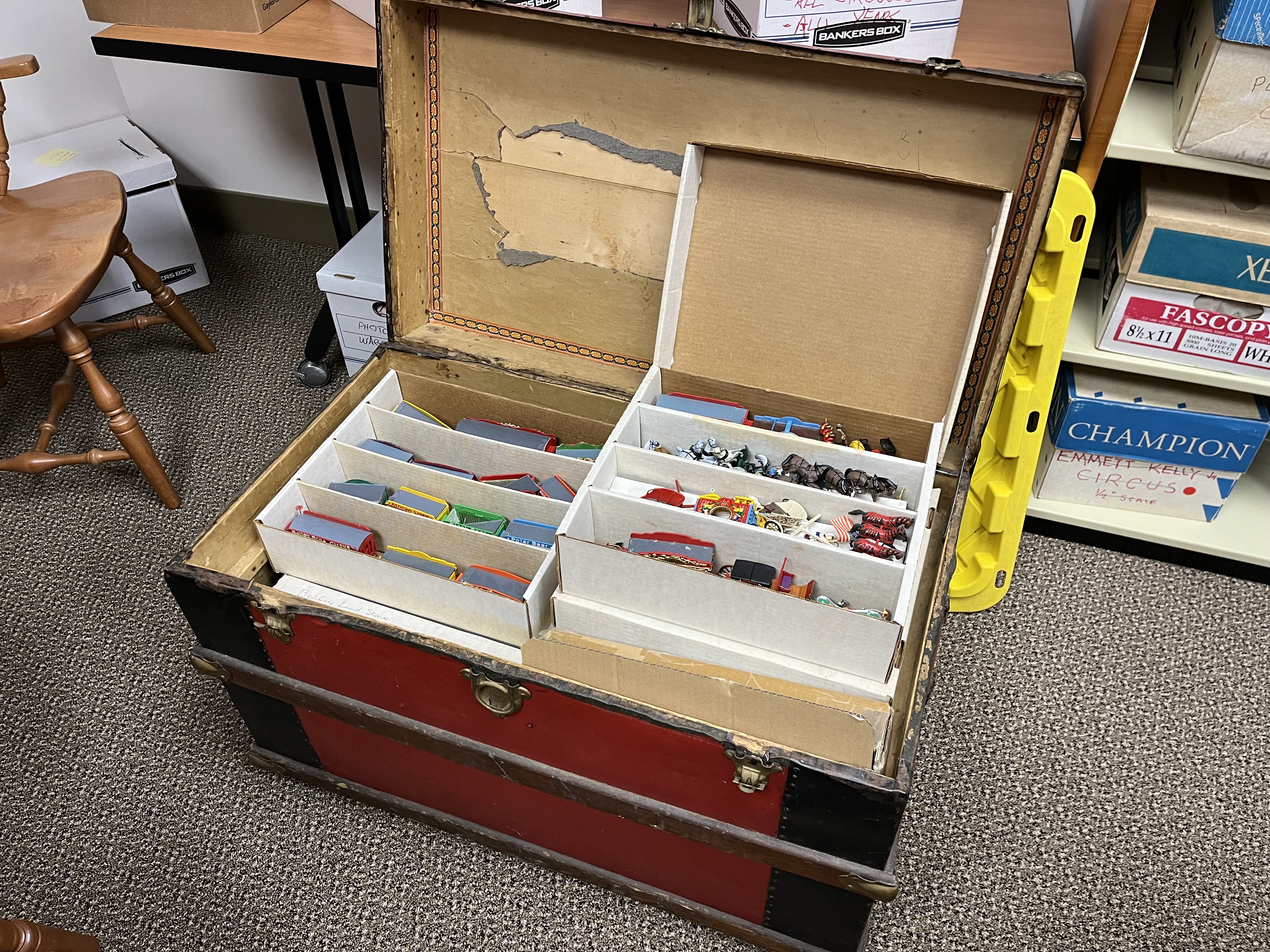

The essays themselves showcase the various items in the collection, but also the ways the Dunwoody Collection could be used for research (and since they were originally produced for a classroom, how the Collection could be used for teaching as well). Taken together, these six essays demonstrate the thin line (often crossed!) between entertainment and exploitation. The first three essays by Tiffany Sandoval, Alex Reynolds, and Noah Albin, highlight how the circus used and abused people for amusement, specifically women, those with dwarfism, and Native Americans, respectively. The next three essays by Gloria Hinterscher, Emma Boyd, and Ahmad Abushammalh confirm how the exploitation and abuse extended to all performers, even the non-human ones as they expose the conditions and experiences of animals in general, and more specifically elephants and giraffes.
In circus slang the “backyard” is the area that is off-limits to the public, whereas “ballyhoo” refers to the figure-eight spotlight that swept over the spectators in the tent.[3] Thus, these essays, collectively referred to as “The Backyard Ballyhoo,” reveal the true cost of the turn-of-the-century circus: sure it was fun, but by and large, not by those who conjured it for the rest of us.
[1] Dominique Jando, “Short History of the Circus,” Circopedia: The Free Encyclopedia of the International Circus, 14 October 2023, http://www.circopedia.org/index.php?title=SHORT_HISTORY_OF_THE_CIRCUS&oldid=40359
[2] Kreig A. Adkins, Peru: Circus Capital of the World (Charleston, SC: Arcadia Publishing, 2009), 27.
[3] Wayne Keyser, “American Circus Lingo,” Goodmagic, 2008 (last accessed 3 April 2024), https://www.goodmagic.com/carny/c_a.htm.

 amUSIngArtifacts
Leave a comment