
Introduction to History 246 Circus Project
A Vicious Cycle: The Treatment of Animals in the Circus
By Gloria Hinterscher
A rainbow of colors fill your vision. The scent of popcorn floods your nose. You sit in anticipation as the ring master enters the stage. The bright lights shine down as the show begins. Lions are tamed, acrobats contort their bodies in seemingly impossible ways, and trapeze artists swing from dozens of feet off the ground. By the time the show ends, you are in awe at the superhuman feats you just witnessed. The circus was once one of the largest forms of entertainment in the United States. In her history of the circus Janet M. Davis noted that a “large railroad circus shut a town down,” resulting in shops closing their doors, schools being out for the day, and even factories stopping their production.[1] Nowadays, however, circuses are visited much less frequently. The idea that a circus could pause a city for a day seems perhaps more impossible than the acrobatic feats themselves. How did the circus win over so many Americans? Why did tens of thousands flock to the grounds just to see it being set up? One reason the circus was so popular was because it made a spectacle out of animals.
Although the circus animals were entertaining to watch, a vast majority of them were abused and mistreated. They were kidnapped, whipped, kept in small cages, and mistreated for years on end. One example of this is the elephant Jumbo. Jumbo was brought from his home to the London Zoo in 1865 and was later bought by P.T. Barnum, owner of the Barnum and Bailey Circus, for the modern equivalent of $10,000. Susan Nance in the book The American Circus writes that in order to control the elephants, circus workers “chained elephants at the ankle to stakes and anchors in the ground or on the floor of the railroad car, box van, or stock trailer at all times when not performing in the ring or being worked by trainers.”[2] Being chained up and locked away in a small box would make any human anxious, let alone an animal that does not understand what is going on. The animals brought to work in the circus were confused and scared, as any living being would be in that situation. This anxiety and confusion caused many of the circus animals to become dangerous. A.H. Saxon in his novel P.T. Barnum: The Legend and the Man describes Jumbo as “violent,” saying that Jumbo “had driven his tusks through iron plates and nearly demolished the reinforced house set aside for him.”[3] Jumbo was not the only animal that became violent as a result of the circus. Linda Simon in her book The Greatest Shows on Earth says that “enraged animals” were a “circus staple” because of the danger and drama of it all.[4] One such circus company went a little too far with their antagonization, resulting in a lion attack during a performance. The February 19, 1967 edition of the Chicago Tribune (See Figures 1 and 2) depicted the story of a father-son lion-taming duo that was mauled by a tiger in front of hundreds of audience members. Jon Zerbini, the son, was “prodding 10 lions from small wheeled cages into a large caged ring” when one of the lions, Prinz, attacked. The two Zerbinis were taken to a hospital where they both recovered.[5]
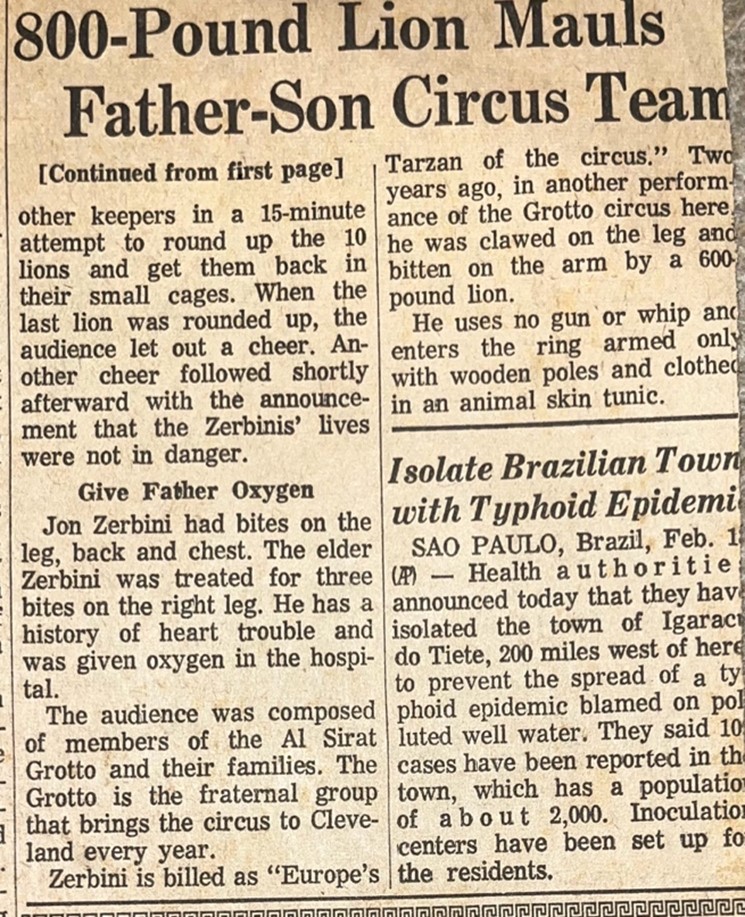
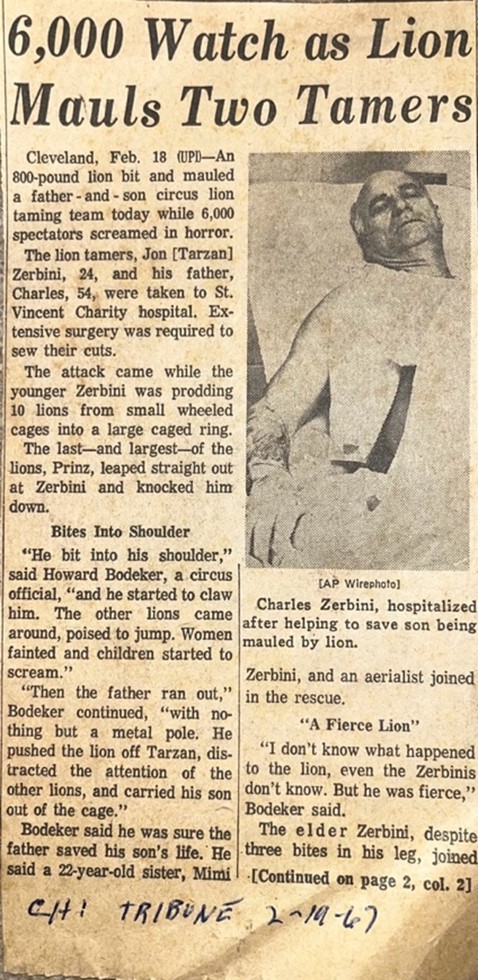
Despite the aggression of these animals, they were still beloved by circus-goers nationwide. Jumbo the elephant was beloved by the country and “was portrayed as a model of manly kindness who – despite his power and potential fury—allowed children to ride him.”[6] This elephant represented a sort of masculine, primal kindness that people would come from all around to see. Unfortunately, Jumbo was struck by a train and killed in 1885. His death was sensationalized as newspapers began to say that he died trying to save a fellow dwarf elephant, Tom Thumb (not to be mistaken for the little person Tom Thumb) and his keeper Mather Scott.[7] Even in death, Jumbo was forced to be a spectacle to bring in money to the circus.
The circus even killed animals that were across the world, not even a part of the show. On hunting expeditions, adult African elephants would be murdered in order for their babies to be captured and taken to work in the circus.[8] However sad, it is important to remember those animals impacted by the circus and to honor and respect them in the way they never were when they were alive. These living beings went through being encaged, starved, and abused for years on end, and it is vital that this information is remembered. Remembering history is how mistakes are prevented and how the world grows. Although most circuses do not use animals anymore, it is vital that the gruesome reality of the early circus is not forgotten.
Footnotes
[1] Janet M. Davis The Circus Age: Culture and Society Under the American Big Top (Chapel Hill: University of North Carolina Press, 2006), 1-2.
[2] Susan Nance, “Elephants and the American Circus” The American Circus (New Haven: Yale University Press, (2012), 234.
[3] A.H. Saxon, “Children’s Friend and Jumbo” Pt. Barnum: The Legend and the Man (New York: Columbia University Press, 1989), 291-292.
[4] Linda Simon “Beasts.” The Greatest Shows on Earth (London: Reakton Books Ltd., 2014), 159.
[5] “800-Pound Lion Mauls Father-Son Circus Team,” The Chicago Tribune (Chicago, IL), Feb. 19, 1967.
[6] Davis The Circus Age, 155-166.
[7] Davis The Circus Age, 155-156.
[8] Nance, “Elephants and the American Circus” 239.
Bibliography
Davis, Janet M. The Circus Age: Culture and Society Under the American Big Top. Chapel Hill: University of North Carolina Press, 2006.
Nance, Susan. “Elephants and the American Circus.” The American Circus, 233-250. New Haven, CO: Yale University Press, 2012.
Simon, Linda. “Beasts.” The Greatest Shows on Earth, 151-178. London: Reakton Books Ltd, 2014.
Saxon, A.H. “Children’s Friend and Jumbo.” P.T. Barnum: The Legend and the Man, 274-302. New York: Columbia University Press, 1989.


 amUSIngArtifacts
Leave a comment