
Introduction to History 246 Circus Project
Taller Than Bars: The Image of the Carson and Barnes 1994 Circus Giraffe By Ahmad Abushammalh
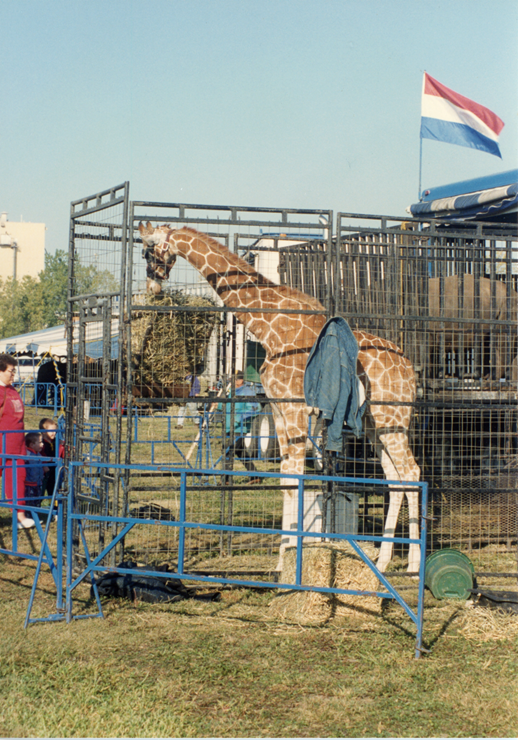
In the vast landscape of the American circus tradition, among the many exotic creatures that have graced the sawdust-covered rings stands tall the giraffe. Picture this: a sunny day in 1994, beneath an expansive sky, a giraffe, with its neck gracefully arched towards the heavens, stands behind a fence in what seems to be an outdoor enclosure. Its elegant frame is captured mid-motion, as it delicately consumes hay from a feeder attached to the fence. This arresting image invites us to explore a moment frozen in time – a moment that encapsulates the complex history of giraffes in American circuses.
Giraffes, listed as vulnerable for The IUCN Red List of Threatened Species in 2016, represent an intriguing facet of the animal kingdom characterized by their towering stature, unique spotted coat patterns, and elongated necks. These herbivorous mammals, native to the African continent, belong to the family Giraffidae. Renowned for being the tallest terrestrial animals, giraffes have evolved distinctive physiological adaptations, such as their prehensile tongues and specialized cardiovascular systems, to navigate their arboreal habitats and consume leaves from the upper canopy of acacia trees. Socially, giraffes often exhibit a gregarious nature, forming loose, dynamic herds characterized by fluid group compositions.
Embarking on a journey to fathom the historical tapestry of the giraffe, one finds an intriguing entry point in exploring the etymology of the term ‘giraffe’ itself. The contemporary English term harkens back to around 1600 and traces its linguistic roots to the French word ‘girafe,’ originating in the 13th century. Interestingly, the French term and its Italian counterpart finds its Romanized expression in the Arabic ‘زرافة’ (pronounced ‘zarāfah’), the word for the animal, introducing a captivating intersection of cultures.
This Romanized term replaced the earlier English designation ‘camelopard,’ a now archaic expression denoting the same enigmatic creature. The archaic vocabulary is intricately linked to the Latin ‘camelopardalis,’ derived from the Greek ‘kamēlos,’ meaning “camel,” and ‘pardalis,’ meaning “leopard.” This etymological connection is further underscored by the creature’s binomial name, “Giraffa camelopardalis,” coined by Linnaeus in 1758.
Delving into the annals of celestial navigation, the Latin term ‘camelopardalis’ transcends its terrestrial connotations to become associated with a sizable and faint constellation in the northern sky. This stellar association, introduced by Petrus Plancius in 1613 (Knowledge Encyclopedia Space!), paints a celestial portrait that echoes the terrestrial elegance of the giraffe, reflecting the Western admiration of the creature.
European Waves of Giraffe Craze:
The European fascination with giraffes unfolds across distinct eras, each marked by unique narratives and cultural significance. In 46 BC, Julius Caesar imported the first giraffe from Cleopatra’s Egypt, parading it in his triumphal procession. This marked the genesis of the giraffe’s presence in Europe. Giraffes became a spectacle for the Roman audiences, with hundreds imported for Circus Games, subjected to mauling by lions. (McCouat)
Following the fall of the Roman Empire, giraffes faded from European consciousness for almost a millennium, resurfacing in Sicilian menageries during the 13th century and in English literature by the 14th century. The 15th century witnessed a spectacular resurgence when a 16-foot-tall giraffe was brought to Florence in 1487. This giraffe, a crucial diplomatic pawn in negotiations between the Egyptian Sultan Qaitbay and Florence’s leader Lorenzo de’ Medici, stirred cultural ripples, inspiring art and even shaping urban nomenclature with the Contrada della Giraffa in Siena. (McCouat)
A grand revival of giraffe fascination occurred in the 19th century. In 1826, a giraffe, a diplomatic gift from Egypt, traversed France to meet the King, capturing the imagination of the public. This giraffe, the first seen in Europe in over 300 years, embarked on an epic journey, becoming a symbol of political intrigue and cultural exchange. The giraffe, referred to as Zarafa, became a sensation in Paris, captivating hearts and minds, even influencing fashion trends and popular culture. Eventually, as the fervor waned, the giraffe’s popularity dwindled, making way for the next wave of marvels in an era marked by constant novelty. Despite this decline, the giraffe, once a national icon, left an indelible mark on European cultural history, celebrated in various forms, from songs and poems to fashion trends and confectionery. And even after her death in 1845, Zarafa is still standing tall with its stuffed body in a museum exhibit in the Jardin des Plantes. (McCouat)

The surges of ‘Giraffemania’ swept over European shores, as ships attempted multiple captures of the elusive creature, often met with failure. These waves carried the captivating animals across the Atlantic to the New World. In the early 19th century, the United States witnessed its inaugural encounter with giraffes, signifying a pivotal moment in the nation’s allure for exotic fauna. Jonas Bartlett, initially affiliated with the Zoological Institute, later delved into the realm of show-business. Teaming up with circus proprietor Rufus Welch in June 1839, Jonas initiated a venture that would unveil giraffes to American audiences. Alongside John Clayton, who had procured giraffes during South African expeditions, they established the Grand National Arena Company and the New York Circus & Arena Company. Clayton’s daunting giraffe-hunting endeavors, featuring lassos and horseback chases, successfully captured eleven giraffes, two of which endured the arduous journey to New York in June 1838. The giraffes debuted on American soil, touring with Clayton in 1838–1839 before joining circuses co-owned by Jonas and Welch. This marked the genesis of the New York Circus and Giraffe Exhibition United around December 1839, captivating audiences nationwide. The giraffes’ arrival piqued public interest, garnering attention in publications like The Youth’s Companion, where their grace and harmlessness were emphasized, transforming the spectacle into a phenomenon that surpassed mere entertainment, eliciting awe and curiosity. (Bartlett)
Up until the early 20th century, the chance to witness giraffes outside traveling shows was a rarity, as these majestic creatures were scarce in America’s early zoos, often due to the challenges of capture and transportation, making them financially demanding acquisitions. Central Park and Philadelphia welcomed their first giraffes in 1872 and 1874, and the first captive-born giraffe was in Cincinnati in 1889. By 1925, the entire country reportedly housed only five giraffes, as many zoos hesitated due to risks or financial constraints. However, the San Diego Zoo, built on a spirit of daring, took a different approach. With the visionary director Belle Benchley, the first female zoo director in the world, and adept fundraiser Dr. Harry Wegeforth at the helm, the zoo secured funds to bring two young Ugandan giraffes and a rhinoceros from Africa in 1938. These giraffes marked the zoo’s first, and with anticipation high in the city, they embarked on a 52-day, 3,200-mile journey aboard the S.S. Robin Goodfellow. The final leg of their trip, however, intersected with the devastating Hurricane of 1938, adding a perilous twist to their already challenging voyage. The storm claimed the rhino and damaged the giraffes’ crates, subjecting them to a tumultuous sea journey. Amidst the chaos, the female giraffe, thought dead, miraculously survived, enduring days of being fed pancakes until she regained the strength to stand. Despite her severe ankle injury, the giraffes, met by the San Diego Zoo’s team in Brooklyn, continued their journey to San Diego, overcoming adversities that forged a unique chapter in their extraordinary tale. (K.)

Life Through Her Eyes:
To gain insight into the existence of the captivating giraffe featured in the initial photograph, along with other giraffes and their fellow animals in American circuses of that era, it is essential to comprehend the living conditions they endured and keep enduring.
According to many animal rights organizations, Carson & Barnes Circus faced a series of alarming citations from the USDA, shedding light on aspects of their treatment of animals, particularly giraffes. The records reveal instances of inadequate veterinary care, safety lapses in maintaining barriers between the public and large animals, and neglect in the maintenance of transport trailers and animal enclosures. Shockingly, reports indicated animal handlers resorting to abusive measures, such as kicking and cursing, highlighting the distressing conditions under which the animals were kept. Disturbing incidents, like a pygmy hippopotamus being struck with a bullhook, documented in a video many activists share on the circus’s Facebook page comments continuously, and a giraffe repeatedly jumping within its cage, further underscored the apparent disregard for their well-being. The USDA citations extended to failures in providing necessary veterinary care, shelter, and proper maintenance, exposing a troubling pattern of negligence and disregard for animal welfare at Carson & Barnes Circus. At least two giraffes lost their lives in Carson & Barners captivity. (PETA, Carson and Barnes Factsheet)
One may ponder: Did that charming giraffe endure mistreatment and cruelty? The response could lie in this close-up image of the same giraffe confined behind its cage, with her eyes reflecting a sense of sorrow. A serene being, dwindling in numbers, abducted, subjected to torment, and confined, all for the sole crime of being beautiful.
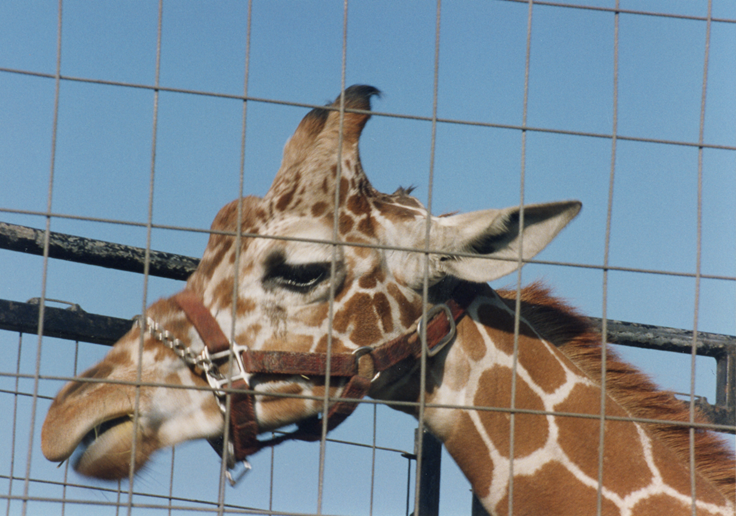
So far, animal use in traveling exhibitions is only restricted or banned in eight states. A dedicated group of activists and animal rights advocates continues to strive for a shift in this status quo, advocating for compassion and speaking up on behalf of these creatures. (“Prohibiting Circuses and Traveling Acts That Use Animals”)
Works Cited
Allin, Michael. Zarafa: A Giraffe’s True Story, from Deep in Africa to the Heart of Paris. New York, Dell, 1998.
“American & Commercial Daily Advertiser.” Google Books, American & Commercial Daily Advertiser, 28 Aug. 1839, books.google.com/books?id=umFBAAAAIBAJ&lpg=PA3&dq=giraffe%20circus%20america&pg=PA3#v=onepage&q=giraffe%20circus%20america&f=false. Accessed 5 Nov. 2023.
Carson & Barnes Circus Factsheet. The Humane Society of the United States, 2 June 2022.
Fennessy, Julian, et al. “IUCN Red List of Threatened Species: Giraffa Camelopardalis.” IUCN Red List of Threatened Species, Name, 9 July 2016, http://www.iucnredlist.org/species/9194/136266699. Accessed 15 Dec. 2023.
“Jonas Bartlett, Giraffes and Other Mammals – Doug Sinclair’s Archives.” Dougsinclairsarchives.com, 2022, dougsinclairsarchives.com/bartlett/jonasbartlett2p4.htm. Accessed 11 Nov. 2023.
K, Karie. “West with Giraffes.” Zoo Walks through History, 11 Feb. 2021, zoohistories.com/2021/02/11/west-with-giraffes/#:~:text=The%20first%20giraffes%20could%20be,didn’t%20have%20the%20funds. Accessed 25 Nov. 2023.
McCouat, Philip. “The Art of Giraffe Diplomacy.” Journal of ART in SOCIETY, 2014, http://www.artinsociety.com/the-art-of-giraffe-diplomacy.html. Accessed 30 Nov. 2023.
موقع العنقاء. “موقع العنقاء.” Alankaa.com, 2016, alankaa.com/etymology/%D8%B2%D8%B1%D8%A7%D9%81%D8%A9. Accessed 7 Nov. 2023.
“Prohibiting Circuses and Traveling Acts That Use Animals.” Animal Legal Defense Fund, 11 July 2023, aldf.org/article/protecting-animals-through-local-legislation/prohibiting-circuses-and-traveling-acts-that-use-animals/. Accessed 26 Nov. 2023.
staff, Website. “Carson & Barnes Circus Incident Reports.” Born Free USA, 14 Feb. 2000, http://www.bornfreeusa.org/2000/02/14/carson_aamp_barnes_circus_fact_sheet/. Accessed 16 Nov. 2023.
The Sciolist. “Etymonline.” Etymonline.com, 2018, http://www.etymonline.com/word/giraffe. Accessed 27 Nov. 2023.




 amUSIngArtifacts
Leave a comment