Introduction to History 246 Circus Project
Circus Elephants: Is the Price of Life Worth it? By Emma Boyd
Meet your circus elephants: abused, neglected, sick, and ready to put on a show! Despite the fact that for nearly a century, elephants had been a star attraction of the circus, their inclusion in the circus was not without controversy. The brochure titled “Meet Your Circus Elephants” gives information about the abuses the elephants endured while being members of the circus. The brochure shifts focus to the livelihood of elephants in the wild, and how circuses should ban the use of elephants in the entertainment industry. The artifact includes a quote from Henry Ringling, an early owner of Ringling Bros., stating, “They work from fear.” Publicized quotes and stories claiming abuse of animals, like the elephant, in the circus turned the once mesmerized public against the unethical use of animals for entertainment.
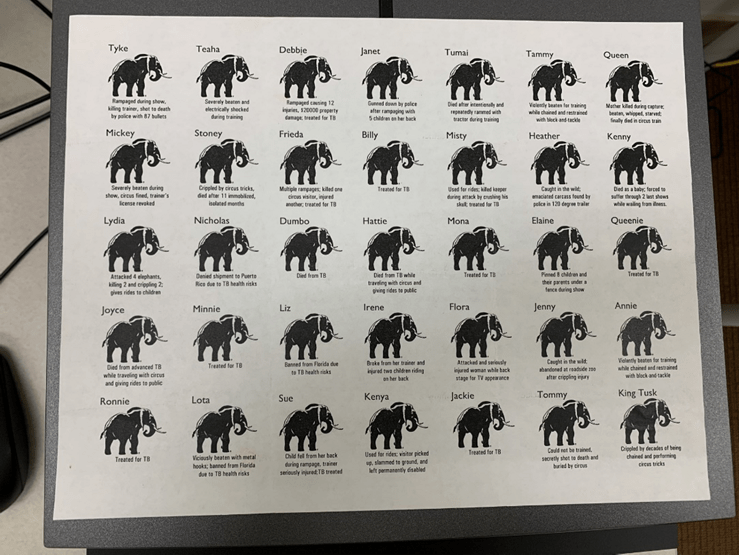
We see more of these abuse stories on the back of the artifact which portrays the common realities of circus elephants. We are given thirty-five pictures with descriptions of elephants who died or were severely abused under the ownership of the circus. Each picture stands for one elephant and tells the story of their cruel punishment, the diseases they harbored, or the neglect they endured. It is there we were taught the tragic story of Queen, an elephant under the ownership of the circus, whose mother was killed during her capture; Queen was then beaten, whipped, starved, and finally succumbed to her injuries in a circus train car. We also met baby elephant Kenny. He died as a baby and was forced to suffer through two last shows while wailing from illness. This depiction of the circus’s use of elephants is shown as inhumane and portrays the shift in American entertainment culture in the 20th century.

Elephants, like most animals employed in the circus, were frequently beaten into submission or with fear-training as mentioned previously by Henry Ringling.[1] Henry Ringling prided himself on his family’s humble beginnings and was an influential icon and circus owner during the 19th and 20th century. Seeing his quote shown in a negative light, introduces the idea that society was beginning to move on from the circus, and even began to villainize its leading members.

Another aspect of circus life that began to gain bad publicity was the forced tricks elephants had to learn that left their body uncomfortable and at times crippled. Specifically, the use of the bullhook trainers used to dominate and control their elephants drew the attention of many spectators finding unease in watching the violent training methods.[2] The spread of tuberculosis and other diseases became apparent in circus viewers who noticed unengaged, slowly walking, and even outraged elephants.[3] The brochure tells us tuberculosis is a deadly, highly contagious disease that spreads rapidly amongst traveling captive elephants. The artifact states sick elephants would become distressed and bolt out of rings with children on their backs, rampaging through crowds, and crushing handlers.
Elephants who “acted out” due to their dismal life were typically killed by trainers for their potential dangers. This was the fate of Tyke, an elephant shown on the back of the artifact, who was shot 87 times by police bullets after rampaging a show killing his trainer. Enraged elephant moments became a spectacle to media covering the circus and they began to write about why these outbursts were happening. Media would note that they were often beaten, overworked, sick, and anxious due to their constant changing surroundings.[4] The press criticizing the circus began to turn the public away from the industry.
This 20th century artifact shows us that the circus was no longer able to hide its unfair treatment of animals that were being shown in media like newspapers, magazines, and activist advertisements. We see a shift in circus culture with the implementation of the Animal Welfare Act in 1970 which was designed to regulate the ownership and care of circus and zoo animals.[5] Scholar Leroy Ashby argues more modern forms of entertainment like the radio, theaters, and the television caused the controversial circus lost to lose its momentum.[6]
It is intriguing to see actual elephant stories rather than just the common fates they endured while employed under the circus. The brochure portrays animal abuse combated with the idea of animal activism meant to convince the reader to not support the injustices of the circus. Once society began learning about the real realities of circus elephants through media, the circus became controversial and other forms of entertainment took its place. In the 20th century the sacrifices of animals, like the elephant, was no longer worth an evening of entertainment.
[1] Davis, Janet M.. Circus Age : Culture and Society under the American Big Top, The University of North Carolina Press, 2002. ProQuest Ebook Central, https://ebookcentral.proquest.com/lib/usiricelib-ebooks/detail.action?docID=427123.
[2] Gruen, Lori (ed.), The Ethics of Captivity (New York, 2014; online edn, Oxford Academic, 19 June 2014), https://doi.org/10.1093/acprof:oso/9780199977994.001.0001, accessed 8 Nov. 2023
[3] Jaynes, Mike “The Ethical Disconnect of the Circus”, ”,Journal for Critical Animal Studies, Volume VIII, 2008
[4] Gruen, “Ethics of Captivity” 41-42.
[5] Bradshaw, G.A., “Elephants in Circus: Analysis of Policy, Practice, and Future,” Animal and Society Institute
[6] Ashby, LeRoy. “With Amusement For All”, University Press For Kentucky, 2012.
[RSA1]You use “learn” and “met” in the same paragraph. Pick a tense and stick with it. I suggest past tense since this is a history paper.
[RSA2]But who was he exactly? Should probably say that he came from a storied family and that he was a circus owner himself.
[RSA3]Definitely not from the 18th century (which was the 1700s). Double check your dates here.


 amUSIngArtifacts
Leave a comment