
*Post written by Mona Meyer, Archives and Special Collections Metadata Librarian.
Once source for this phrase dates back to a 1984 commercial for Wendy’s in which the customer at another restaurant asked what parts of a chicken went into his sandwich and was told that it was all different parts….but, after all, “parts is parts.” Today we might say this to mean that one part is just as good as any other. I’m using this phrase to introduce a blog on the history of the west side of Evansville. YES, I know that could be a dissertation, and NO, I’m not foolish enough to go there. This is but a brief explanation of three areas that were once separate towns but have long been incorporated into the city we call Evansville.

The first area was (and still is) called Lamasco. The original city of Evansville dates to circa 1812, but grew and spread out from that nucleus. “The roots of the area locally known simply as ‘the west side’ date to 1837, when a 480-acre tract of land northwest of Evansville was platted as Lamasco, which derived its name from the surnames of its founders: John and William Law, James B. MacCall (McCall), and Lucius H. Scott. Encompassing the area from the Ohio River north to Maryland Street and from First Avenue on the east to St. Joseph Avenue on the west, Lamasco became an area marked by
distinction, both geographically and culturally.”1 Some 20 years later the portion of Lamasco east of Pigeon Creek was incorporated into the city of Evansville. Although no longer separate, it maintained/maintains a strong German influence and pride of place. The bank seen below still carried the name of Lamasco even though it was not established until 1914, long after incorporation.


Club House in Cook’s Park at what was formerly 410 Maryland St. It was located on the east bank of Pigeon Creek, where Columbia Street now crosses. It had extensive buildings for lodging guests who came to enjoy the rest and the mineral waters. Cook Brewing took it over sometime between 1890-1895 and enhanced it by the addition of a clubhouse, lake, pavilion, and pool. It was also known as Exposition Park and later Pleasure Park. It closed during Prohibition and was subsequently razed. RH033-395, the Evansville Postcard Collection

St. Vincent’s Day Nursery at 611 N. First Ave. Built in 1884 according to the tax assessor’s database (the Historic Evansville database gives at date of 1869). This is the former William Heilman residence. Heilman established Heilman Plow Works in 1847, which was later renamed Vulcan Plow Works. This house encompasses the entire block. It became the day care facility in 1931, and continues to operate as such today. MSS 183-176, the Hammond Awe Collection
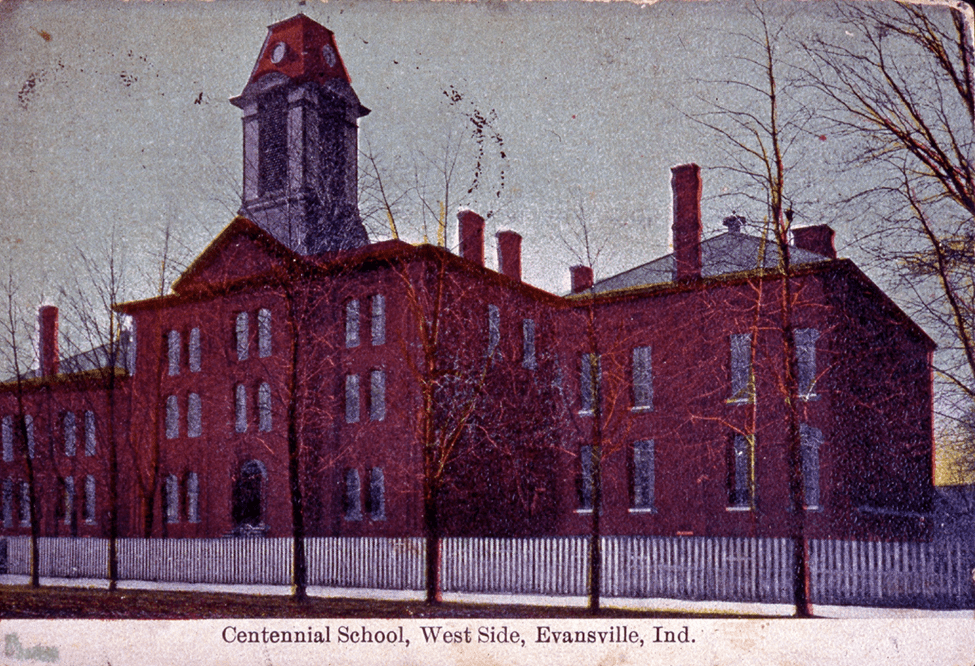
The area of Lamasco west of Pigeon Creek continued to be independent for several more years, renaming itself, appropriately, as Independence. It was annexed in 1870. Here are some images of buildings in the area once called Independence.

MSS 184-0725, the Brad Awe Collection


The final section of the west side to be discussed in Howell. Howell was railroad town on the far west side, centered around the Howell L & N Railroad, so named after local agent Lee Howell. The railyard was laid out in 1885 and shops opened 1889. There little else there, but by 1900, 75% of this land was owned by rail employees. Howell was annexed by the city of Evansville in 1916.


Looking down on Howell Railroad Yards, 2601-2701 Dixie Flyer Rd. This dates back to 1889.
MSS 181-1409, the Darrel Bigham Collection


Resources Consulted
HistoricEvansville.com website.
i Industrial Heritage, p. 7
 amUSIngArtifacts

.jpg)
Leave a comment