
part of the Then and Now continuing series about the March of Time
*Post written by Mona Meyer, Archives and Special Collections Metadata Librarian
(Title of this blog from a play by the same name by Eugene O’Neill, written in 1939, published and produced in 1946)
Here in the cold of winter it only seems appropriate to talk about the topic of ice! You’re probably familiar with getting ice for your drinks this way, or possibly from an “old style” ice tray.

Before convenient, in-home refrigeration, ice had to be delivered to households, possibly multiple times per week. Households had cards similar to the one seen below. You placed this in your window, with the amount wanted at the top.

The iceman would come to your house, knock on the door (often the door was left unlocked for this purpose) and come in and put your ice in an ice box. He might make 2 or more deliveries to you each week.

Here is a circa 1890 image of Evansville Ice and Storage Co. manufacturing plant at 1-27 Lower 8th St., built circa 1890 and destroyed by fire in 1984.

Another such local business was Holt & Brandon Ice and Cold Storage Company located at 820 Walnut St., also built circa 1890 and razed in 1967 for the construction of today’s Civic Center complex.

This ice would have been used in an icebox. An Evansville company named Servel (coined from the phrase, “Serving Electric”) made iceboxes and later refrigerators. (Interesting historic fact: the Servel factory made wings for the P-47 “Thunderbolt” during WWII, but that’s another blog story!)
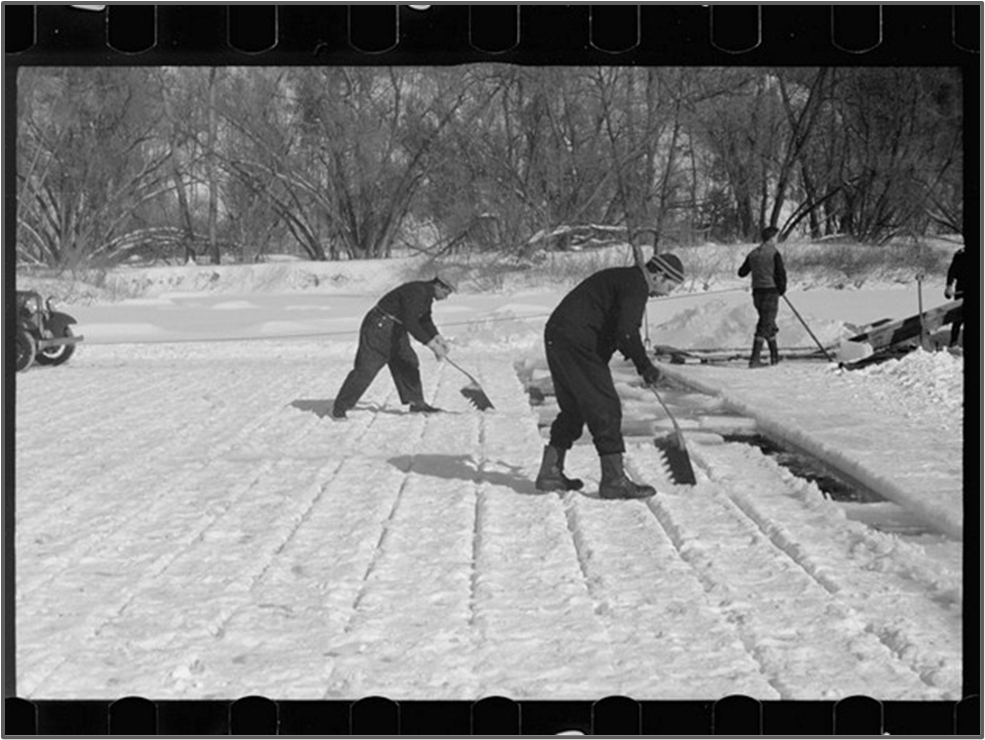
Where did the ice come from, at least in the 18th through early 20th centuries? After a body of water (lake, river, etc.) had built up at least a foot of ice, it was hand cut into blocks and transported to icehouses for storage.

For those of you thinking, the Ohio River could not be used for this purpose, I remind you in the past, when the climate was colder and the river “less regulated” than it is now, the Ohio River has indeed frozen over. Just take a look at this amusing 1937 image of a man standing by a sign advertising Ice Service, Inc. in the ice gorge on the Ohio River. Ice Service, Inc. was located at 820 Walnut St.

I think this gives new meaning to “on the rocks!”

 amUSIngArtifacts


Leave a comment