Let’s take a trip out west, to that city by the bay, the place where the great Tony Bennett left his heart….San Francisco. We’re going to jump in a time machine and go back to the year 1906.
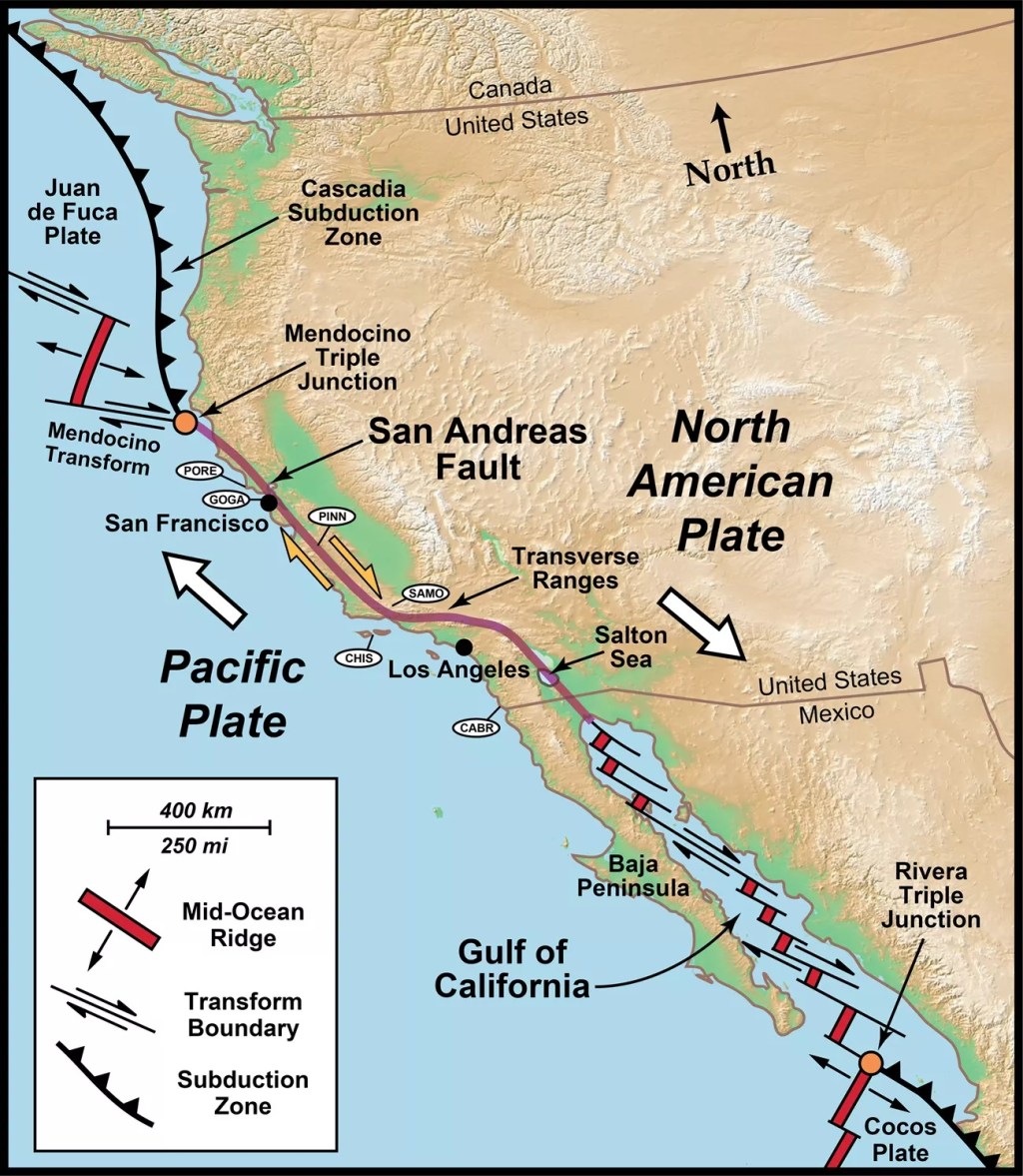
San Francisco lies on the San Andreas Fault. “The San Andreas fault line formed about 30 million years ago as the North American plate engulfed nearly all of the Farallon plate. Since then, the North American plate has ground against the Pacific plate at a boundary called a strike-slip fault. This fault is one of the largest faults in the world, running more than 800 miles from the Salton Sea to Cape Mendocino. It carves the state in two. San Diego, Los Angeles, and Big Sur are on the Pacific Plate. San Francisco, Sacramento and the Sierra Nevada are on the North American Plate. The two plates crisscross with dozens of active and passive earthquake faults.”i
Robert Louis Stevenson adopted San Francisco as his home and wrote an essay about it in 1882, entitled San Francisco. He said, “The sandy peninsula of San Francisco, mirroring itself on one side of the bay, beaten on the other by the surge of the Pacific, and shaken to the heart by frequent earthquakes, seems in itself no very durable foundation. According to Indian tales, perhaps older than the name of California, it once rose out of the sea in a moment, and sometime or other shall, in a moment, sink again. No Indian, they say, cares to linger on that doubtful land.”ii There were recorded quakes in 1808, 1812, 1829, 1839, 1865, and 1868 before the 1906 event, and according to the Seismological Society of America, “San Francisco experienced more than 460 earthquakes between June 21, 1808 and April 18, 1906.”iii
Mark Twain came to San Francisco in 1864 and took a job as a reporter for the Daily Morning Call. In his 1872 book Roughing It, he tells of his experiences on October 8, 1865.
“I enjoyed my first earthquake. It was one which was long called the “great” earthquake. … It was just after noon, on a bright October day. I was coming down Third street. The only objects in motion anywhere in sight in that thickly built and populous quarter, were a man in a buggy behind me, and a street car wending slowly up the cross street. Otherwise, all was solitude and a Sabbath stillness. As I turned the corner, around a frame house, there was a great rattle and jar. … Before I could turn and seek the door, there came a really terrific shock; the ground seemed to roll under me in waves, interrupted by a violent joggling up and down, and there was a heavy grinding noise as of brick houses rubbing together. … I knew what it was, now, and from mere reportorial instinct, nothing else, took out my watch and noted the time of day; at that moment a third and still severer shock came, and as I reeled about on the pavement trying to keep my footing, I saw a sight! The entire front of a tall four-story brick building in Third street sprung outward like a door and fell sprawling across the street, raising a dust like a great volume of smoke! … Every door, of every house, as far as the eye could reach, was vomiting a stream of human beings; and almost before one could execute a wink and begin another, there was a massed multitude of people stretching in endless procession down every street my position commanded. Never was solemn solitude turned into teeming life quicker. … The destruction of property was trifling—the injury to it was wide- spread and somewhat serious.”iv
By 1906, the 1865 quake was but a distant memory.
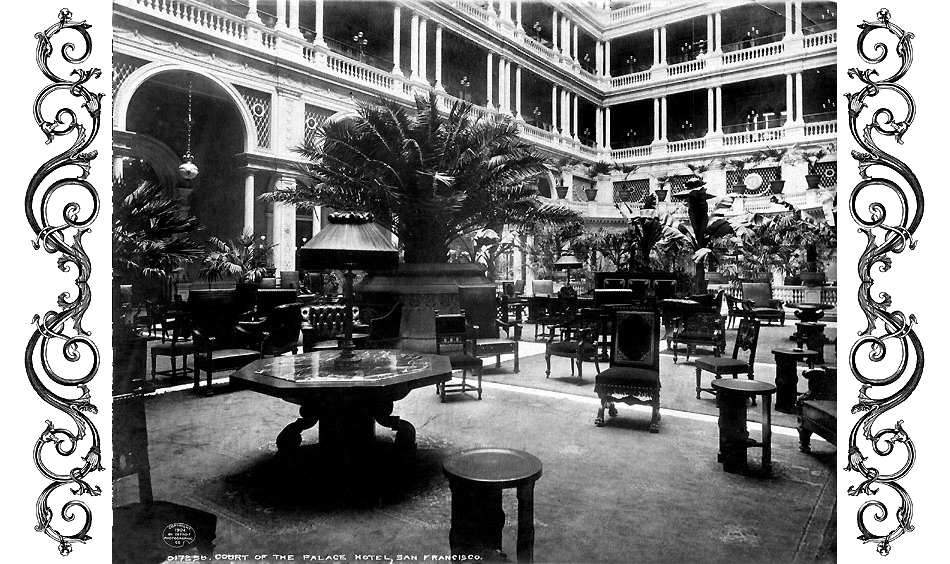
Political corruption was rampant, and the then mayor, Eugene Schmitz, was described as “the smallest man mentally and the meanest man morally”v to serve as mayor. Yet, there was great beauty, wealth, and culture in the city, too. The Palace Hotel, opened in 1875, was all that was luxurious and opulent. It had 755 rooms surrounding a magnificent palm court, hydraulic elevators, an electric call button in each room, private bathrooms, and a parlor in each room that overlooked the street. Enrico Caruso stayed at the Palace Hotel the night of April 17, 1806 after performing in the opera Carmen at the 2500 seat Grand Opera House. Former governor Leland Stanford and his wife had a 50 room mansion on Nob Hill (although they no longer lived there at this time). His house was one of the many built by the “nabobs” (Nob, as in Nob Hill, is a version of this term), including those of the Big Four of the Southern Pacific Railroad (Stanford was one of these), owners of the Comstock Lode, mining millionaire (and father of William Randolph Hearst) George Hearst, etc.
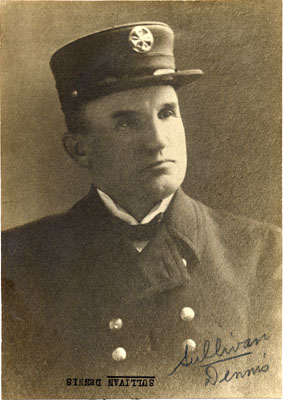
Before we talk about the ‘main event,’ it’s important to talk about the San Francisco Fire Department, “one of the most modern and efficient in the world. It had the most current telegraph alarm system in the country, and the communications complex directed its force smoothly to the city’s fires through 424 fire alarm boxes, bells in most of the firemen’s homes, and 30 bells in business premises patronized by firemen. And engine companies had now the most up-to-date steamers available….most of them not more than eight years old and all on a rigid schedule of maintenance. … Firemen now had mandatory drill periods.”vi As important as the equipment and training was Fire Chief Dennis Sullivan, at age 53 thirteen years into his tenure and highly respected. Sullivan knew his city well and the hazards it faced. Most of the buildings were constructed of wood and many were on hillsides or on the windy bay. Sullivan understand the importance of a high pressure water system, especially crucial for dealing with fire in tall buildings or in an elevated area, and had requested funding for an elevated reservoir, which had not been granted. There were some 63 cisterns in the city, but they were not well maintained. Sullivan was familiar with the use of dynamite to fight fires, but the cost of building a shed to house a large amount was seen as prohibitive. Furthermore, while the hillier areas consisted of harder, more durable soil, much of the rest was sand and/or clay, not to mention “made land,” where the city created land on which to build by reclaiming parts of the bay. “Just six months before, the National Board of Fire Underwriters had written in a report on the insurability of San Francisco: ‘In view of the exceptionally large areas, great heights, numerous unprotected openings, general absence of fire breaks or stops, highly combustible nature of buildings….and interspersed frame buildings, the hazard is very severe. … In fact, San Francisco has violated all underwriting traditions and precedents by not burning up. That it has not already done so is largely due to the vigilance of the fire department, which cannot be relied on indefinitely to stave off the inevitable.’ “vii
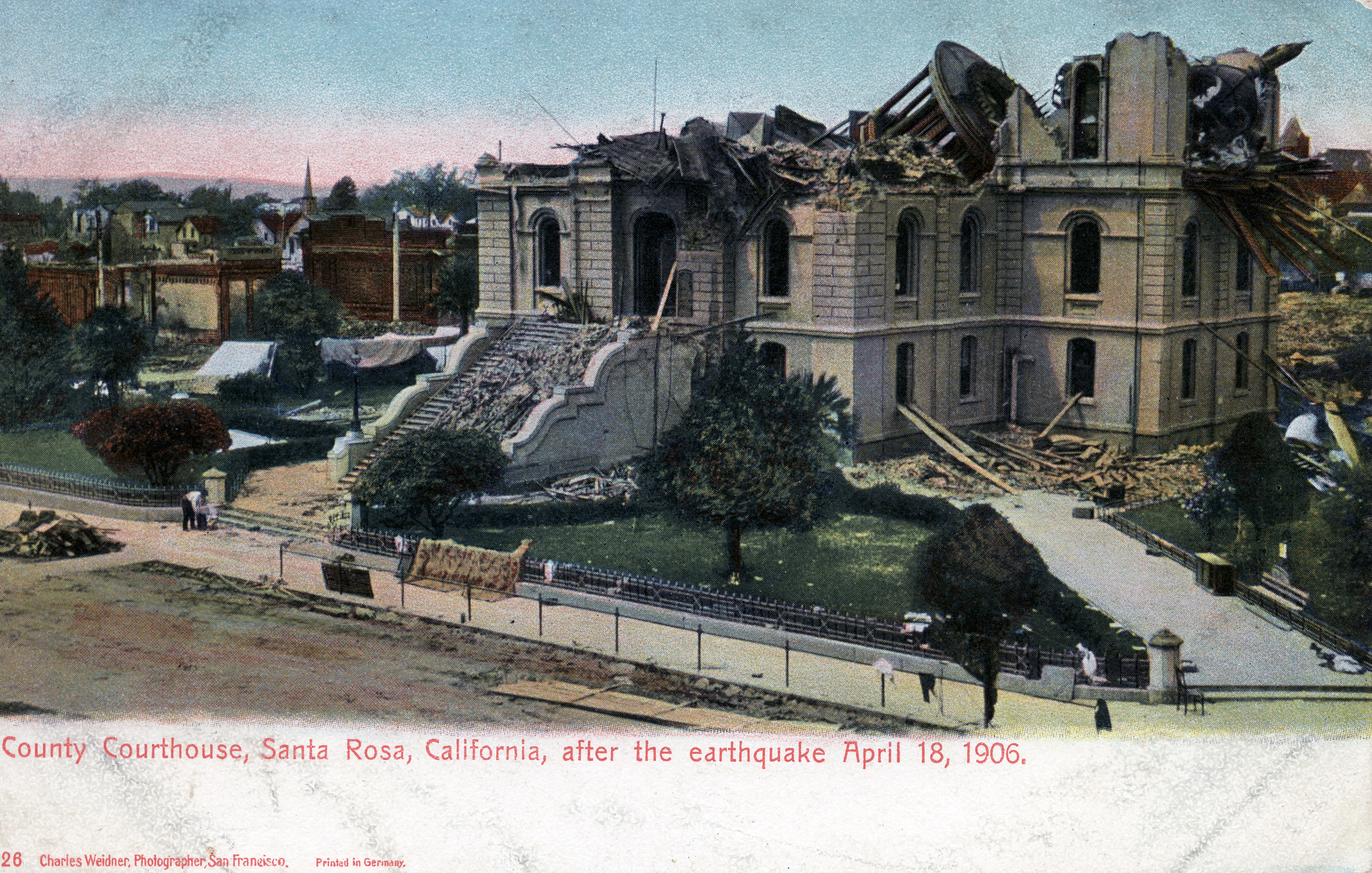
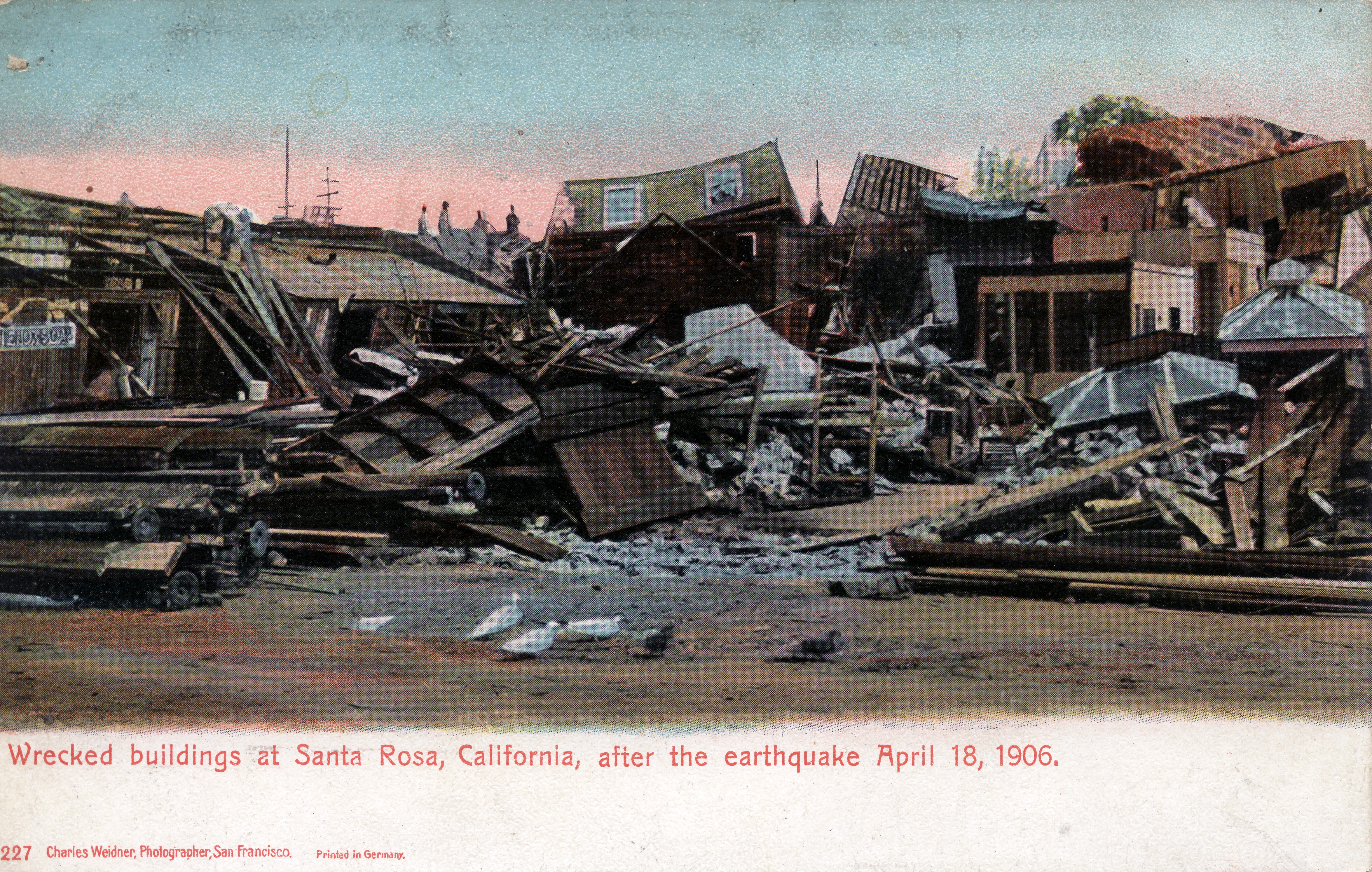
That inevitable began in the pre-dawn hours of Wednesday, April 18, 1906, specifically at 5:12 a.m. The earth lurched both up and down and back and forth. For as far as 200 miles (see these images of Santa Rosa, some 55 miles north of San Francisco) along the fault the earth shifted as much as 21 feet. According to some estimates, the force was like that of 6 million tons of TNT exploding, or 12,000 times that of the atomic bomb in Hiroshima in 1945. The earth flowed almost like water; buildings on harder and rockier soil suffered less, but in areas where the soil was sandy or created by man, buildings sank into the abyss. The Richter scale was not developed until 1935, but estimates after the fact put the quake as high as 8.3. (In comparison, the 1989 Loma Prieta quake was 7.1 and the Northridge one in 1994, 6.4.)
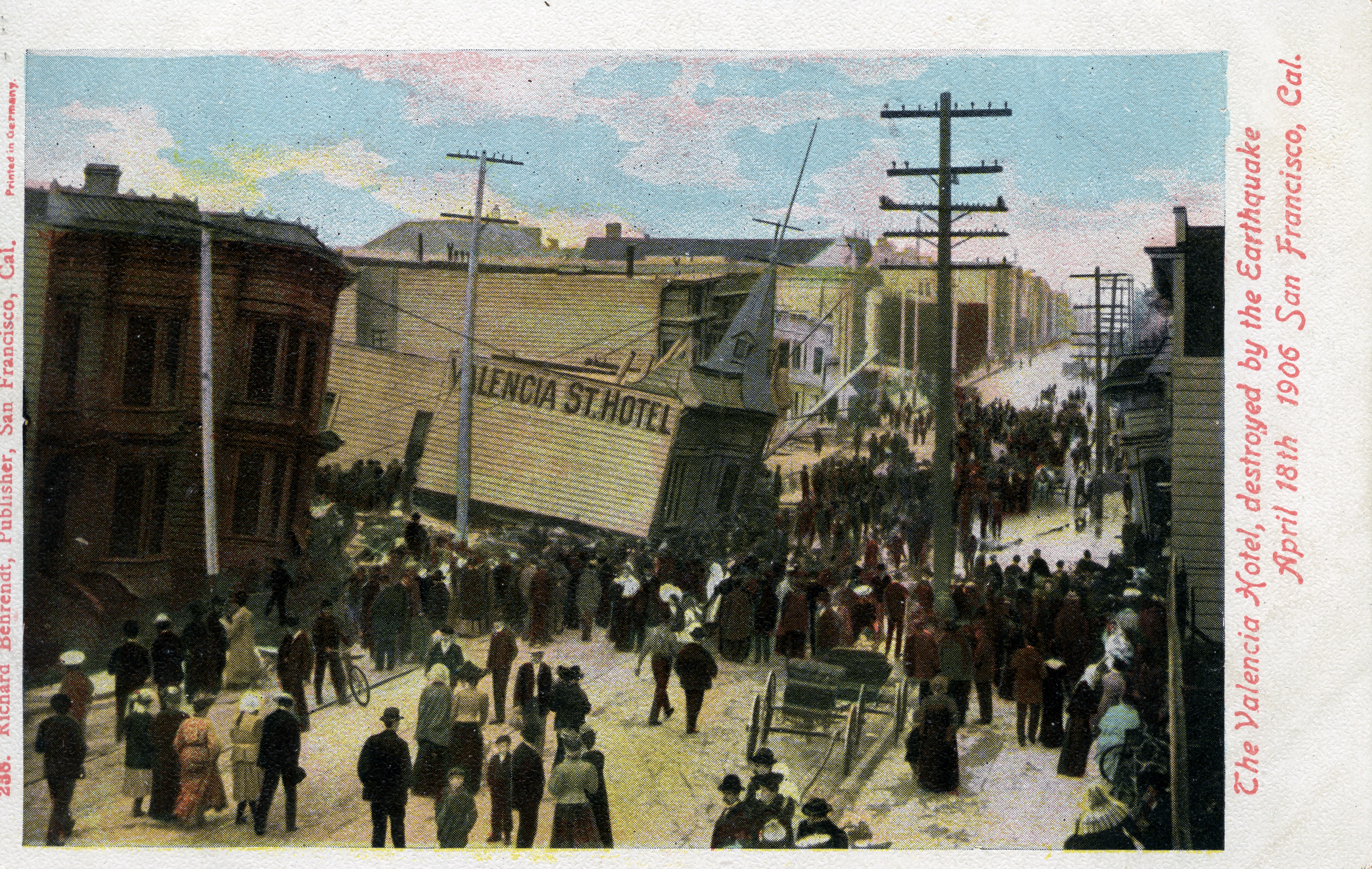
One particularly bad area was south of Market St., where the Valencia Hotel was located. “Just two of its five stories remained above the ground, and these had pitched forward onto the sidewalk. … At the same time that many of the hotel’s 120 guests were buried in their rooms beneath the ground, a water main had burst and filled whatever voids existed, drowning the hapless and trapped victims. Except for a few who were in their rooms on the top floor, not many survived the collapse.”viii
City Hall fared no better. Built at the cost of $7 million, it had only been standing for 7 years when it crashed to the ground, just as the quake stopped after 47 seconds. Corruption in the building trades was uncovered with the discovery of shoddy materials and faux marble in the wreckage.
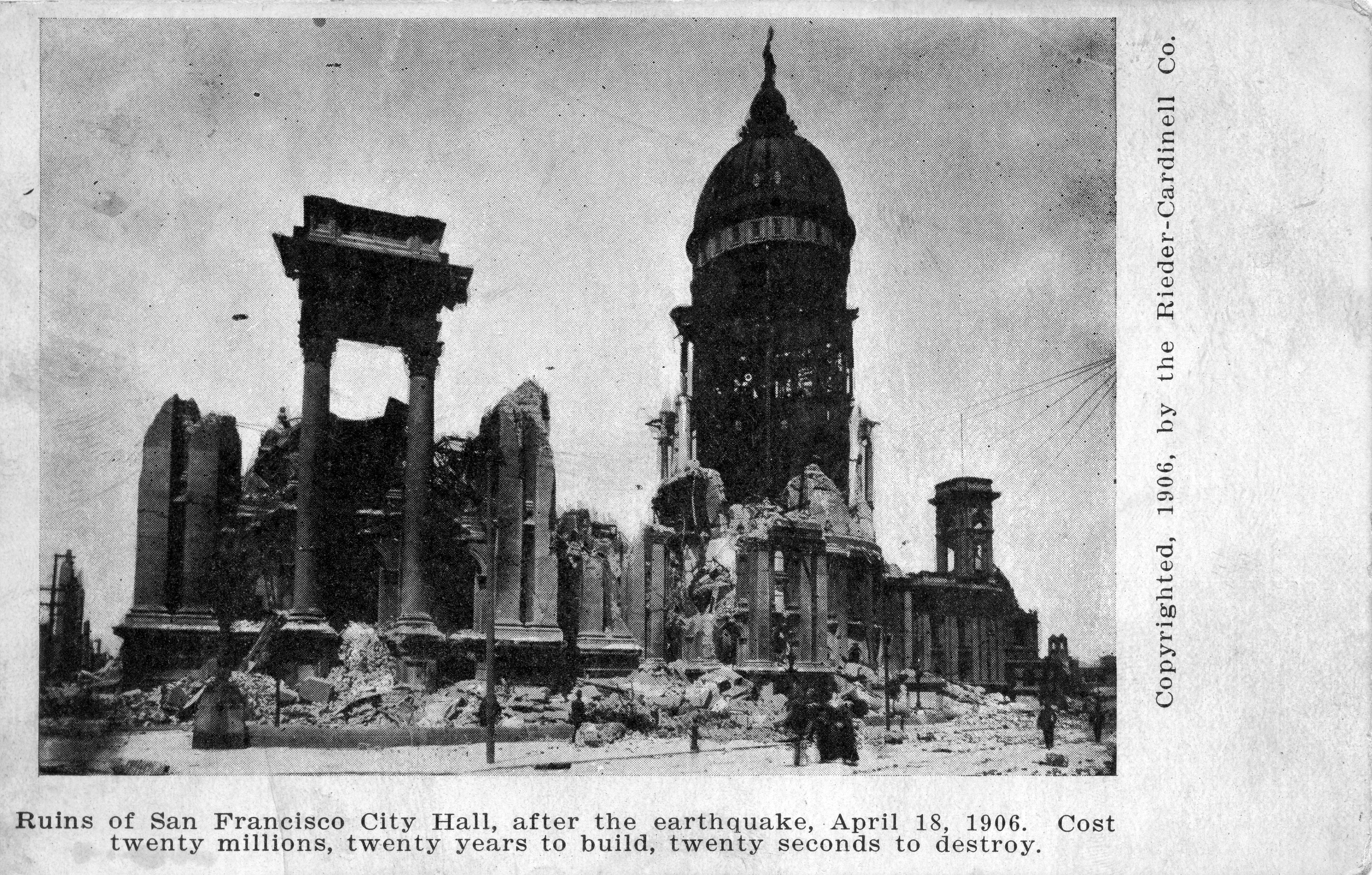
Worse devastation was still to come. The quake snapped gas mains and toppled chimneys, and to compound this problem, nearly all the water mains broke. Some 50 fires broke out immediately. One of these was in a Chinese laundry, where the fire used to heat the irons quickly got out of control. Another was the so called “ham and eggs fire.” A woman living at 395 Hayes St., unaware of how severe the destruction was and that her chimney was damaged, set out to prepare breakfast. The subsequent fire spread rapidly, completing the destruction of City Hall and much more of the city.
As noted earlier, San Francisco had a stellar fire department. Its alarm system was second to none, but 556 of the 600 batteries used to power the system were destroyed by the quake, meaning that no official fire alarm was ever sounded. Its fire chief Dennis Sullivan was asleep in the third floor of a firehouse when the earthquake occurred. As he awoke, his thoughts turned to his wife, asleep in the next room, and he headed towards her, just as a huge crash shook the building. “He did not realize that the thin cupola of the California Hotel, which stood next door, had topped in the shaking and penetrated the firehouse roof, piercing the floors beneath like a knife as it fell. [His wife], tucked firmly into her bed, dropped in the path of the steeple down to the second floor, and to the first, and finally through the apparatus floor to the basement. Because of the dust the chief did not see the hole in the third floor and stumbled into it, plunging to the basement himself. …The chief…came to rest near the rear of the basement, against the heating furnace, a large coal-fed boiler connected to the water and steam heat system. One of its galvanized pipes had broken apart and was gushing steam with the force of a large hose. Dennis Sullivan was lying in the immediate path of this thick flow of boiling hot water and air.”ix Sullivan succumbed to his injuries the next morning, leaving San Francisco, in the midst of its greatest crisis ever, without the mechanisms to fight the fire and the brains to create and direct the response.
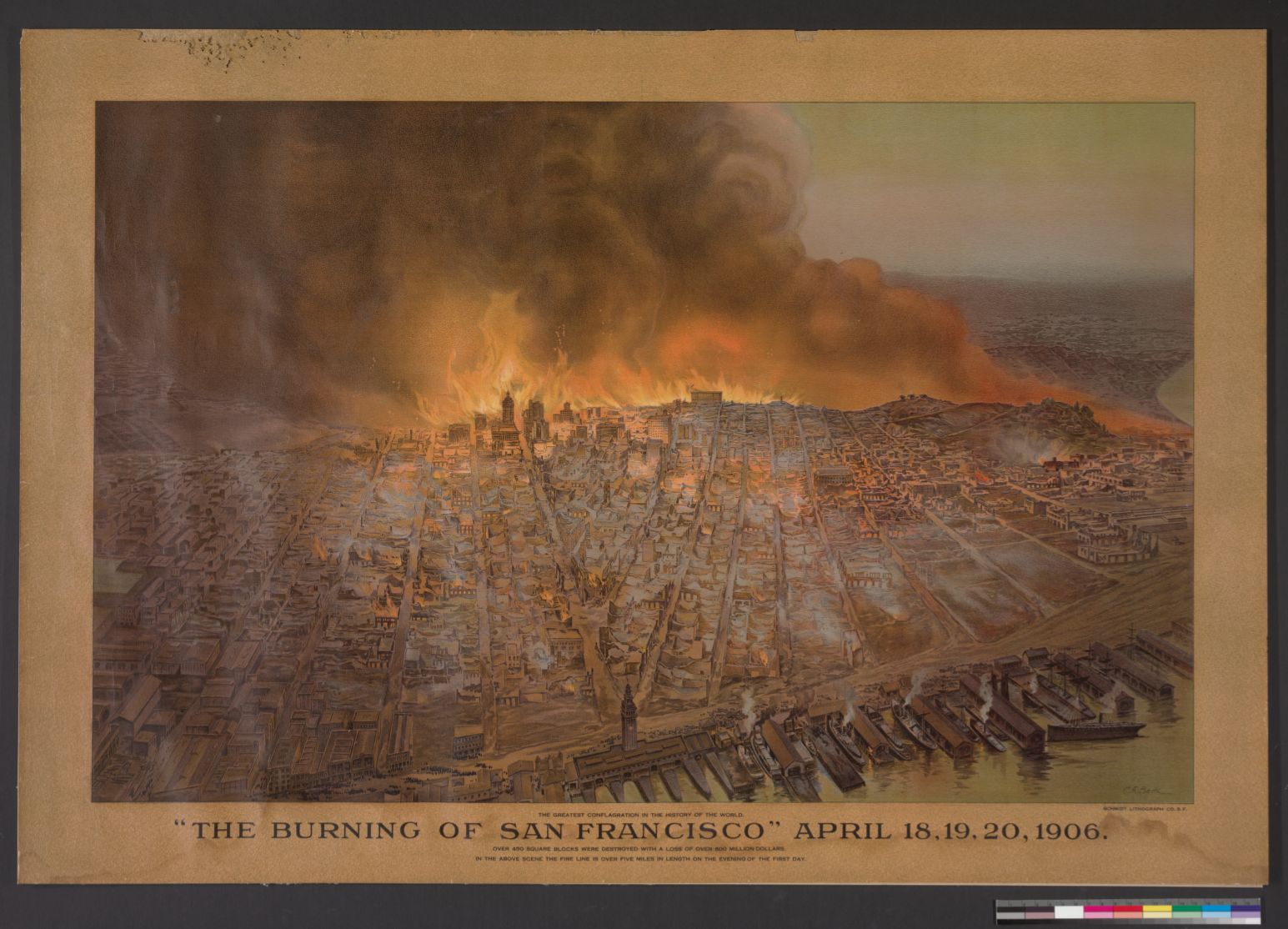
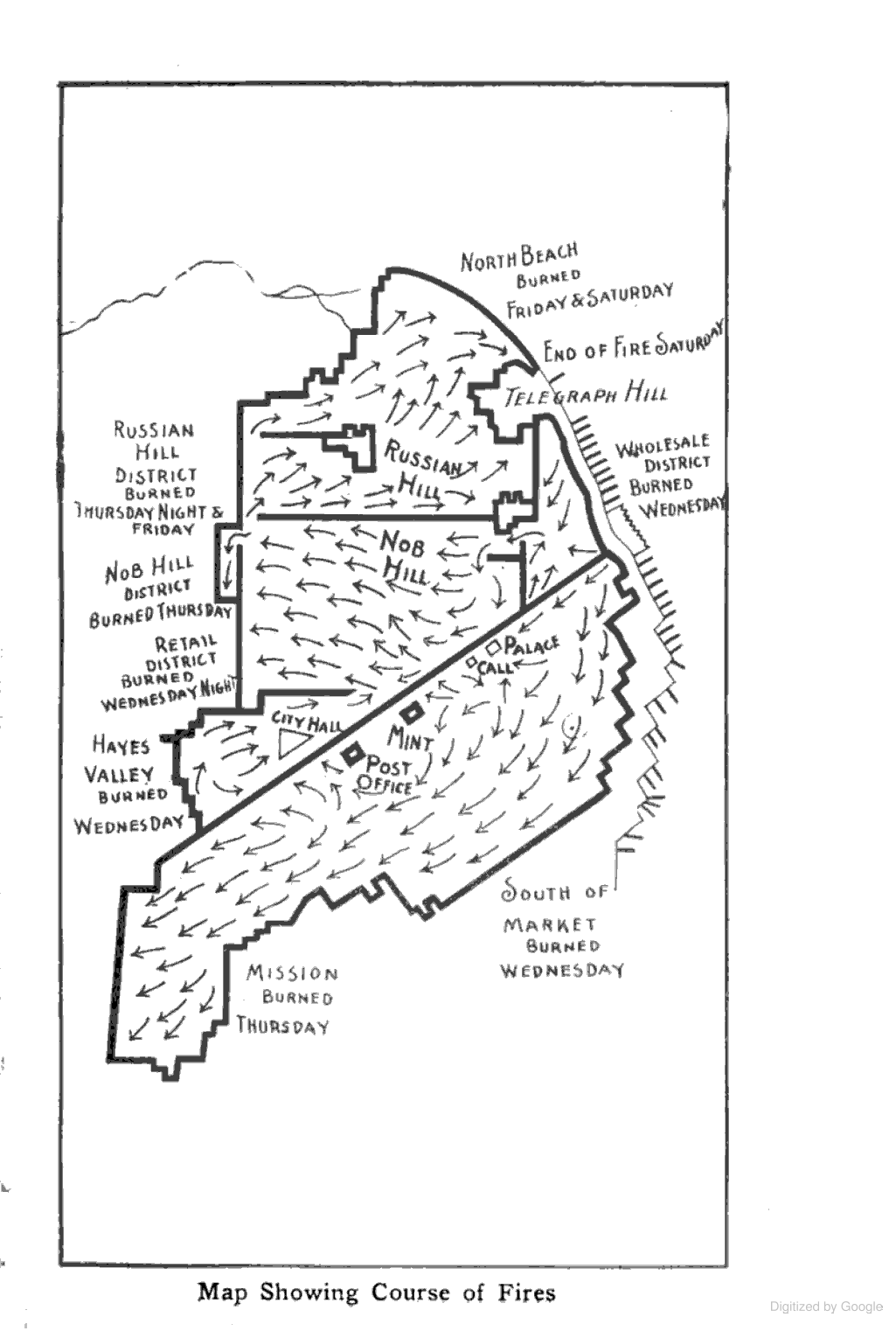
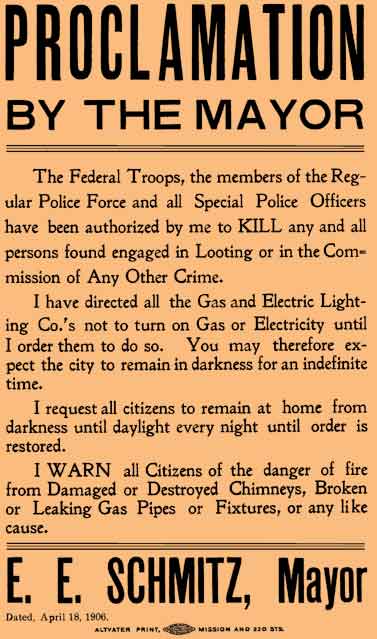
The problem was compounded by a corrupt and incompetent mayor, unsupervised military, poor decision making, lack of knowledge about dynamite, and natural forces like a pervasive wind that created firestorms causing spontaneous combustion. The proclamation seen here appears to be a declaration of martial law. By law, only the president of the United States, in consultation with the governor of the state, can order federal troops into a city, thus Mayor Schmitz was without authority to issue this kill order. Brigadier General Frederick Funston was in charge of the U.S. Army post at the Presidio in San Francisco, in the temporary absence of his superior officer. Funston’s role is a contentious one….some regarded him as the savior of San Francisco, while others lambasted him for unauthorized seizing of power, poor decision making, and an excess of hubris.
Sullivan was probably the only one who had studied and knew the proper use of dynamite to create fire breaks. “About 95 percent of the explosives sent by the army to be used for firebreaks consisted of gun cotton, black powder, and a substance called dynamite powder, all three of which were classified as low explosive, as opposed to the high explosive of dynamite. Hardly anyone in San Francisco understood the nature of these materials, or that low explosives had an undeniable tendency to start fires.”x In at least one instance the dynamiting of a building caused the fire, at that time nearly under control, to spread and destroy another 50 square blocks. Ill advised evacuation orders prohibited families from removing materials from their homes which were not yet in immediate danger. When the fire actually came to those homes, it had even more combustible materials to promulgate its spread.
On April 21, 4 days after it started, the fire was finally under control. Some 522 square blocks of the city had been destroyed.
(In the slide show below, all images are from MSS 010, the postcard collection. Respectively, they are 0044, 0017, 0195, 0703, 0704, 0923, 0120, 0054, and 055.)
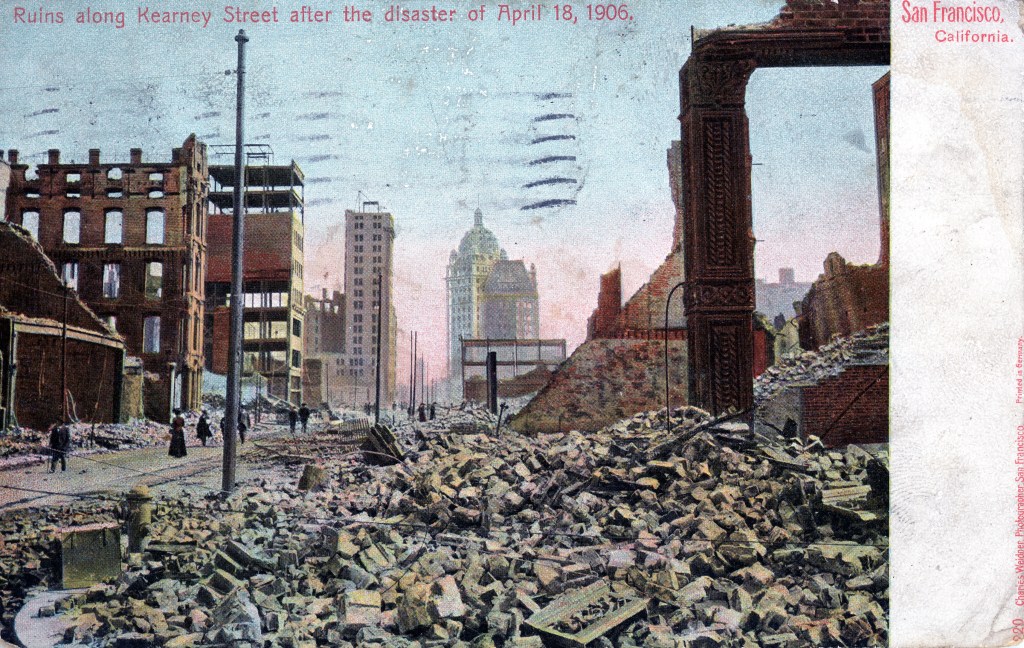
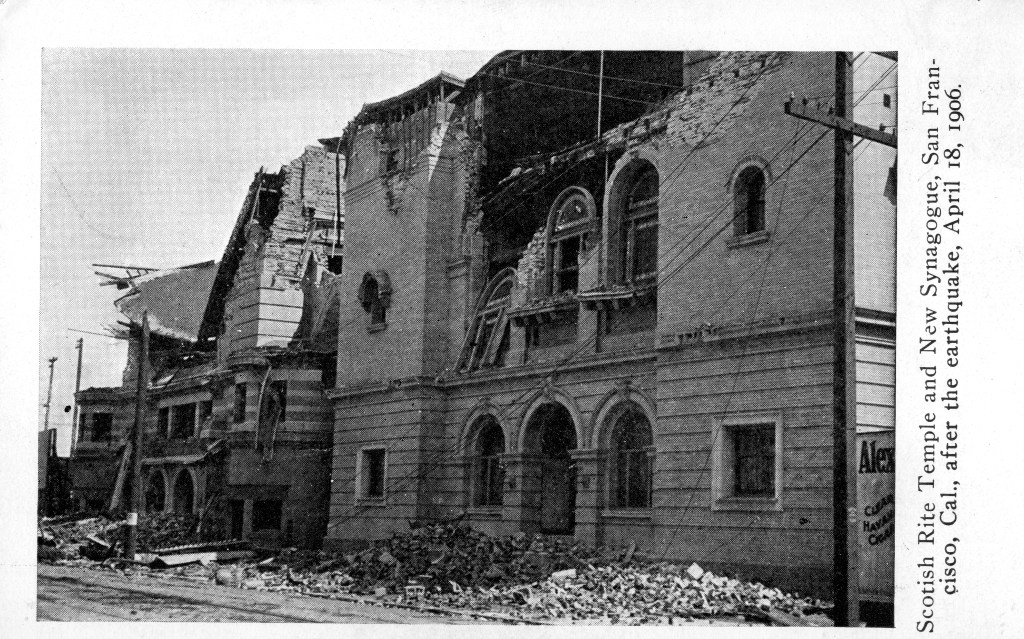
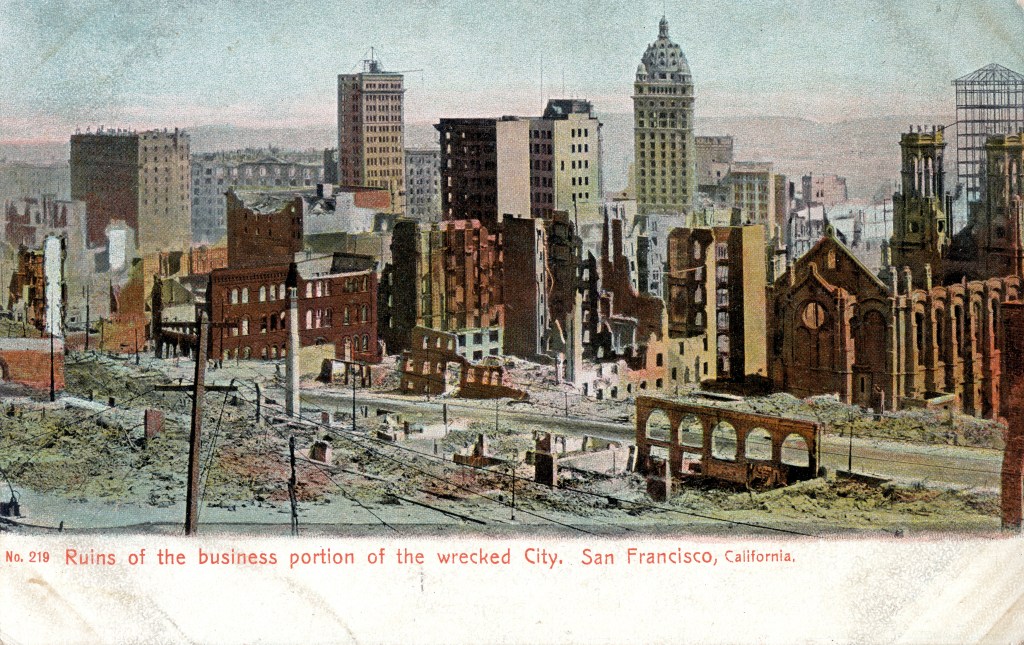
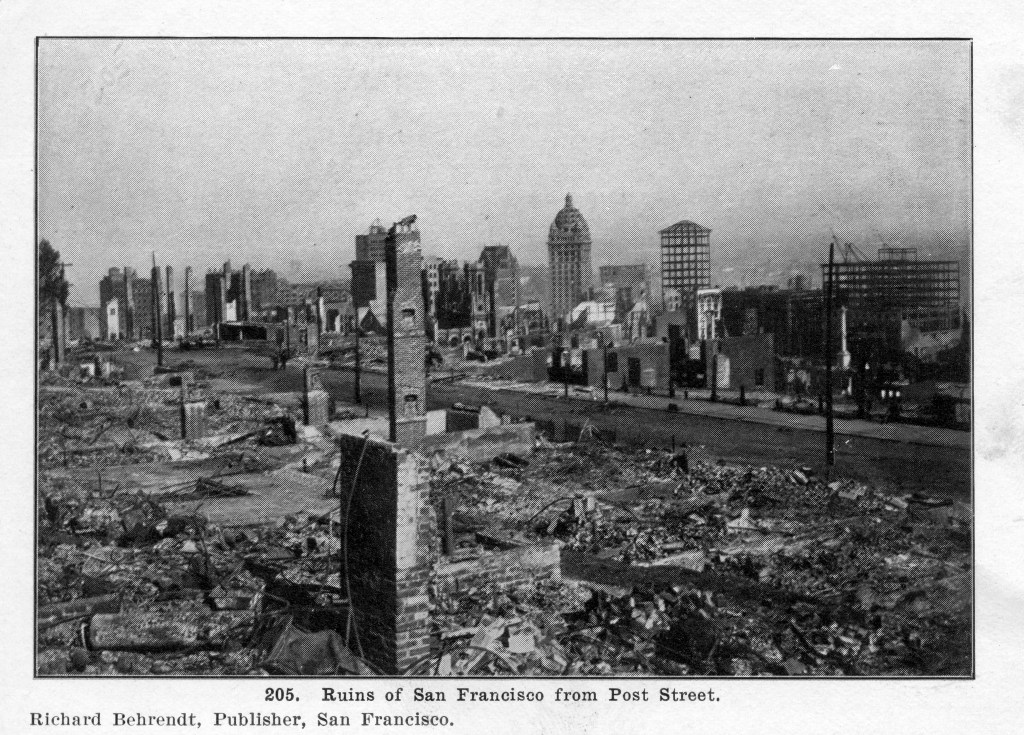
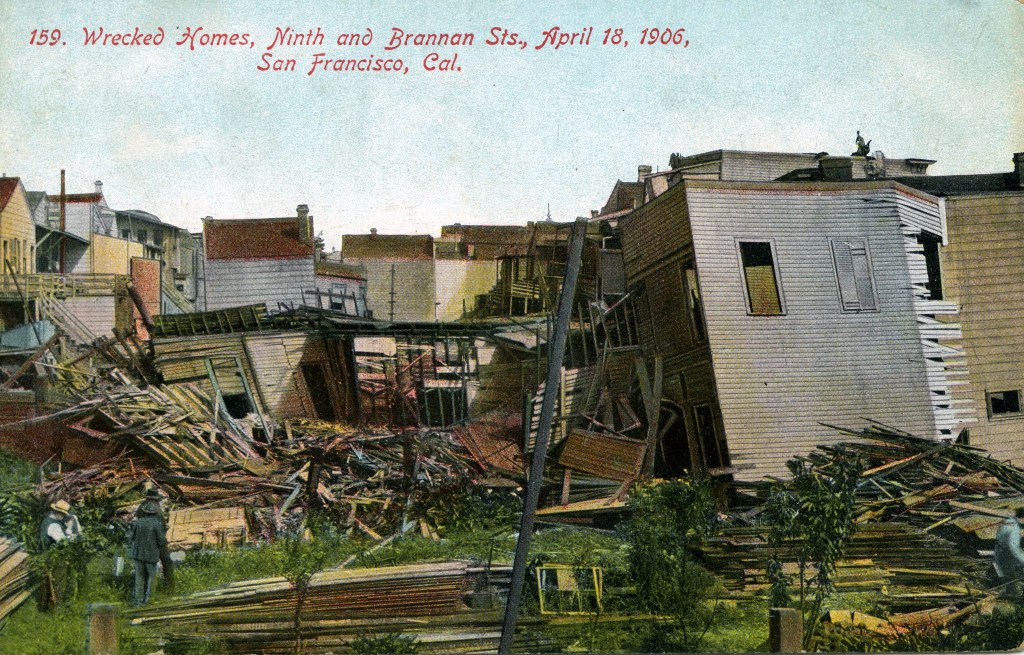
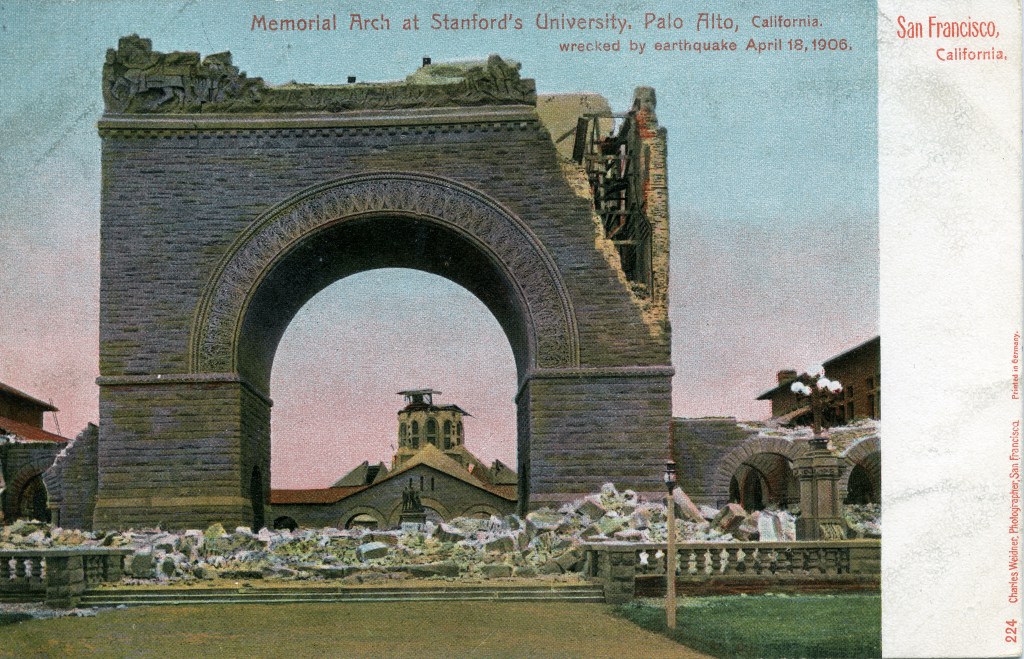
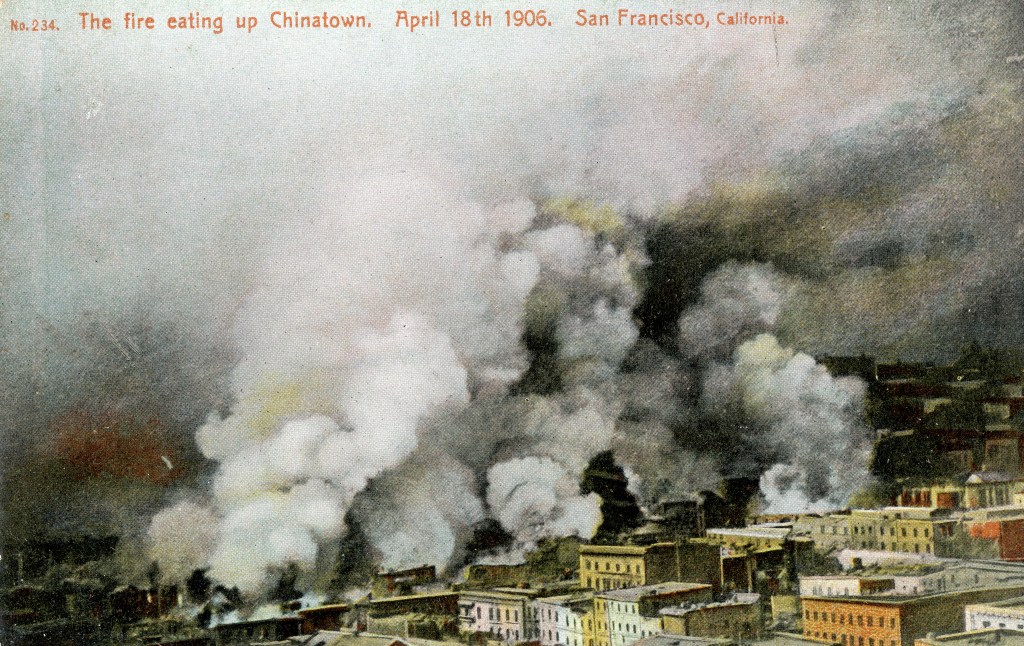
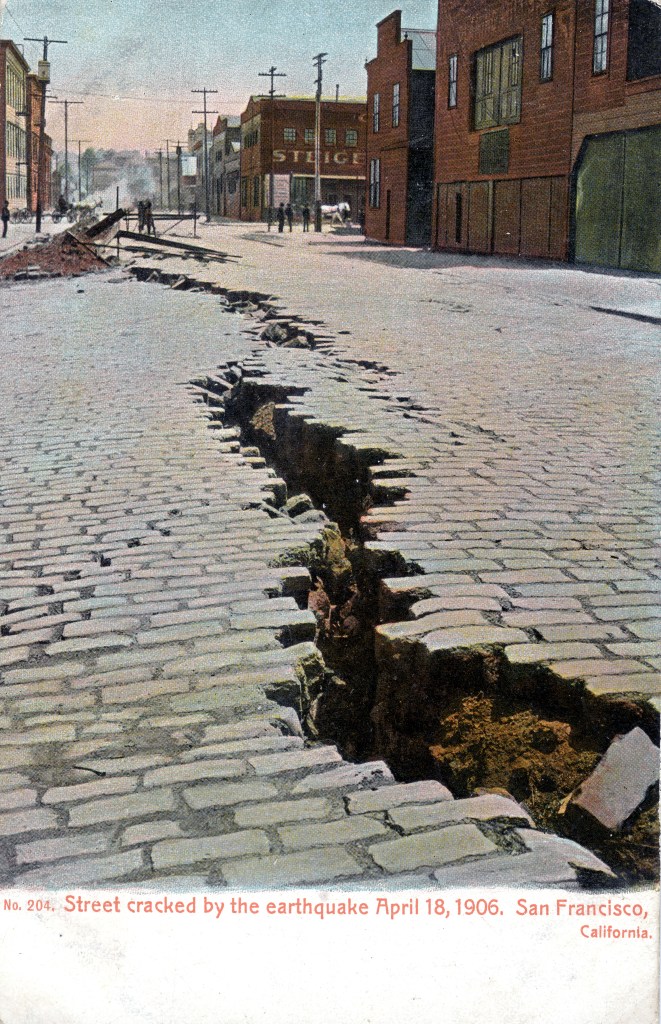
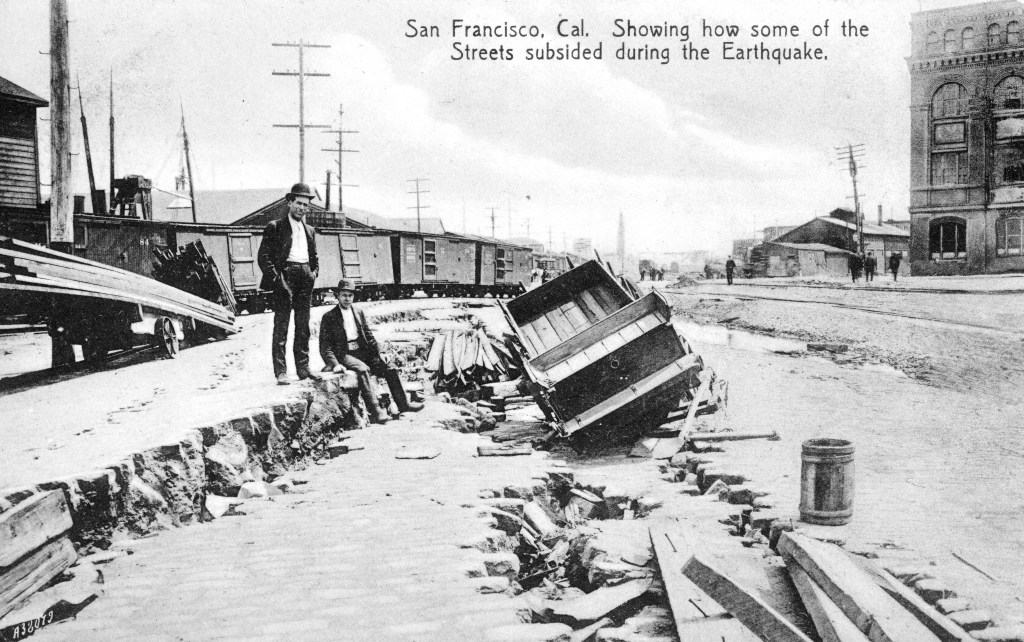
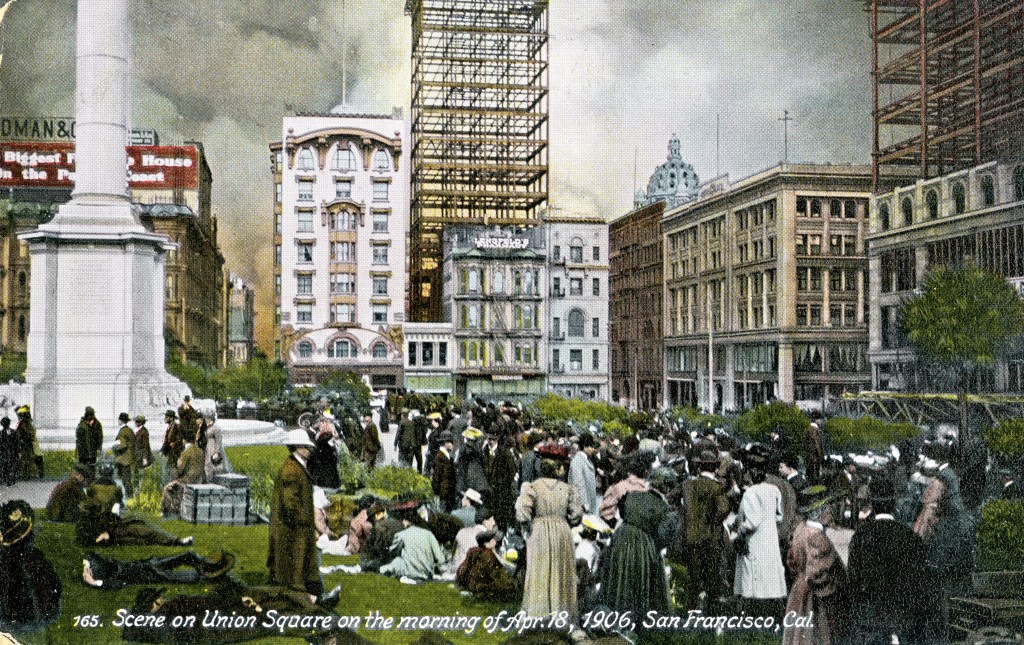
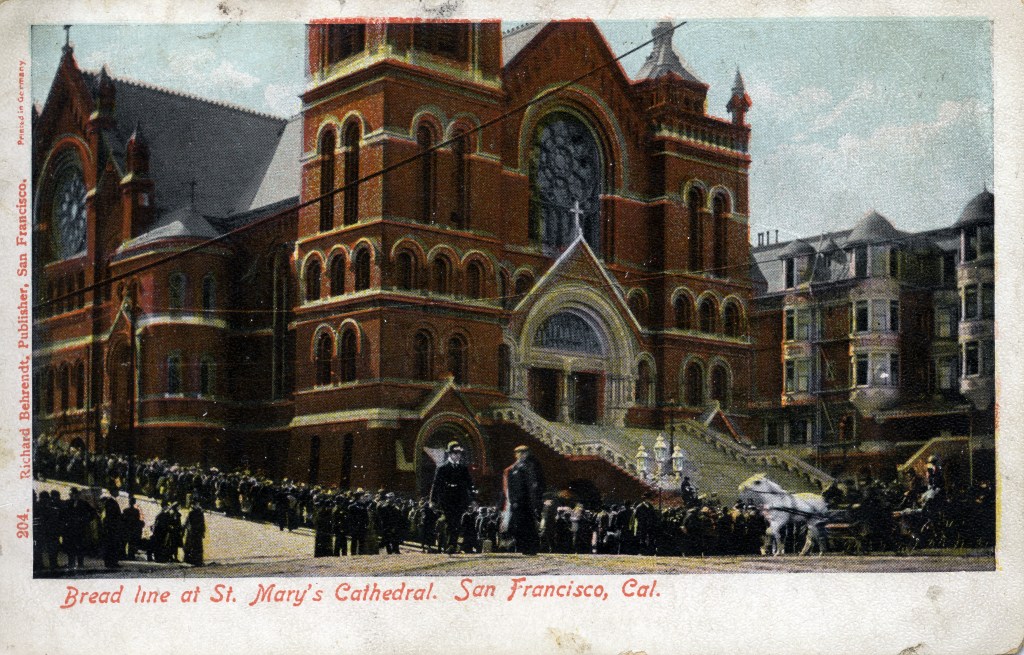
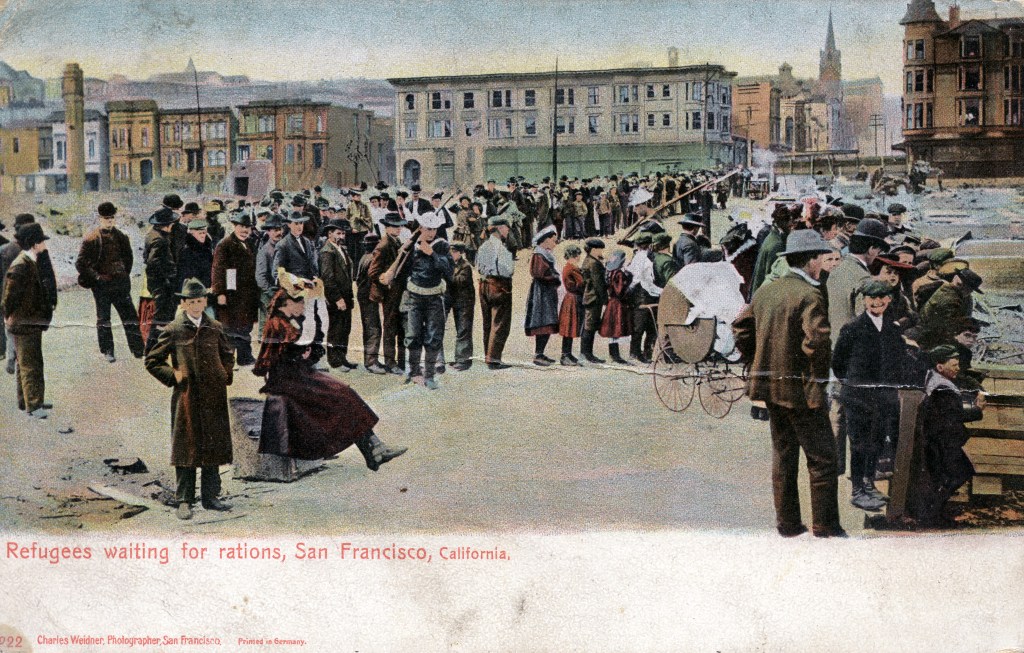
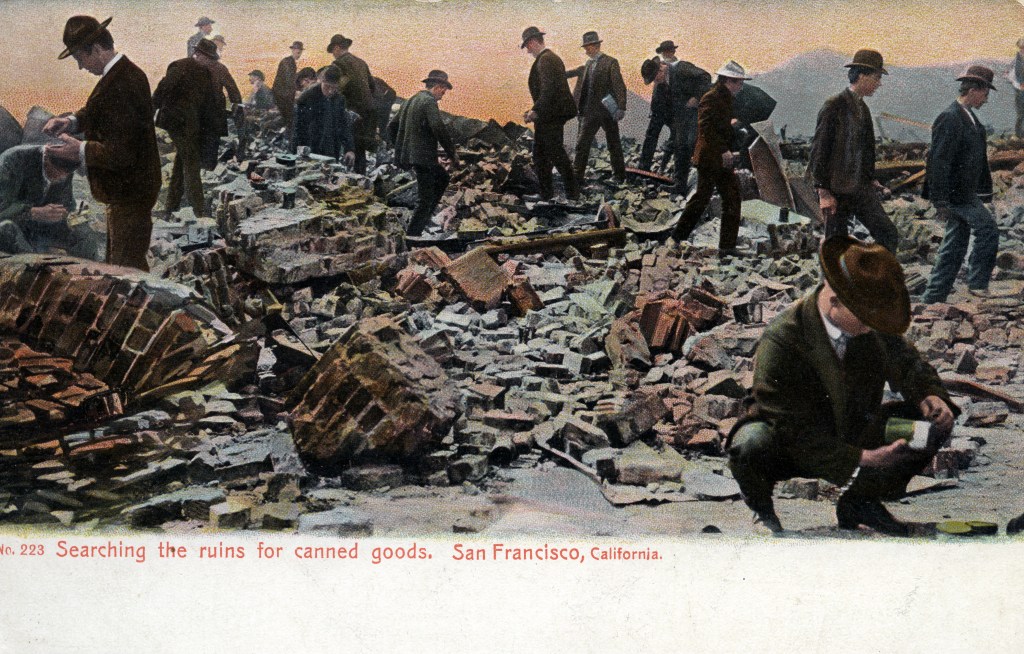
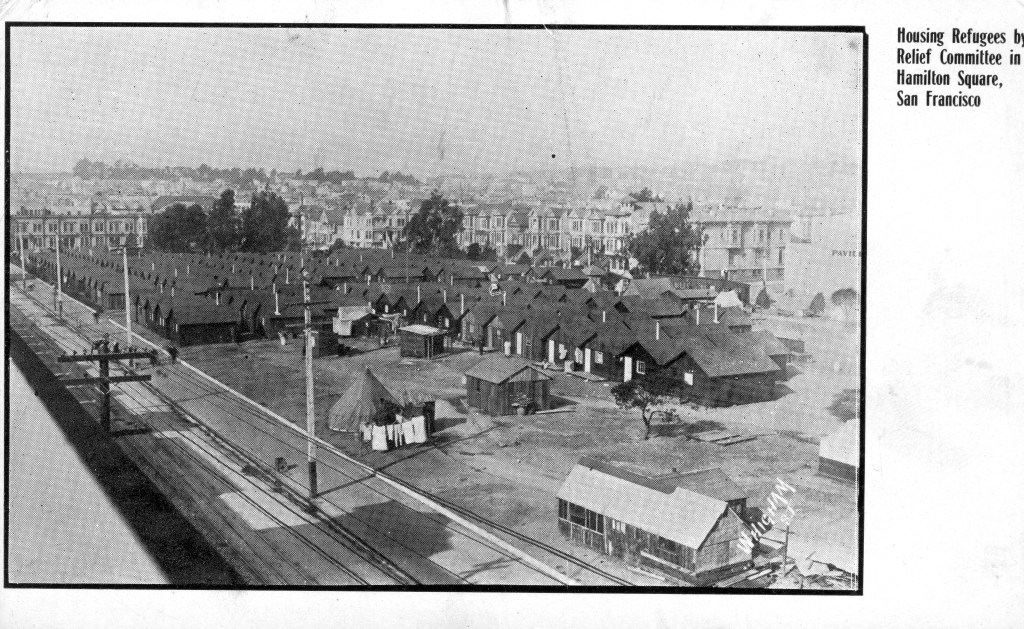
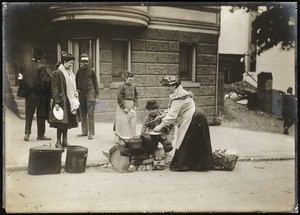
Refugees crowded into city parks and squares, some eventually in provided housing. The Army sent nearly every available cot in the country. Everyone was in the same boat….the poor and the mighty stood in bread lines together. Men salvaged through the rubble for canned goods. “No one was permitted to make a fire in a house, so that even those who were occupying their own houses were obliged to do their cooking….on the street.”xi
(In the slide show below, all images are from MSS 010, the postcard collection. Respectively, they are 0136, 0707, 0899, 0900, and 0197.)
But San Franciscans were resilient, and soon clean-up and rebuilding began. “Money would arrive from all over. European countries gave $300,000. John D. Rockefeller sent $100,000, as did his company, Standard Oil. [A relief committee] raised $413,000 from 131 San Franciscans, all of whom were themselves in need of money to rebuild. The U.S. Congress sent $2.5 million. [The] finance committee ultimately took in more than $10 million in relief contributions, mostly through the Red Cross.”xii It cost $90,000 to demolish the Palace Hotel, and another $20 million to haul away and dump the ruins in the city into the bay.
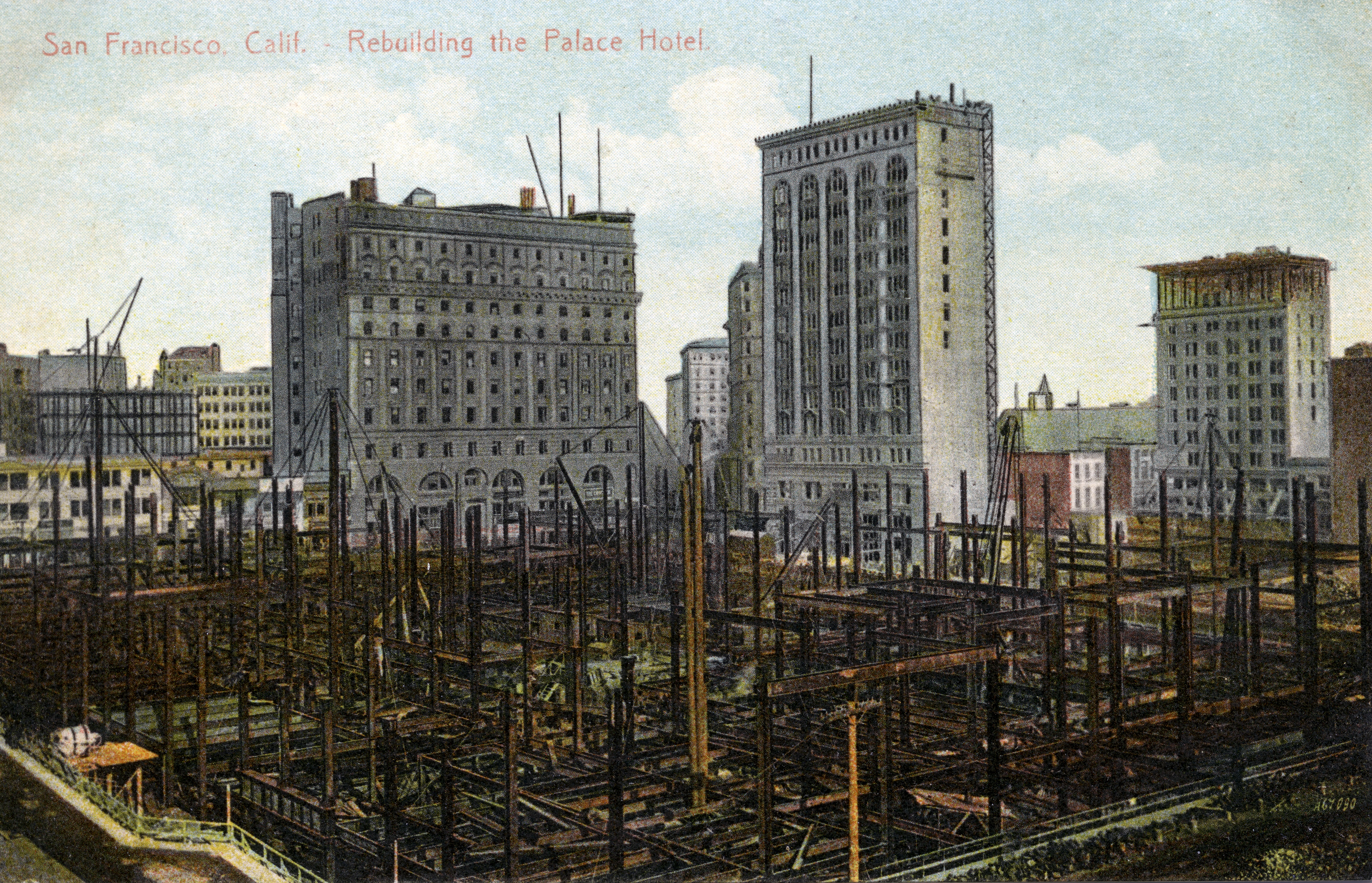
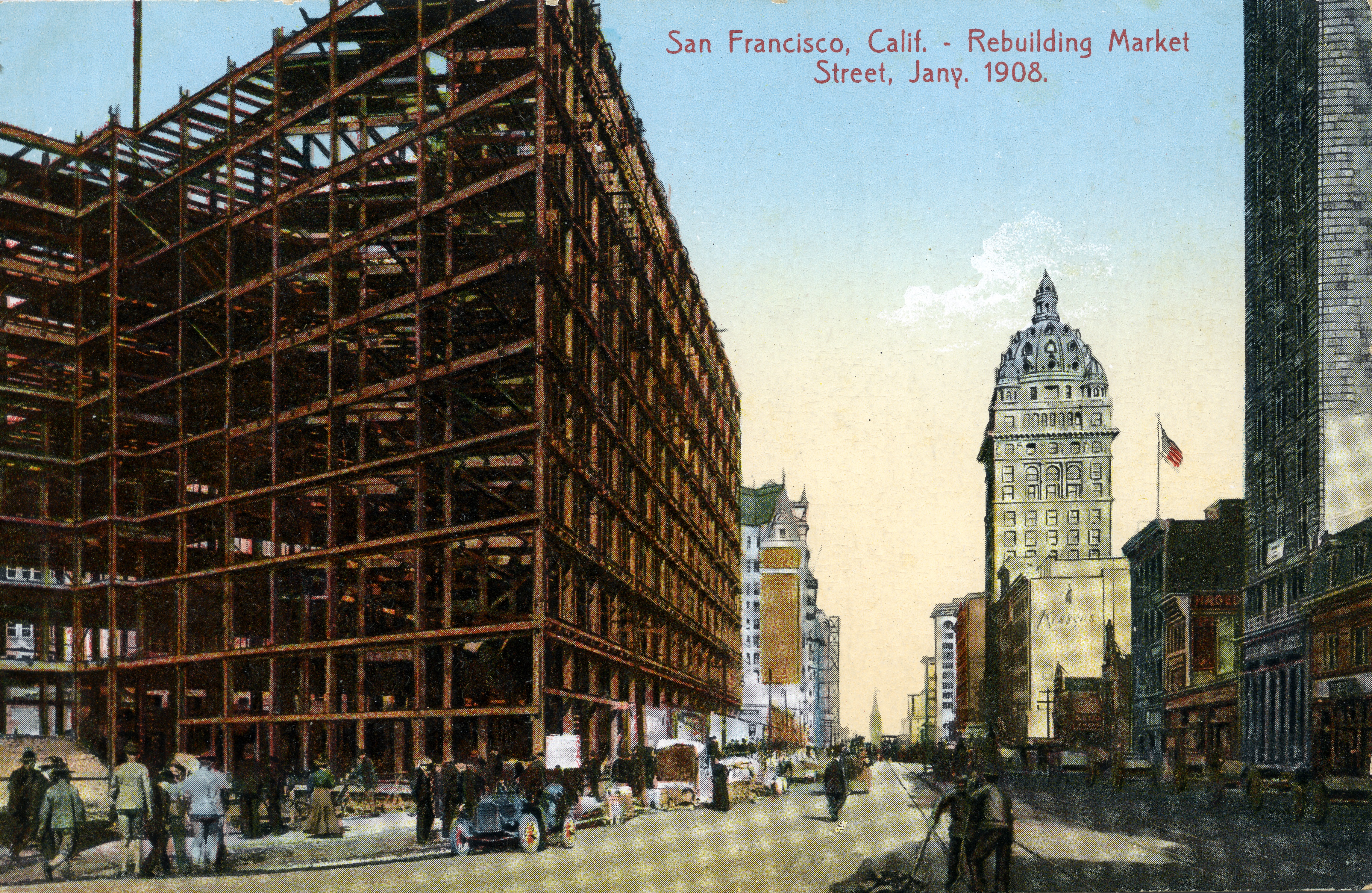
The work was hard–within 18 months, 15,000 horses had been worked to death. Workmen poured in from all across the country. A carpenter could make as much as $4/day—this at a time when an attorney in New York City might earn $1.50/day. The first trolley was working within 10 days, and within several weeks, there were 225 miles of tracks. If 28,000 buildings were destroyed, then 20,500 new ones were built within 3 years. And amazingly, San Francisco was able to host the 1915 World’s Fair, the Panama Pacific International Exposition!
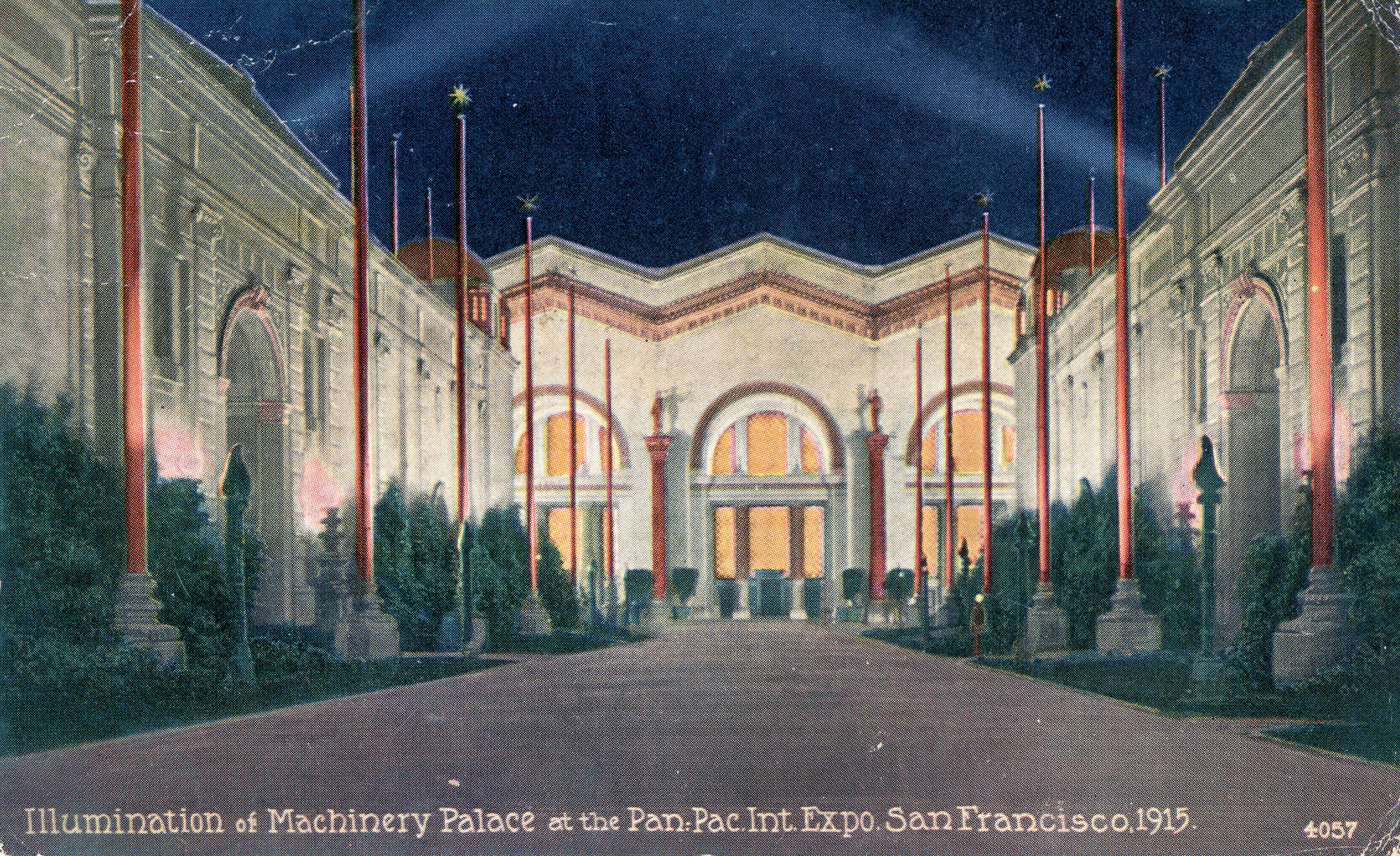
Will this happen again? It’s safe to say that an earthquake in the San Francisco area is as much a sure thing as death and taxes. Today’s technology is far more sophisticated, but the population and amount of infrastructure are also much higher. I’ve just scratched the surface of this topic, so take a look at the resources listed below to learn more. In particular, stop by UASC and ask to see Earthquake Days: The 1906 San Francisco Earthquake & Fire in 3-D. Its location is Special Collections Oversize F869.S343 B97 2005. The illustrations are magnificent, and the 3-D aspect is well worth your time.
Resources Consulted:
Burkhardt, David. Earthquake Days: The 1906 San Francisco Earthquake & Fire in 3-D. San Bruno, CA: Faultline Books, 2005. Special Collections Oversize F869.S343 B97 2005
California Earthquake Authority. What is the San Andreas Fault?
The Great San Francisco Earthquake [videorecording] / WGBH Educational Foundation; a Moira Productions, Inc. film for American Experience; WGBH Boston; written and produced by Tom Weidlinger. Boston: Boston Video, 2005. DVD F869.S34 G743 2006
San Francisco Earthquake, 1906. The Center for Legislative Archives, National Archives.
San Francisco’s Barbary Coast Today. Real San Francisco Tours, January 7, 2022.
Smith, Dennis. San Francisco is Burning: The Untold Story of the 1906 Earthquake and Fires. New York: Plume, 2006. General Collection TH9449.S26 S65 2006
Twain, Mark. Roughing It. Published 1872, Project Gutenberg edition December 12, 2000.
i California
ii Burkhardt, p. 1
iii Burkhardt, p. 20
iv Twain, chapter 58
v Smith, p. 13
vi Smith, p 44
vii Smith, p. 50
vii Smith, p. 115
ix Smith, p. 61
x Smith, p. 91
xi Burkhardt, p. 154
xii Smith, p. 151


Leave a Reply