Evansville has a lot of churches that have a German background, not particularly surprising for a city early settled by many German immigrants. Actually, German immigrants were commonplace in many areas, not just Evansville. “By the middle of the 18th century, German immigrants occupied a central place in American life. Germans accounted for one-third of the population of the American colonies, and were second in number only to the English. The German language was widely spoken in nearly every colonial city and was circulated in locally published periodicals and books. When the members of the Continental Congress first met in Philadelphia, they walked down streets lined with German businesses sporting German signs, and their deliberations were reported in German broadsides and debated in German coffeehouses. When the Declaration of Independence was signed on July 4, 1776, a German newspaper was the first to break the news, and German copies of the Declaration were on the streets the next day.”
While German immigrants didn’t strictly believe that ‘God only spoke in German,’ hearing the Bible read and sermons given in German helped those newly arrived and not yet proficient in English understand the message more fully, and fostered a sense of community. Interestingly, “the first Bible in America was published in German by Christopher Saur, a German printer in Philadelphia.”
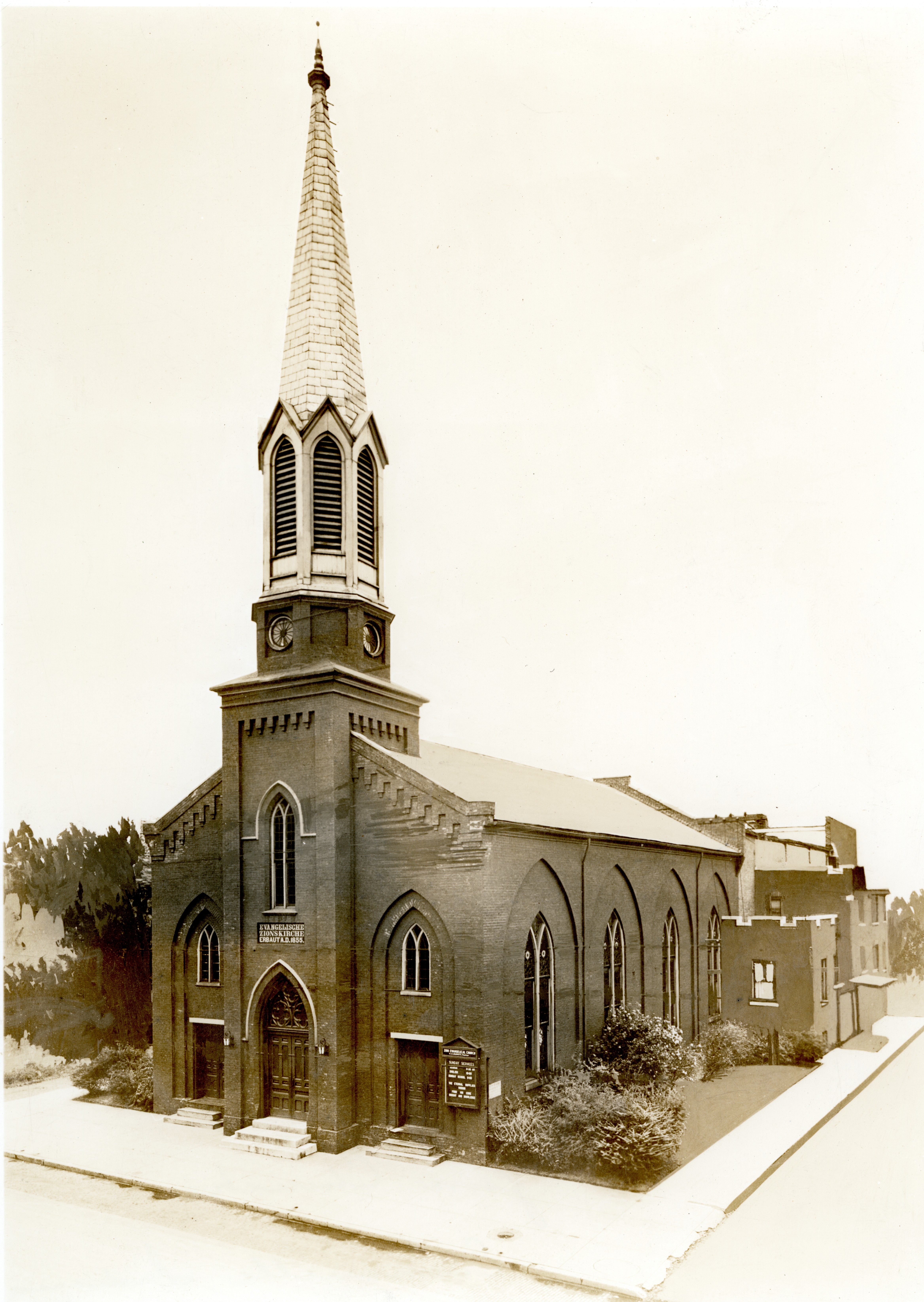
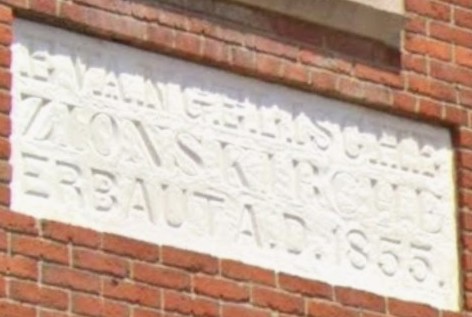
Zion Evangelical United Church of Christ was initially formed as a congregation on New Year’s Day 1849, with 35 members, although its 16 members met as early as 1845 in a log house. At that time it was called German Evangelical Church, with the name “Zion” added in 1852. This made it one of the earliest churches in Evansville, which was itself only incorporated in 1847. In 1856 a church was built and an organ obtained, all for the price of $1301.77. The current building, seen above, was built at its current location at 415 NW 5th St. in 1878. Above the door is this sign, which reads EVANGELISCHE ZIONS KIRCHE ERBAUT A.D. 1855.
Time marches on and churches change. The “United Church of Christ” churches were formed in 1957 with a merger of the Evangelical and Reformed Church with the Congregational Christian Church. Sometimes the word “Evangelical” was retained to honor the tradition of being rooted in the German Protestant Reform tradition. The word might also imply that that particular church was perhaps a little more traditional, liturgical, or moderate that other UCC churches.
One big change came with WWI—the emphasis on the German language. English had already been making inroads into the congregation (to retain youth who no longer were fluent in German as members), and there began to be more English confirmations than German, but the overwhelming anti-German sentiment in WWI put anyone preaching, teaching, or otherwise espousing anything German in danger of being branded a traitor. A November 19, 2019 blog entitled Sprechen Sie Deutsch? tells a fuller version of this story.
In 1918 Zion dropped its German language services, picking them up again after the war, but by that time they were relegated to a secondary position.
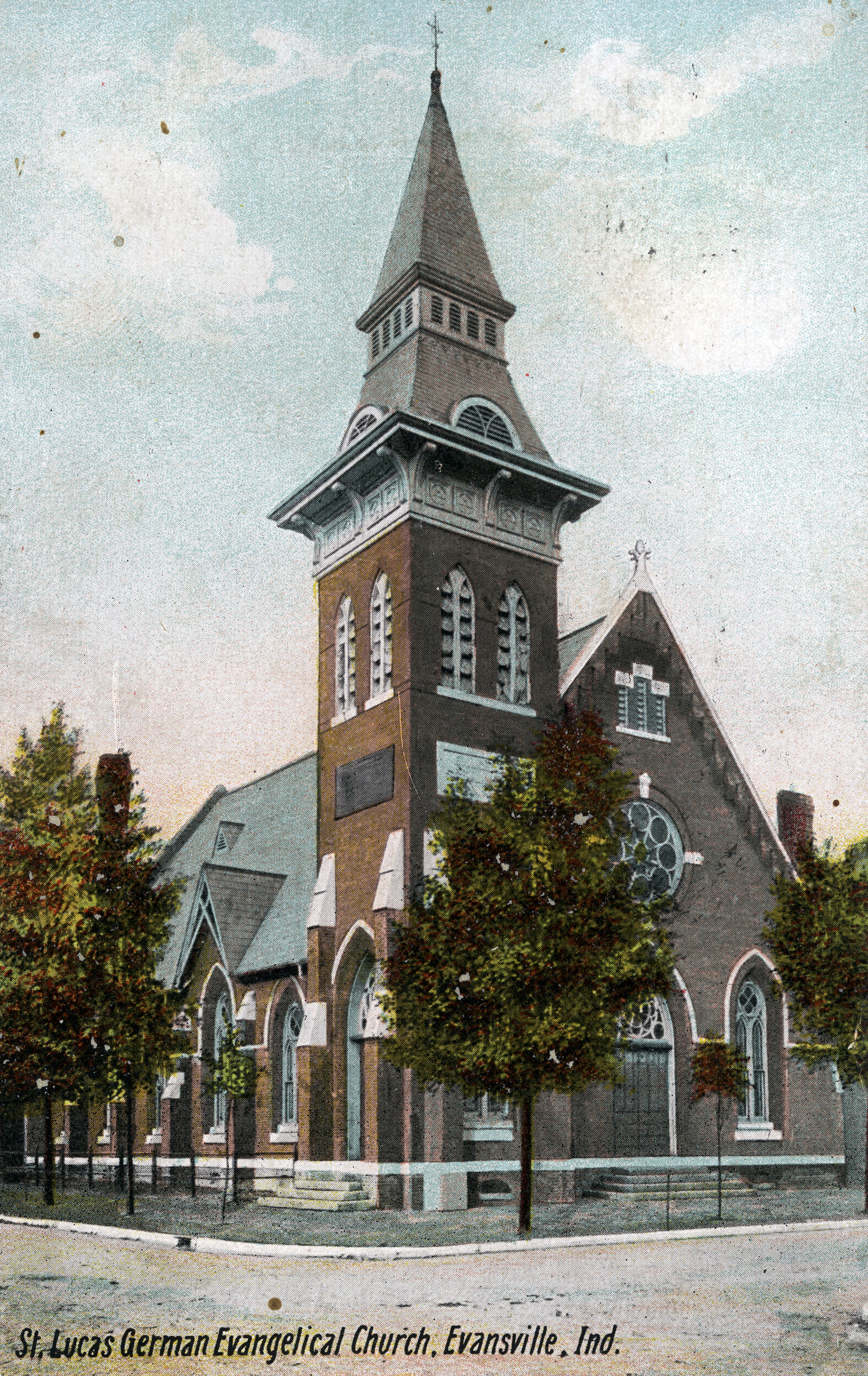
According to a May 11, 1947 Sunday Courier and Press article (p. 13-14), “Zion’s Evangelical church was formed by a group of dissenters from Trinity Lutheran Church. … Both churches, Trinity Lutheran and Zion’s Evangelical have been mother churches in Evansville to the respective denominations.” Zion went on to start St. Lucas Evangelical Church July 21, 1889. The Evangelical Deaconess Home and Hospital Association was established in 1892, led by the pastor of St. Lucas as well as others. Today this exists as the Deaconess Health System in Evansville. St. Peter’s Reformed, later renamed Evangelical St. Paul’s Church, was begun in 1892. Today this is St. Paul’s United Church of Christ at 7700 Middle Mt. Vernon Rd. What became Bethel United Church of Christ (now at 3029 N. Green River Rd.) was founded in 1904 and St. Matthews UCC in 1914, still at 3007 First Ave., today called St. Matthew’s Church.
As noted, time marches on. Zion held its last service on October 27, 2024, having been a house of worship for 175 years. The good work of the church continues: the congregation opted NOT to raze its building, but rather donate it to Aurora to be made into 41 family apartments to help the homeless.
In order to preserve the church’s story and legacy, its files, photographs, ledgers and other items were donated to University Archives and Special Collections/University of Southern Indiana. Much of the information for this blog came from these documents.
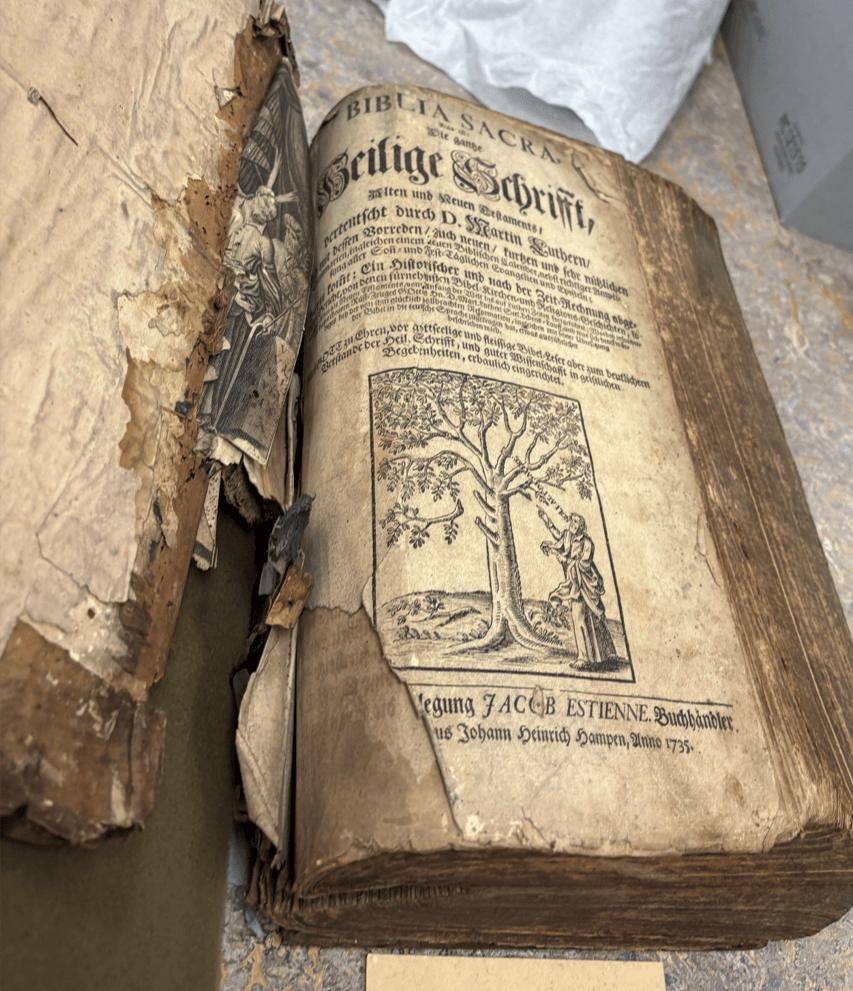
One particular treasure to highlight is this German language Bible, published in 1735 and owned by the Rech family for generations.
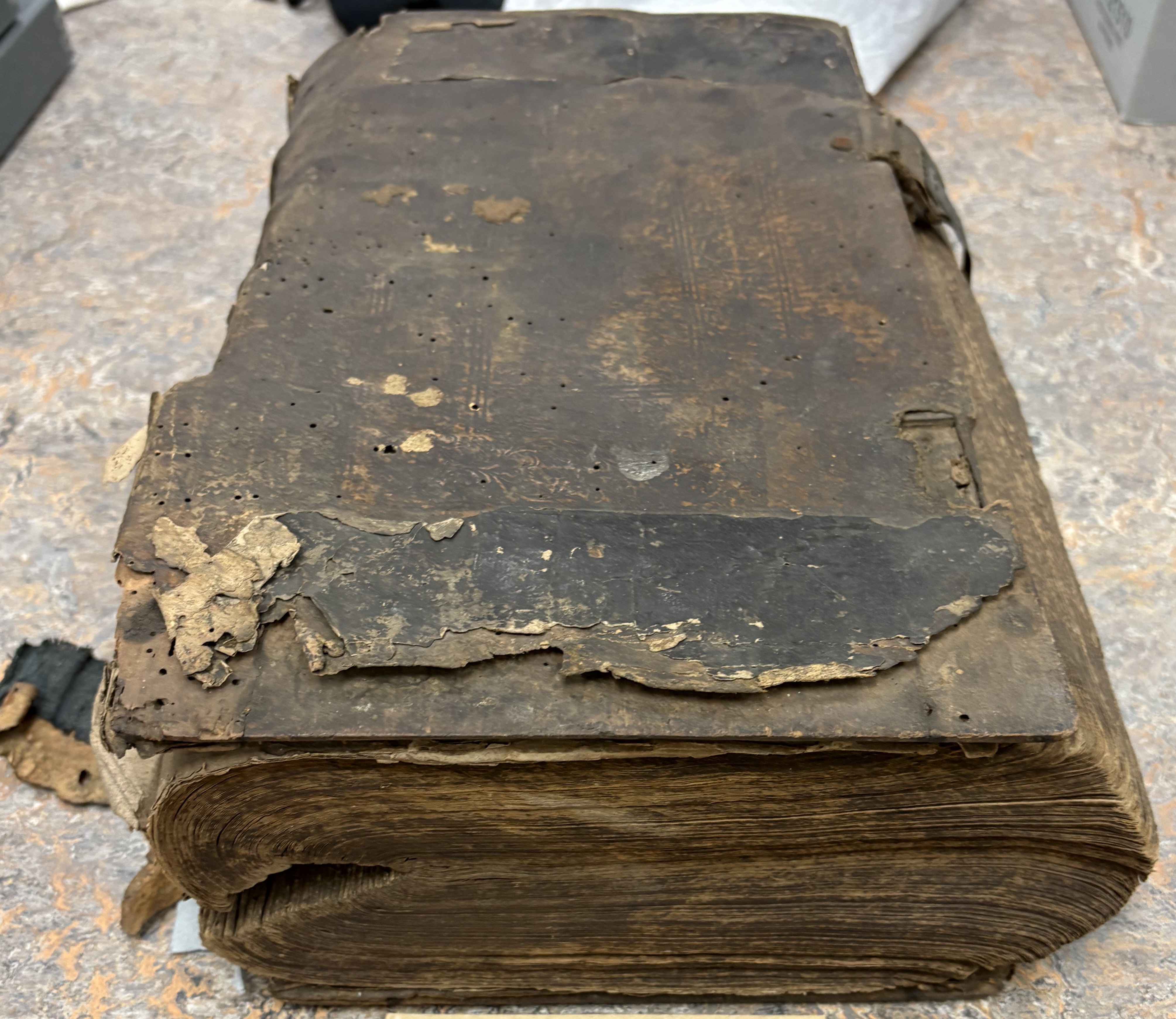
As you can see, this Bible is in very poor condition. Its spine is deteriorating and folding in on itself. It would require major conservation to be restored
A partial translation of the title page seen above: This is the entire Holy Scriptures Old and New Testaments Germanized (i.e. translated into German) by Martin Luther. (Special thanks to Dr. Silvia Rode for this translation.) As a brief reminder as to why this is important: prior to Luther’s translation, most Bibles were in Latin, the language of the clergy, not the language of the people. Luther’s translation made it accessible to anyone literate in German, one of the dominant languages in Europe at that time. Certainly most members of Zion would have been able to read it.
If this glimpse of an historic church and its documents intrigues you, be aware that the collection is only newly received and by no means fully processed. Contact UASC for more information.
Stay tuned for more from AmUSIngArtifacts!



Leave a Reply