
Even with the many discoveries and advances in medicine today, we cannot cure everything. According to the National Center for Health Statistics at the Center for Disease Control, in 2024, 619,876 in the U.S. died from cancer, the second leading cause after heart disease. That number has been on the decline for some time, but sadly, cancer has not been eliminated as a cause of death.
If we still struggle with knowledge about and cures for diseases, think how challenging it was in the past. People resorted to all kinds of treatments broadly labelled patent medicines. Actually, patent medicine is a bit of a misnomer…none of these remedies was “patented” in the sense we mean this today. This usage comes from English kings’ “patents of royal favor.” Surely, people thought, if the king favors it, it must be good. There was also the naïve belief that if something was printed, it must be true. Full disclosure wasn’t even totally desirable—people felt that the efficacy of a remedy was in its mystery. And finally, many thought that the worse a medicine tasted, the better it worked.
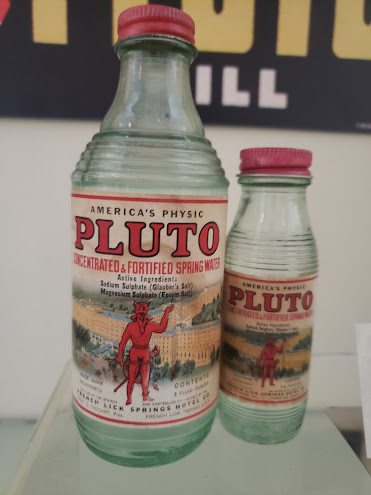
Let’s look at a couple of remedies that have area or local connections. First is Pluto Water, from French Lick, IN. Although it’s no longer sold at the French Lick Resort (it was later found to contain lithium), you might still occasionally smell a hint of sulphur in the air from the mineral water flowing through that area. Its presence was one reason the resort hotels at French Lick and West Baden were established in the first place, back in 1845 and 1855, respectively. It was touted as relieving anxiety when used as a bath, and when ingested, the sky was the limit for its ability to fix what “ailed” you! The owner of the hotel after 1902, Thomas Taggart, was a canny promoter. He recognized that medical professionals would rightly be skeptical about some of the more extreme claims, so he paid a professor of physical chemistry at the University of Missouri to analyze the water and advertised that.
Pluto Spring Water
• Sodium chloride (1,995 parts per million)
• Calcium sulphate (1,709)
• Sodium sulphate (680)
• Magnesium carbonate (559)
• Magnesium sulphate (344)
• Silica (24)
• Iron and aluminum (trace)
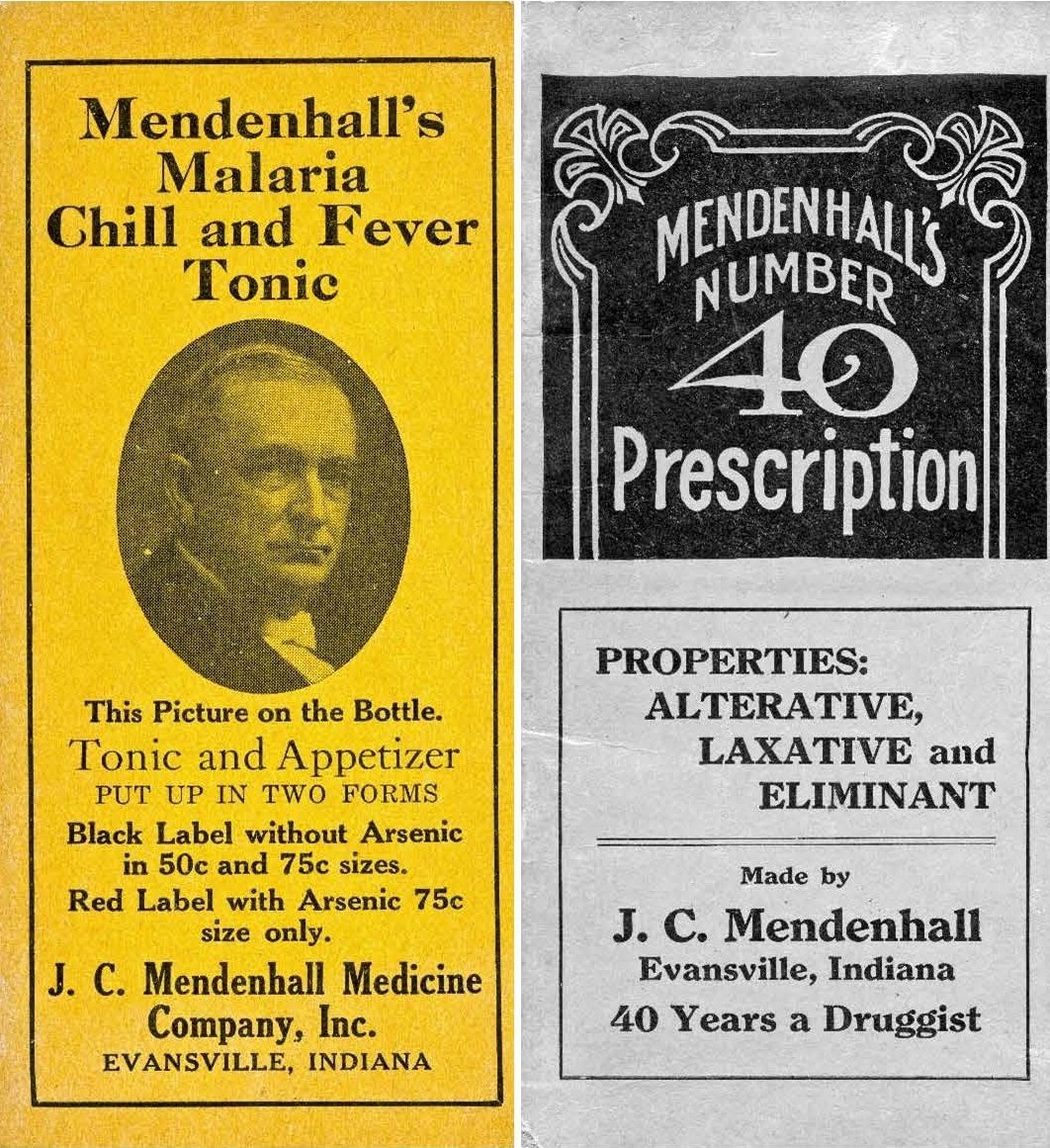
Entrepreneurs in Evansville got in on the patent medicine action, too. The 1878 city directory shows a Depot Drug Store on Fulton Ave. at the corner with Ohio St., with a proprietor named Dr. John Mendenhall. By 1908 the J.C. Mendenhall Medicine Co. seemingly was operated out of his home at 225 Lower 1st St. It is highly unlikely that Dr. in this case indicated a qualified medical physician–many times it was used to provide the allusion of medical approval.
Take a look at the yellow label below on the left….note that it’s sold with or without arsenic! Arsenic is a toxin; today there are some rare medical uses, but only in extreme cases when other treatments do not work. It is highly unlikely that such a level of sophistication went into the preparation of this medicine. As for Mendenhall’s Number 40, its claims to cure “syphilis, aneurysm of the aorta, gonorrhea, eczema, rheumatism, catarrh, malaria, and diseases of the liver, kidneys and spleen” were proven fraudulent and the company fined in 1918. (American Medical Association. Nostrums and quackery: articles on the nostrum evil quackery reprinted from the Journal of the American Medical Association. v. 2, 1911, p. 606)
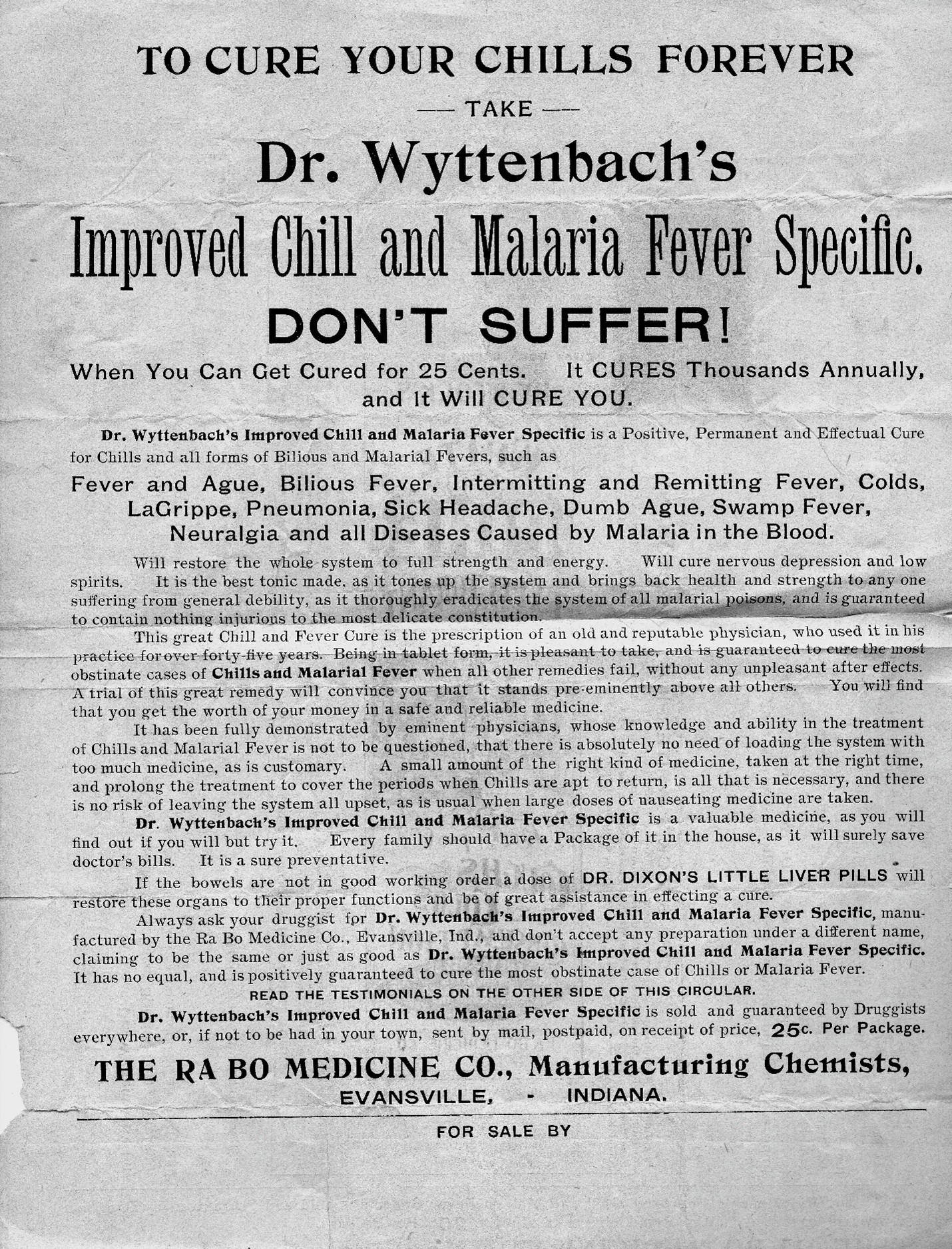
Another Evansville entrant into the patent medicine furor was a druggist by the name of John Wyttenbach, who, circa 1908, was located at the corner of Chestnut and Walnut Streets. Look at those claims—you could be cured of malaria for only 25 cents. That would be the equivalent of $8.97 today….still an incredible deal to be cured of something as virulent as malaria!
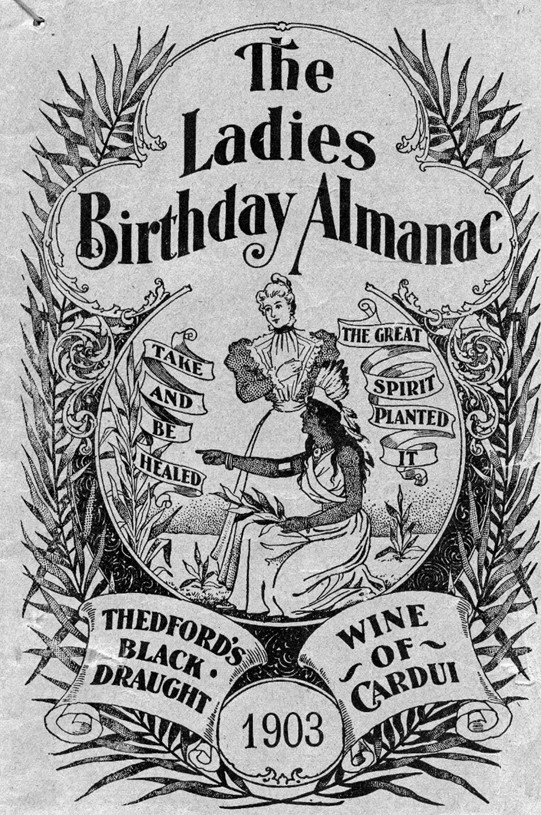
The Ladies Birthday Almanac was published by the Chattanooga Medicine Company in Chattanooga, TN as early as 1891 and appears to have continued publishing until the late 1970s. In addition to the typical almanac material, it published many advertisements for what was a large market for patent medicines: “women’s complaints/ailments/weaknesses.”
The image seen here refers to the tale that the original Wine of Cardui was a tea made from “blessed thistle” by a Native American woman (then referred to as an “Indian squaw”) who gave it to a mother for her ailing daughter (non-natives). That mother planted some of those seeds and the concoction was later bottled. This image also illustrates another advertising ploy: “the belief in botanic medicine and a primitive hostility toward the educated doctor—both flowed together and climaxed in the belief that untutored peoples were “natural” physicians.” (Carson, Gerald. One For a Man, Two for a Horse. New York: Bramhall House, 1961, p. 23)
Wine of Cardui contained no wine, but it was 20% alcohol. The prescribed tablespoonful dosage was equivalent to 100 drops of whiskey. No wonder you felt better after you took it! It also contained small amounts of the extracts from blessed thistle and black haw, neither of which had any medicinal value.
It’s surely not a coincidence that both Thedford’s Black Draught and Wine of Cardui were manufactured by the publisher of this almanac!


Leave a comment